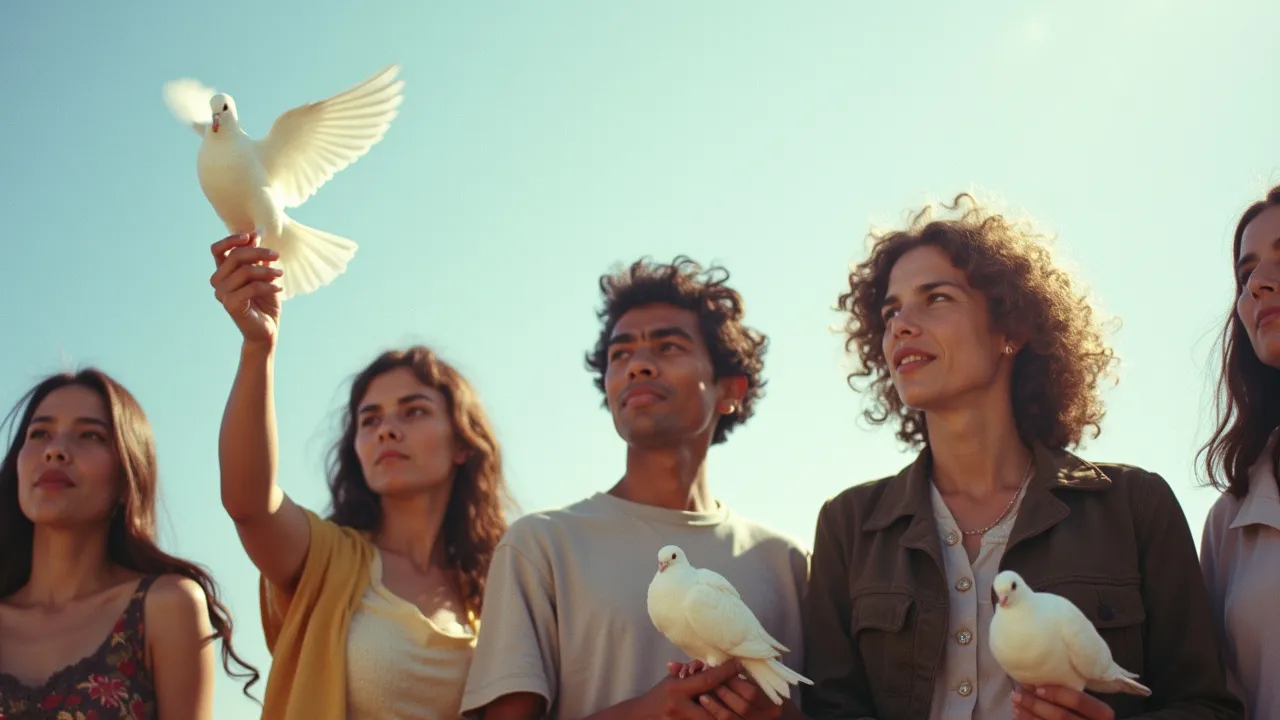
Observed annually on January 1st, the World Day of Peace is a global call for ceasefire and non-violence. Established by the Catholic Church in 1967, it encourages individuals and nations to reflect on the importance of peace and take concrete actions.
The Historical Origins & Evolutionary Journey
The World Day of Peace, observed on January 1st each year, has its roots in the Catholic Church's desire to promote peace in the modern world. It was established by Pope Paul VI in 1967, who envisioned a day dedicated to prayers and actions for peace. The first observance took place on January 1, 1968.
The Foundational Catalyst
In the aftermath of World War II and during the Cold War tensions, the Catholic Church sought to address the growing nuclear threat and global conflicts. Pope Paul VI, inspired by the Second Vatican Council's emphasis on peace and justice, issued the apostolic letter 'Pacem in Terris' (Peace on Earth) in 1963. This encyclical by Pope John XXIII had already set the stage, but Paul VI wanted a specific day to mobilize the faithful. He chose January 1st, which is already a holy day of obligation honoring Mary, the Mother of God, to infuse the peace message with a Marian dimension.
The Official Adoption
On December 8, 1967, Pope Paul VI officially announced the institution of the World Day of Peace to be celebrated on January 1st. He invited all people of good will to join Catholics in a day of reflection and prayer. The Vatican has since released a papal message each year addressing a specific peace-related theme, such as disarmament, justice, or migration. Over time, the observance gained traction beyond the Catholic Church, with many secular organizations and governments adopting it as a day for peaceful activities.
Modern Global Legacy
Today, the World Day of Peace is recognized by the United Nations and numerous civil society groups. While it retains its Catholic character, it is often celebrated ecumenically and interreligiously. The themes chosen by the pope often reflect contemporary global challenges, such as climate change, migration, and digital ethics. The day serves as a springboard for peace education, community dialogues, and ceasefire calls. In many countries, schools organize peace marches and art contests. The legacy of Paul VI's initiative continues as a beacon for non-violence and dialogue.
How to Celebrate World Day of Peace
Celebrating the World Day of Peace can be done individually or collectively. The key is to promote understanding, reconciliation, and non-violence. Below are practical ways to observe the day:
For Individuals and Families
- Attend a peace vigil or interfaith service in your community.
- Read the papal message for the current year and reflect on its themes.
- Practice personal reconciliation by forgiving someone or mending a broken relationship.
For Schools and Educational Institutions
- Organize a peace assembly with student talks, songs, and art.
- Hold a peace essay or poster contest focusing on the year's theme.
- Invite a speaker from a peace organization to talk about conflict resolution.
For Organizations and Communities
- Launch a peace campaign on social media using hashtags like #WorldDayOfPeace.
- Collaborate with local religious groups for an interfaith prayer.
- Volunteer for charities that support refugees or victims of war.
In some countries, such as Italy and the Philippines, the day is marked by special masses and community feasts. In the United States, many churches hold a 'Peace Mass' and encourage members to sign peace petitions. The key is to turn the date into a catalyst for ongoing peace efforts throughout the year.
Global Impact and Significance
The World Day of Peace has a profound impact on global consciousness. It serves as an annual reminder that peace is not just the absence of war but the presence of justice and human dignity.
United Nations Endorsement
Although the UN has its own International Day of Peace on September 21, many UN bodies recognize the World Day of Peace. The Catholic Church's strong diplomatic presence has leveraged this day to advocate for peace in conflict zones. For example, popes have used the day call ceasefires in Syria and Ukraine.
Interfaith Dimensions
Since the 1986 Assisi World Day of Prayer for Peace, the Catholic Church has actively engaged other religions. The World Day of Peace now includes Buddhist meditation, Islamic prayers, and Jewish peace walks. This interfaith approach expands the reach of the day beyond Christendom.
Media and Symbolism
The dove and olive branch, ancient symbols of peace, are central to the day's imagery. The Vatican issues a poster each year, and many media outlets publish peace-themed editorials. The day also influences public policy: some governments announce amnesties or release prisoners on symbolic grounds. Despite its religious origins, the World Day of Peace has become a universal platform for peace advocacy.
Core Themes and Messages
Each year, the pope chooses a specific theme for the World Day of Peace message. These themes address pressing global issues and guide reflection and action. Over the decades, themes have evolved:
Historical Themes
- 1968: 'The Promotion of Peace' – general call.
- 1983: 'The Peaceful Solution of Conflicts' – focused on dialogue.
- 2000: 'Peace on Earth: A Hope That Does Not Disappoint' – millennial reflection.
Contemporary Focus
Recent themes include 'Good Politics is at the Service of Peace' (2019), 'Brothers All: No One is a Stranger' (2020), and 'Dialogue Between Generations, Education, and Work: Tools for Building Lasting Peace' (2022). These reflect Pope Francis's emphasis on social justice, ecology, and fraternity. The messages are published in multiple languages and widely distributed. They serve as study documents for schools, parishes, and peace groups. The core message always revolves around respect for human dignity, active non-violence, and the common good.
World Day of Peace in Different Cultures
While the World Day of Peace is universally observed on January 1st, cultural traditions vary greatly.
In Italy and Vatican City
The day begins with a solemn Mass celebrated by the pope at St. Peter's Basilica. Afterwards, the Angelus prayer includes a peace message. Many Italians attend the Vatican event or watch it on TV. Schools often hold peace essay contests, and local governments organize peace walks.
In the Philippines
A predominantly Catholic country, the Philippines holds large peace processions. The Catholic Bishops' Conference issues a pastoral letter. Many families light candles for peace at home. Some cities declare a 'peace day' with community feasts.
In the United States
While not a public holiday, churches host peace prayer services. Non-religious groups organize potlucks and dialogues. The day is often used to launch year-long peace initiatives. In New York, the United Nations holds a special ceremony.
In Africa and Asia
In countries like Nigeria and India, interfaith groups organize rallies and tree-planting. Muslim communities often recite peace verses from the Quran. Buddhist monks lead meditation sessions. The diversity of celebrations shows the day's adaptability to local contexts.
The Role of Education and Youth
Education is a central pillar of the World Day of Peace. Pope Francis has repeatedly stressed the importance of teaching peace to younger generations.
School Programs
Many Catholic schools and some public schools integrate peace studies into their curriculum. On January 1st, children create peace flags, write poems, and perform plays. The Vatican provides educational materials online, including lesson plans and posters.
Youth Movements
Organizations like 'Peace Child International' and 'Youth for Peace' use the day to launch campaigns. Social media challenges such as '30 Days of Peace' start on January 1st. Young people are encouraged to become peace ambassadors in their communities. The 2018 theme 'Migrants and Refugees: Men and Women in Search of Peace' particularly engaged youth in advocacy for refugees.
Digital Peace Education
With the rise of online platforms, the World Day of Peace has a strong digital presence. Webinars, virtual peace walks, and e-petitions allow global participation. The Vatican's 'Pope's Worldwide Prayer Network' streams a peace meditation. Schools can participate in international video conferences. Education remains the most powerful tool to sustain the peace message.
Challenges and Future Directions
Despite its global reach, the World Day of Peace faces challenges.
Religious and Cultural Barriers
While intended for all, the Catholic origin can be a barrier for some secular or non-Christian groups. Efforts to make it fully inclusive are ongoing. Some countries prioritize their own peace days over January 1st.
Political Instrumentalization
Occasionally, governments use the day to distract from internal conflicts or human rights abuses. The Vatican's messages sometimes critique these actions, but the day can be co-opted.
Climate Change and War
New threats like ecological collapse and cyberwar require adaptable peace concepts. The Church is incorporating 'integral ecology' into peace messages, linking environmental and social justice.
Future Directions
The World Day of Peace may expand to include more online participation and grassroots initiatives. The emphasis on intergenerational dialogue (as in 2022 theme) suggests a focus on youth leadership. The day's future lies in its ability to remain relevant while staying true to its core message of non-violence. As conflicts persist, the call for peace on January 1st becomes ever more urgent.
Historical Timeline
Pope Paul VI establishes the World Day of Peace on December 8, 1967, choosing January 1st as its annual date.
First official observance of the World Day of Peace on January 1, 1968, with Pope Paul VI's message 'The Promotion of Peace'.
Pope Paul VI expands the day to include ecumenical participation, inviting other Christian denominations to join.
Pope John Paul II hosts the World Day of Prayer for Peace in Assisi, Italy, bringing together leaders of different religions.
After the September 11 attacks, Pope John Paul II's message 'No Peace Without Justice, No Justice Without Forgiveness' gains global attention.
Pope Francis publishes his first World Day of Peace message, 'Blessed are the Peacemakers', emphasizing non-violence and reconciliation.
Theme 'Brothers All: No One is a Stranger' focuses on migration and fraternity, mirroring Pope Francis's encyclical Fratelli Tutti.
Theme 'Dialogue Between Generations, Education, and Work: Tools for Building Lasting Peace' highlights intergenerational cooperation.