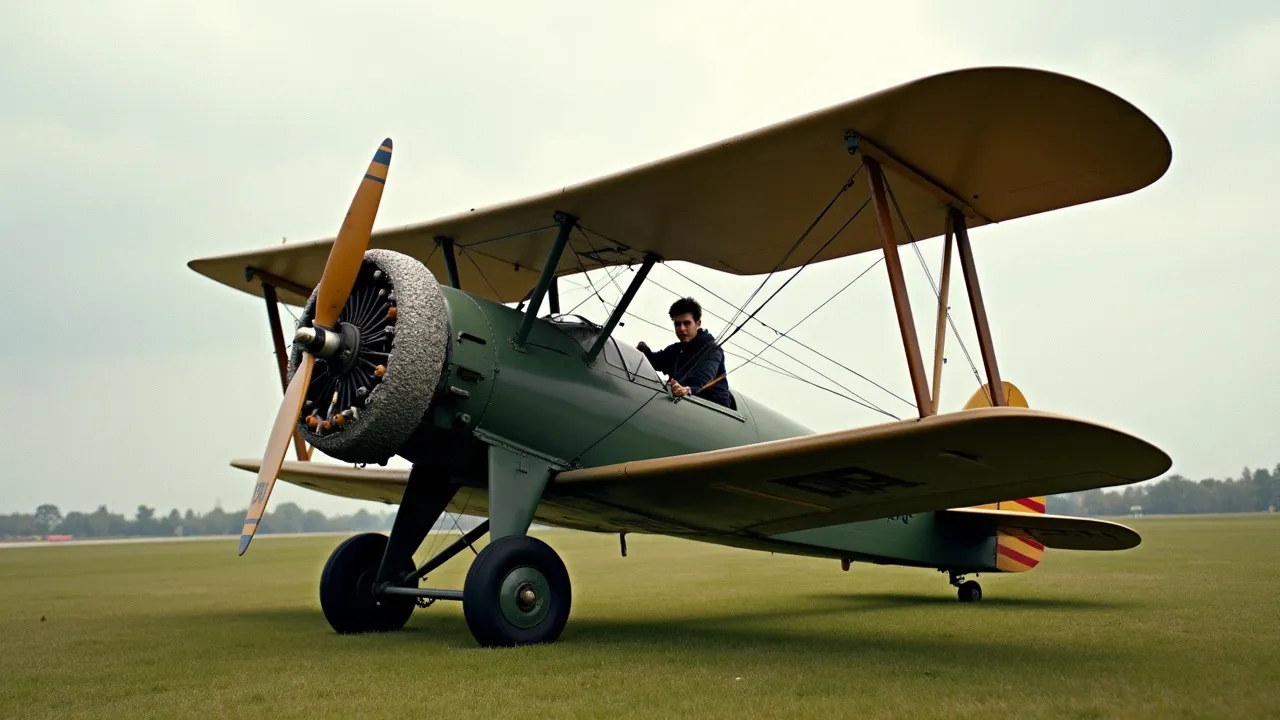
National Aviation Day, observed on August 19th, honors the birth of Orville Wright and celebrates the history and future of flight. Established by FDR in 1939, it's a day to explore aviation's impact on society.
The Historical Origins & Evolutionary Journey
The Foundational Catalyst
National Aviation Day was officially established by President Franklin D. Roosevelt through Presidential Proclamation 2344 on August 19, 1939. The date was chosen to coincide with the birthday of Orville Wright (1871–1948), who together with his brother Wilbur made the first powered flight on December 17, 1903. The proclamation urged Americans to observe the day with activities that promote the advancement of aviation.
The Legislative/Official Adoption
The original proclamation stated: "...the Congress, by joint resolution approved May 24, 1939, requested the President to issue a proclamation designating August 19th of each year as National Aviation Day." The day was codified into law under Title 36, Section 118 of the United States Code. Unlike many observances, National Aviation Day remains a non-federal holiday, meaning government offices remain open, but it is recognized as a day of national celebration.
Modern Global Legacy
While primarily a U.S. observance, the day has inspired international recognition. The International Civil Aviation Organization (ICAO) and various national aviation authorities often coordinate events. In recent decades, museums, air shows, and schools have expanded the day's scope to include STEM education, drone technology, and space exploration, reflecting aviation's evolution from wood-and-canvas biplanes to supersonic jets and commercial spaceflight.
How to Celebrate National Aviation Day
For Individuals & Families
- Visit a local airport or aviation museum – Many offer free or discounted admission on August 19th.
- Take a discovery flight – Flight schools often host introductory lessons for beginners.
- Build and fly model aircraft – A hands-on way to learn aerodynamics.
For Schools & Educational Institutions
- Organize a STEM aviation workshop – Topics include lift, propulsion, and navigation.
- Invite guest speakers – Pilots, engineers, or air traffic controllers can share career insights.
- Launch paper airplane contests – Combine fun with principles of flight.
For Corporations & Organizations
- Host a career fair – Highlight jobs in aerospace, maintenance, and unmanned systems.
- Conduct drone demonstrations – Showcase modern aviation technology.
- Offer flight scholarships – Support the next generation of aviators.
Global Celebrations
Although National Aviation Day is U.S.-centric, countries like India celebrate Indian Air Force Day on October 8, and Russia marks Air Fleet Day on the third Sunday of August. In Canada, Aviation Day is observed on the last Friday of February. Internationally, many nations use August 19 as a day to promote aviation awareness through social media campaigns and local fly-ins.
Global Impact of Aviation
Aviation has transformed the world into a global village. The industry supports over 65 million jobs worldwide and contributes approximately $2.7 trillion to global GDP (Air Transport Action Group data). From overnight package delivery to emergency medical evacuations, aviation is indispensable.
Economic Connectivity
- Tourism: 50% of international tourists now travel by air.
- Trade: 35% of global trade by value (though only 1% by volume) is shipped by air.
- Investment: Airlines and airports drive infrastructure development in emerging economies.
Cultural Exchange
Flight allows people to experience diverse cultures, fostering understanding and collaboration. The Erasmus program and international student exchanges rely heavily on affordable air travel.
Technological Transformations in Aviation
From Piston to Jet
The shift from propeller-driven aircraft to turbojet engines in the 1950s revolutionized speed and range. The Boeing 707 (1958) made transatlantic travel routine.
Digital Cockpits and Fly-by-Wire
Modern aircraft like the Airbus A320 use computerized flight controls, reducing pilot workload and enhancing safety.
Sustainability and Green Aviation
- Sustainable Aviation Fuels (SAF) – Can reduce lifecycle CO2 emissions by up to 80%.
- Electric and hybrid aircraft – Companies like Joby Aviation and Eviation are developing zero-emission planes.
- Hydrogen propulsion – Airbus plans to launch hydrogen-powered aircraft by 2035.
Aviation Safety and Regulation
Aviation is one of the safest modes of transport due to rigorous regulation. Key bodies include:
- ICAO (International Civil Aviation Organization) – Sets global standards.
- FAA (Federal Aviation Administration) – Regulates US airspace.
- EASA (European Union Aviation Safety Agency) – Oversees European safety.
Safety Statistics
In 2022, the global accident rate was 0.16 per million flights (IATA). Continuous improvement through Flight Data Monitoring and Safety Management Systems drives this record.
The Future of Flight
Aviation stands at the cusp of a new era. Key trends include:
- Urban Air Mobility (UAM) – Air taxis and eVTOL aircraft promise congestion relief in cities.
- Supersonic Revival – Companies like Boom Supersonic aim to bring back commercial supersonic travel by 2029.
- Space Tourism – SpaceX and Blue Origin are making suborbital flights accessible.
- Autonomous Aircraft – Cargo drones and eventually passenger planes may fly without human pilots.
National Aviation Day serves as a reminder to celebrate past achievements while inspiring future breakthroughs.
Historical Timeline
Orville Wright is born in Dayton, Ohio. He will later co-invent the world's first successful airplane.
The Wright brothers achieve the first powered, sustained, and controlled airplane flight near Kitty Hawk, North Carolina.
Orville Wright demonstrates the Wright Flyer to the U.S. Army at Fort Myer, leading to the first military aircraft contract.
President Franklin D. Roosevelt signs Presidential Proclamation 2344, establishing National Aviation Day on August 19th each year.
The Chicago Convention establishes the International Civil Aviation Organization (ICAO), standardizing international air travel.
The Boeing 707 enters commercial service, ushering in the Jet Age.
Concorde, the first supersonic passenger jet, makes its maiden flight.
Boeing 747, the first wide-body 'Jumbo Jet,' enters service with Pan Am.
The Hubble Space Telescope is launched via Space Shuttle Discovery, expanding aviation's reach into space.
Airbus A380, the world's largest passenger airliner, makes its first flight.
Solar Impulse 2 completes the first circumnavigation by a solar-powered airplane.
COVID-19 pandemic grounds much of global air travel, leading to accelerated digital transformation and safety protocols.
NASA and partners unveil the X-59 QueSST, a supersonic aircraft designed to reduce sonic booms to a 'thump.'