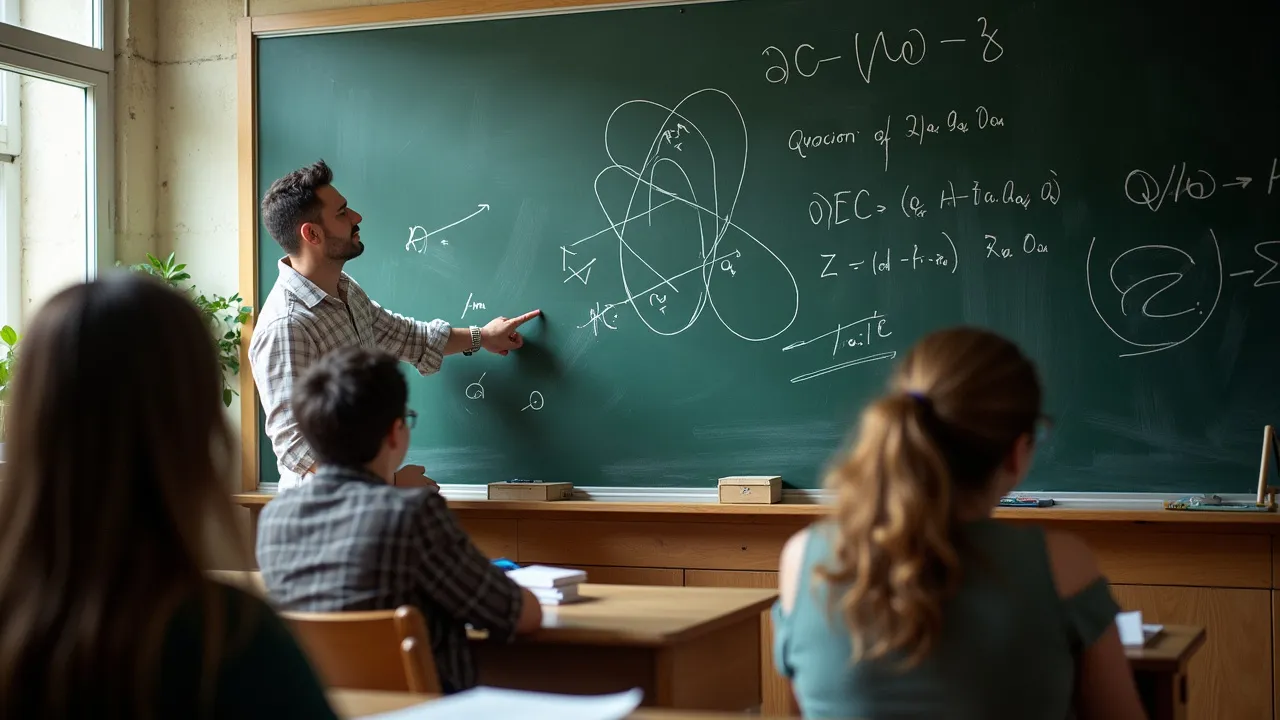
World Quark Day, observed annually on January 19th, honors the fundamental particle that forms matter. It celebrates scientific discovery and the quest to understand the universe's building blocks.
The Historical Origins & Evolutionary Journey
World Quark Day traces its roots to the revolutionary proposal of quarks in 1964 by physicists Murray Gell-Mann and George Zweig. Their independent work suggested that protons and neutrons are composed of smaller, fundamental particles. Gell-Mann borrowed the whimsical name "quark" from James Joyce's Finnegans Wake.
The Foundational Catalyst
The quark model emerged from the need to classify a growing "zoo" of subatomic particles. Gell-Mann's "Eightfold Way" classification scheme laid the groundwork. The introduction of quarks—three flavors: up, down, and strange—simplified particle physics dramatically. Experimental confirmation came in 1968 at the Stanford Linear Accelerator Center (SLAC), where deep inelastic scattering experiments revealed point-like constituents inside protons.
The Official Adoption
World Quark Day was first proposed in 2001 by the International Union of Pure and Applied Physics (IUPAP) to commemorate the 40th anniversary of the quark's discovery (though the actual discovery was earlier). January 19th was chosen because it marks the date in 1969 when Gell-Mann delivered his Nobel lecture elaborating on quarks. The day was officially recognized by the United Nations Educational, Scientific and Cultural Organization (UNESCO) in 2003.
Modern Global Legacy
Today, World Quark Day is celebrated in over 50 countries with events ranging from public lectures at CERN to quark-themed art exhibitions. It has become a springboard for broader science communication, inspiring the next generation of physicists. The discovery of the Higgs boson at CERN in 2012 further cemented the significance of quarks in the Standard Model.
How to Celebrate World Quark Day
World Quark Day offers diverse ways for individuals, schools, and organizations to participate. Below are actionable strategies.
For Individuals
- Watch a documentary: Stream "The Hunt for the Higgs" or "Particle Fever" to understand quarks in context.
- Attend a virtual lecture: Many universities host free webinars on particle physics.
- Run a quark-themed quiz: Test friends with questions about the six quark flavors.
For Schools
- Build a quark model: Use colored clay to represent up, down, and strange quarks inside a hadron.
- Host a science fair: Encourage projects on the Standard Model.
- Invite a physicist: Arrange a guest talk from a local university.
For Organizations
- Public outreach: Set up an exhibition at a science museum showcasing quark research.
- Social media campaign: Use hashtags like #WorldQuarkDay to share facts.
In the United States, Fermi National Accelerator Laboratory hosts an open house. At CERN in Switzerland, scientists give guided tours of the Large Hadron Collider. In Japan, KEK organizes a symposium on quark-gluon plasma. In India, the Tata Institute of Fundamental Research conducts workshops.
The Science of Quarks: Nature's Fundamental Building Blocks
Quarks are elementary particles that combine to form hadrons, such as protons and neutrons. They are the only particles in the Standard Model to experience all four fundamental forces: strong nuclear, weak nuclear, electromagnetic, and gravity (though gravity is negligible).
Quark Flavors and Properties
There are six flavors, grouped into three generations: up (u) and down (d), charm (c) and strange (s), top (t) and bottom (b). Each has fractional electric charge (+2/3 for up, charm, top; -1/3 for down, strange, bottom). Quarks also carry a property called "color charge" (red, green, blue), which is the source of the strong force.
Color Confinement and Asymptotic Freedom
Quarks are never found alone due to color confinement; they always bind into hadrons. The strong force increases with distance, leading to asymptotic freedom at short distances—a discovery that earned Gross, Politzer, and Wilczek the 2004 Nobel Prize.
Quark-Gluon Plasma
At extreme temperatures, quarks and gluons deconfine into a quark-gluon plasma, recreated in heavy-ion collisions at RHIC and the LHC. This state existed microseconds after the Big Bang.
Impact on Modern Physics and Technology
The quark model revolutionized particle physics, leading to the development of the Standard Model. It unified the electromagnetic and weak forces into the electroweak force and predicted the existence of the Higgs boson.
Technological Spin-offs
- Particle accelerators: Technologies used in medical imaging (PET scans) and cancer therapy (hadron therapy) derive from accelerator research.
- Grid computing: The data processing infrastructure for LHC experiments pioneered distributed computing, influencing cloud technology.
- Superconducting magnets: Used in MRI machines, these were developed for high-energy physics.
World Quark Day thus highlights not only fundamental science but also its tangible benefits to society.
Cultural Impact and Public Engagement
Quarks have permeated popular culture, appearing in movies like Star Trek and Ant-Man, and in music albums. The term "quark" itself is a cultural touchstone. World Quark Day encourages public engagement through art-science collaborations, such as the "Quark Art" project where physicists and painters create visual representations of quark interactions.
Educational programs target underrepresented groups: the "QuarkNet" program in the US brings particle physics to high school classrooms. In Europe, the "Discover the Quark" mobile app gamifies quark physics. Social media trends on January 19th include #QuarkSelfie, where participants wear a quark-colored shirt.
Future of Quark Research: Unanswered Questions
Despite great progress, many mysteries remain. The origin of quark masses and the hierarchy among generations are not explained. The search for rare processes like proton decay (which requires quarks to decay) continues. Future experiments at the Electron-Ion Collider (EIC) and LHCb upgrade will probe quark structure with unprecedented precision.
World Quark Day serves as a reminder that the journey to understand matter is far from over. Dark matter, neutrino masses, and the matter-antimatter asymmetry may all involve quarks in ways we are yet to discover.
Historical Timeline
Murray Gell-Mann and George Zweig independently propose the quark model, suggesting that hadrons are made of elementary, fractionally charged particles.
Deep inelastic scattering experiments at SLAC provide direct evidence for quarks, confirming the existence of point-like constituents inside protons.
Discovery of the J/psi particle at SLAC and Brookhaven, confirming the charm quark and validating the quark model.
Discovery of the upsilon particle at Fermilab, revealing the bottom quark.
Top quark discovered at Fermilab's Tevatron, completing the third generation of quarks.
First official World Quark Day celebrated on January 19th, organized by IUPAP to promote particle physics.
UNESCO recognizes World Quark Day as an international observance for science education.
Discovery of the Higgs boson at CERN, confirming the mechanism that gives quarks and other particles mass.