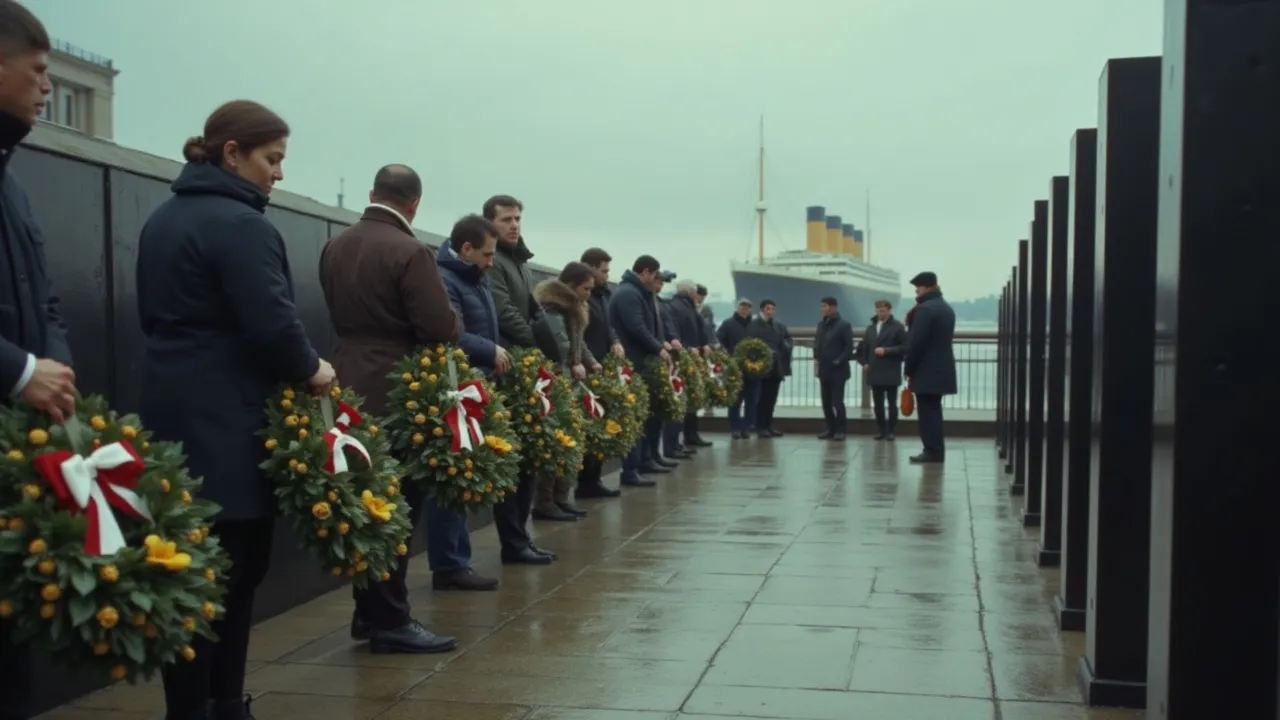
Observed annually on April 15th, Titanic Remembrance Day honors the 1,517 lives lost in the 1912 sinking of the RMS Titanic. It is a day of solemn reflection on maritime safety, human courage, and the enduring legacy of the disaster.
The Historical Origins & Evolutionary Journey
Titanic Remembrance Day, observed every April 15th, marks the anniversary of the sinking of the RMS Titanic in 1912. The day serves as a global tribute to the over 1,500 souls who perished when the luxury liner struck an iceberg on its maiden voyage. This solemn observance has evolved from local memorial services to an internationally recognized day of reflection on maritime safety and human resilience.
The Foundational Catalyst
The Titanic disaster occurred in the early hours of April 15, 1912, after the ship collided with an iceberg at 11:40 PM on April 14. Inadequate lifeboat capacity, insufficient safety drills, and a lack of radio protocols contributed to the high death toll. The immediate aftermath saw an outpouring of grief and anger, leading to public demand for maritime reform. The first memorial services were held in Southampton, England (the Titanic's home port), and in New York City, where survivors arrived aboard the Carpathia. Over the following weeks, communities worldwide held vigils, church services, and fundraising events for the victims' families. These early commemorations laid the foundation for an annual day of remembrance.
The Legislative/Official Adoption
Although no single government officially proclaimed Titanic Remembrance Day as a national holiday, the observance became formalized through the efforts of historical societies and maritime organizations. In 1997, the Titanic International Society, along with the Titanic Historical Society, spearheaded a campaign to establish April 15 as an official day of remembrance in the United States and the United Kingdom. While it remains a non-statutory observance, many cities now hold official ceremonies at Titanic memorials and cemeteries. The United States Senate and House have occasionally issued resolutions recognizing April 15 as Titanic Remembrance Day, particularly during the centennial years. In the UK, the Maritime and Coastguard Agency often coordinates remembrance events at sea.
Modern Global Legacy
Today, Titanic Remembrance Day is observed across the globe, from the United States to Canada, the UK to Australia, and beyond. It has expanded beyond simple mourning to include educational programs, museum exhibits, and charity fundraisers. The advent of the internet and social media has allowed virtual commemorations, with live-streamed ceremonies and digital memorial walls. The day's legacy also includes the SOLAS (Safety of Life at Sea) convention, which established the International Ice Patrol and mandated lifeboat drills. Titanic Remembrance Day remains a poignant reminder of the need for vigilance at sea and the enduring human spirit in the face of tragedy.
How to Celebrate Titanic Remembrance Day
Observing Titanic Remembrance Day can be both a personal act of reflection and a communal event. Whether you are an individual, a school, or an organization, there are many meaningful ways to honor the memory of those lost and to educate others about the disaster's significance. Below are detailed strategies for different contexts.
For Individuals
- Attend a local memorial service: Many cities hold candlelight vigils or wreath-laying ceremonies at Titanic memorials or maritime museums. Check local event listings for details.
- Visit a Titanic exhibition or museum: Explore artifacts and personal stories at venues like the Titanic Belfast, Titanic Museum Attraction in Pigeon Forge, or the Maritime Museum of the Atlantic in Halifax.
- Observe a moment of silence: At 2:20 AM (the time the ship sank), pause for a moment of reflection. Many people light a candle or ring a ship's bell.
- Read or watch survivor accounts: Immerse yourself in firsthand narratives from books like "A Night to Remember" or documentaries such as "Titanic: The Complete Story".
- Donate to maritime safety organizations: Contribute to groups like the International Ice Patrol, the Coast Guard Foundation, or maritime heritage societies.
For Schools and Educational Institutions
- Conduct a classroom lesson on the Titanic: Use primary sources to teach about the disaster, its causes, and its impact on maritime safety. Include discussions on class, gender, and heroism.
- Organize a school-wide assembly: Feature student presentations, poetry readings, or a short play depicting the events of April 15, 1912.
- Assign creative projects: Have students build model ships, write journal entries as passengers, or create digital timelines of the sinking and rescue.
- Host a gallery walk: Display student artwork, research posters, or family history connected to the Titanic.
For Organizations and Maritime Groups
- Host a remembrance banquet or dinner: Serve a replica of the Titanic's last menu (first-class dinner included oysters, filet mignon, and roasted pigeon). Use proceeds for charity.
- Coordinate a ship horn salute: At noon, vessels in harbors sound their horns in unison to honor the victims. This has become a tradition in ports like New York and Southampton.
- Launch a public awareness campaign: Use social media to share facts, survivor stories, and safety tips. Use hashtags like #TitanicRemembranceDay.
- Collaborate with historical societies: Partner with groups like the Titanic International Society to host lectures, film screenings, or artifact displays.
Across different countries, traditions vary. In the UK, a memorial service is held at the National Maritime Museum in Greenwich. In Canada, especially in Halifax (where many victims are buried), services occur at Fairview Lawn Cemetery. In the US, the Titanic Memorial Lighthouse in New York City is illuminated. The day is a unifying moment for all who respect maritime history.
Global Impact: Maritime Safety Reforms and Cultural Legacy
The sinking of the Titanic catalyzed one of the most significant overhauls of maritime safety in history. The disaster's aftermath led to the establishment of the International Convention for the Safety of Life at Sea (SOLAS) in 1914, which remains the most important international treaty concerning merchant ship safety. Key reforms included:
- Mandatory lifeboat drills for all passengers and crew.
- Sufficient lifeboat capacity for everyone on board, not just a fraction.
- 24-hour radio watch on all passenger ships.
- Creation of the International Ice Patrol to monitor iceberg dangers in the North Atlantic.
- Improved ship design, including double hulls and watertight compartments.
These changes saved countless lives in subsequent maritime disasters. Culturally, the Titanic has become a symbol of human ambition, hubris, and the fragility of technological progress. It has inspired countless books, films, and works of art, most notably James Cameron's 1997 film "Titanic," which renewed public interest in the disaster. The story resonates across generations, serving as a cautionary tale and a testament to human courage in the face of catastrophe. Titanic Remembrance Day keeps these lessons alive.
Memorials and Tributes Around the World
Numerous physical memorials across the globe honor the victims of the Titanic. These sites become focal points for remembrance on April 15th each year. Notable examples include:
- Titanic Memorial (New York City, USA): A 60-foot lighthouse erected at the entrance to the South Street Seaport, now located in Battery Park. A wreath-laying ceremony is held annually.
- Titanic Memorial (Washington, D.C., USA): A bronze statue of a partially clad male figure representing the heroism of the men who sacrificed their lives for women and children. Located at the National Oceanic and Atmospheric Administration headquarters.
- Fairview Lawn Cemetery (Halifax, Canada): The burial site of 121 Titanic victims, marked by simple gray headstones arranged in the shape of a ship's bow. Many visitors leave flowers and coins on April 15.
- Titanic Belfast (Belfast, Northern Ireland): A massive visitor attraction built near the shipyard where the Titanic was constructed. It hosts a special exhibition and remembrance program on the anniversary.
- Southampton Titanic Memorial (UK): A granite monument dedicated to the ship's engineers who stayed at their posts. Located in East Park, a service is held each year.
- Museum of Maritime (Cobh, Ireland): Cobh (then Queenstown) was the Titanic's last port of call. The museum holds a commemoration ceremony including a reading of the names of the 123 Irish victims.
These memorials not only honor the dead but also educate visitors about the disaster and its legacy.
The Titanic's Enduring Legacy in Media and Popular Culture
Few historical events have been as extensively depicted in media as the Titanic disaster. The story has been told through films, television series, documentaries, stage plays, novels, and even video games. The most famous adaptation is James Cameron's 1997 film "Titanic," which became the highest-grossing film of its time and won 11 Academy Awards. Its portrayal of the sinking, while romanticized, brought the tragedy to a new generation. Other notable works include:
- "A Night to Remember" (1958 film): Considered one of the most accurate dramatizations, based on Walter Lord's book.
- "Titanic" (1996 TV miniseries): A CBS production with a star-studded cast.
- "Titanic: The Complete Story" (1994 documentary): A comprehensive account using archival footage and interviews.
- "The Wreck of the Titan" (1898 novel): The eerily predictive book by Morgan Robertson.
- "Titanic: Honor and Glory" (video game): An immersive simulation that allows users to explore the ship in detail.
- Band music: The story of the ship's band playing "Nearer, My God, to Thee" has become legendary.
These works ensure that the Titanic remains a fixture in modern consciousness, not just as a tragedy but as a powerful narrative about human nature.
Commemorative Events and Traditions: A Day of Global Unity
April 15th sees a diverse array of commemorative events worldwide. While each community observes the day uniquely, certain traditions have become widespread. In addition to memorial services and museum programs, many people participate in the following:
- The Titanic Remembrance Day Run: Held in several cities, participants run or walk 15 kilometers (symbolizing April 15) to raise funds for maritime charities.
- Silent ship horn salutes: At exactly 2:20 AM (ship's time), ships in port sound their horns in a haunting tribute.
- Virtual reality experiences: Some museums offer VR tours of the wreck site, allowing visitors to explore the remains of the Titanic as it rests on the ocean floor.
- Online memorial walls: Websites like TitanicRemembered.com allow people to post tributes, photos, and memories of ancestors who were passengers or crew.
- Special radio broadcasts: Ham radio operators often set up special stations to commemorate the distress calls sent from the sinking ship (CQD and SOS).
- Library and bookstore displays: Local libraries feature collections of Titanic-related books, films, and documents.
These traditions foster a sense of global community, connecting people from all walks of life who are united by a shared interest in preserving the memory of the Titanic. They also serve as a reminder of the importance of safety, heroism, and human dignity.
Historical Timeline
The RMS Titanic departs from Southampton, England, on her maiden voyage to New York City, making stops at Cherbourg, France, and Queenstown (Cobh), Ireland.
At 11:40 PM ship's time, Titanic strikes an iceberg in the North Atlantic. The collision causes a series of fatal hull breaches below the waterline.
Titanic sinks at 2:20 AM with over 1,500 people still aboard. RMS Carpathia arrives at 4:10 AM and rescues 705 survivors from lifeboats. News of the disaster reaches the world later that day.
First memorial services held in Southampton, New York, and other affected communities. The Titanic Memorial Lighthouse is erected in New York, and the first proposals for maritime safety reforms are submitted.
The first International Convention for the Safety of Life at Sea (SOLAS) is adopted, mandating lifeboat capacity, wireless radio watches, and international ice patrols.
The wreck of the Titanic is discovered by a joint American-French expedition led by Dr. Robert Ballard, lying 12,500 feet deep on the ocean floor. This reignites global fascination with the ship.
James Cameron's film 'Titanic' is released, becoming a cultural phenomenon and rekindling interest in the disaster. The same year, the Titanic International Society begins formally promoting April 15 as Titanic Remembrance Day.
The centennial of the sinking is observed worldwide with major commemorations, including a memorial cruise that stops at the wreck site, and numerous TV specials and exhibitions.
The Titan submersible implosion near the Titanic wreck site draws attention to the risks of deep-sea tourism, leading to renewed calls for safety regulations and public awareness.