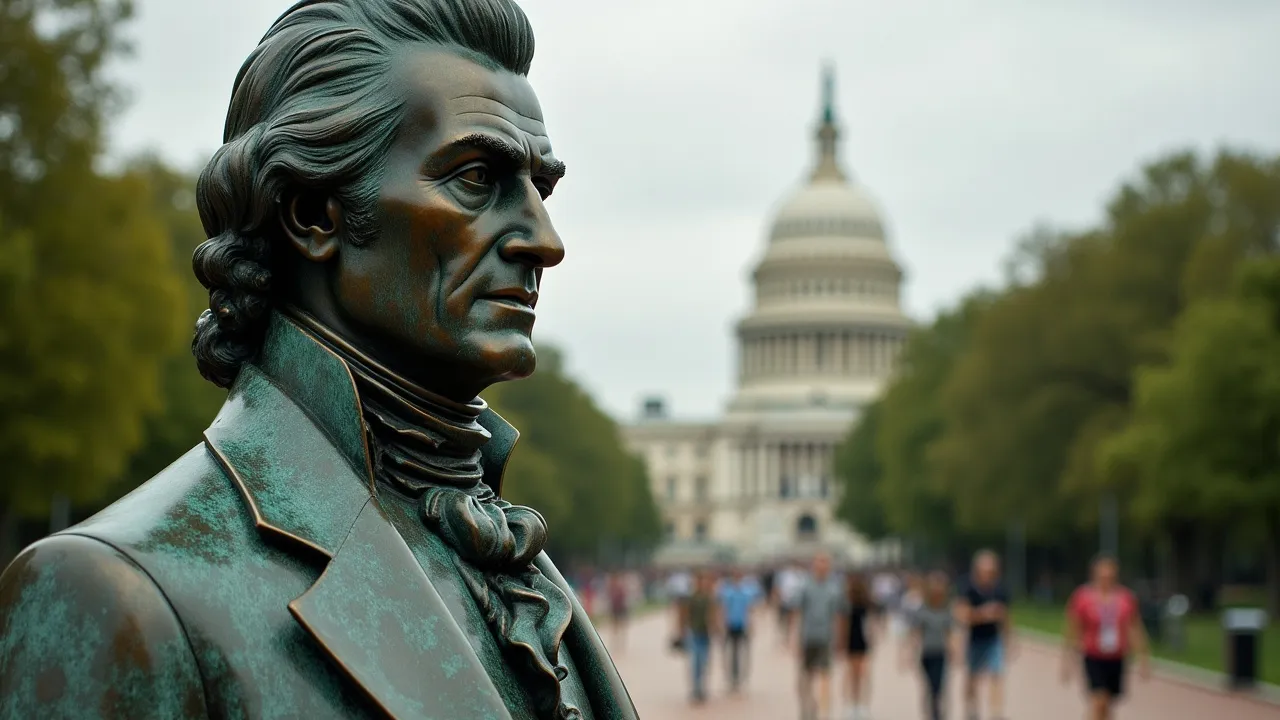
Thomas Jefferson Day, observed annually on April 13th, honors the birth and legacy of the third U.S. president and Founding Father. This day recognizes Jefferson's contributions to American independence, education, and democratic ideals.
The Historical Origins & Evolutionary Journey
Thomas Jefferson Day commemorates the birth of Thomas Jefferson on April 13, 1743 (April 2, Old Style). Jefferson, the principal author of the Declaration of Independence, third U.S. president, and visionary of American democracy, has been honored through various observances over the centuries.
The Foundational Catalyst
The earliest tributes were informal local celebrations held near Jefferson's home at Monticello. After his death on July 4, 1826, the 50th anniversary of the Declaration, public sentiment grew for a national day of remembrance. However, it was not until the 20th century that formal recognition emerged.
The Legislative/Official Adoption
In 1905, President Theodore Roosevelt issued a proclamation designating Jefferson's birthday for the dedication of the Jefferson Memorial building site. Subsequent presidents followed with annual proclamations. The decisive moment came in 1984 when the U.S. Congress passed Public Law 98-464, officially designating April 13 as Thomas Jefferson Day. The law authorizes the President to issue a proclamation each year, urging citizens to observe the day with appropriate ceremonies and activities.
Modern Global Legacy
While not a federal holiday, Thomas Jefferson Day is widely observed in educational institutions, historical societies, and government offices. The day emphasizes Jefferson's ideals of liberty, education, and religious freedom. International recognition exists, particularly in France (where he served as minister) and in countries that admire American democratic principles. The Library of Congress and Monticello host annual events.
How to Celebrate Thomas Jefferson Day
Thomas Jefferson Day offers opportunities for individuals, schools, and organizations to reflect on Jefferson's contributions. Here are specific ways to celebrate:
- Visit Monticello: Take a tour of Jefferson's iconic Virginia plantation, often offering special programs on April 13.
- Read the Declaration of Independence: Hold a public reading or classroom exercise to discuss its relevance.
- Explore Jefferson's Writings: Organize a study group focusing on the Notes on the State of Virginia or his letters on liberty.
For Schools
- Conduct historical reenactments of the drafting of the Declaration.
- Assign projects on Jefferson's architecture (e.g., the University of Virginia Rotunda).
- Encourage students to write essays on Jefferson's complex legacy, including his views on slavery.
For Organizations and Communities
- Host a mock Continental Congress at libraries or community centers.
- Partner with historical societies for lectures on Jefferson's impact on education, science, and religious freedom.
- Organize a naturalization ceremony to honor Jefferson's vision of an inclusive democracy.
Internationally, Jefferson's ideals are celebrated in countries such as France (where he was minister) and Poland (which adopted elements of the U.S. Constitution). Many embassies hold events highlighting U.S.-France friendship.
Jefferson's Enduring Legacy in Education & Architecture
Thomas Jefferson's influence on education and architecture is profound. He founded the University of Virginia in 1819, designing its distinctive Rotunda and academic village, a UNESCO World Heritage site. His belief in public education as a cornerstone of democracy led to the establishment of the first state university in the United States that was open to all.
Architectural Innovations
Jefferson was a self-taught architect who championed Neoclassical designs inspired by ancient Roman and Greek buildings. His architectural masterpieces include Monticello, the Virginia State Capitol, and the University of Virginia campus. He popularized the use of the Palladian style in America, emphasizing symmetry and proportion.
His architectural legacy is celebrated on Thomas Jefferson Day through lectures, exhibits, and tours. Many architecture schools hold symposiums on Jefferson's contributions, linking them to modern sustainable design practices.
Thomas Jefferson's Role in Securing Religious Freedom
Jefferson was a fervent advocate for religious freedom, drafting the Virginia Statute for Religious Freedom in 1777 (enacted 1786). This statute became the foundation for the First Amendment's establishment and free exercise clauses. Jefferson's metaphor of a 'wall of separation between church and state' has shaped American jurisprudence.
On Thomas Jefferson Day, faith groups, civil liberties organizations, and legal associations often host events discussing the ongoing relevance of religious liberty. The Thomas Jefferson Memorial Church (Unitarian) in Charlottesville often holds interfaith services on April 13.
Criticisms and Complexities: Slavery and Contradictions
While Jefferson articulated profound ideals of liberty, he owned over 600 enslaved people during his lifetime and did not free them in his will. His writings on race, particularly in Notes on the State of Virginia, are deeply problematic, reflecting the prejudices of his era. These contradictions are essential to a nuanced celebration of Thomas Jefferson Day.
Modern observances often include critical discussions about Jefferson's legacy, particularly from African American and indigenous perspectives. The Slavery at Monticello initiative provides resources to acknowledge the lives of the enslaved community. Some activists advocate for 'counter-celebrations' that highlight the struggle for true equality. Teachers and historians recommend using Jefferson Day as an opportunity for honest dialogue about America's founding contradictions and the ongoing pursuit of justice.
Global Recognition and Diplomatic Impact
Thomas Jefferson's influence extends far beyond the United States. As the first U.S. Secretary of State and later President, he prioritized diplomacy and international trade. His time in Paris as Minister to France (1785-1789) left a lasting impression, and he is still celebrated in France for his contributions to the Franco-American alliance.
On April 13, U.S. embassies and consulates often host receptions or educational programs highlighting Jefferson's role in shaping American foreign policy. The Thomas Jefferson Foundation awards the Thomas Jefferson Medal to individuals who exemplify his ideals. In countries like the Netherlands and Italy, Jefferson's agricultural innovations are remembered through botanical exhibits.
International media coverage of Thomas Jefferson Day often focuses on his writings on democracy, which have inspired movements for self-government worldwide.
Historical Timeline
Thomas Jefferson is born on April 13 (April 2 Old Style) at Shadwell, Virginia, to Peter Jefferson and Jane Randolph.
Jefferson drafts the Declaration of Independence, adopted by the Continental Congress on July 4.
Jefferson serves as U.S. Minister to France, observing European political thought and architecture.
Jefferson serves as third President of the United States, overseeing the Louisiana Purchase (1803) and the Lewis and Clark expedition.
Jefferson founds the University of Virginia, designing its campus and curriculum.
Jefferson dies on July 4, the 50th anniversary of the Declaration of Independence.
President Theodore Roosevelt issues a proclamation designating Jefferson's birthday for the cornerstone laying of the Jefferson Memorial.
The U.S. Congress passes Public Law 98-464, officially designating April 13 as <strong>Thomas Jefferson Day</strong>.