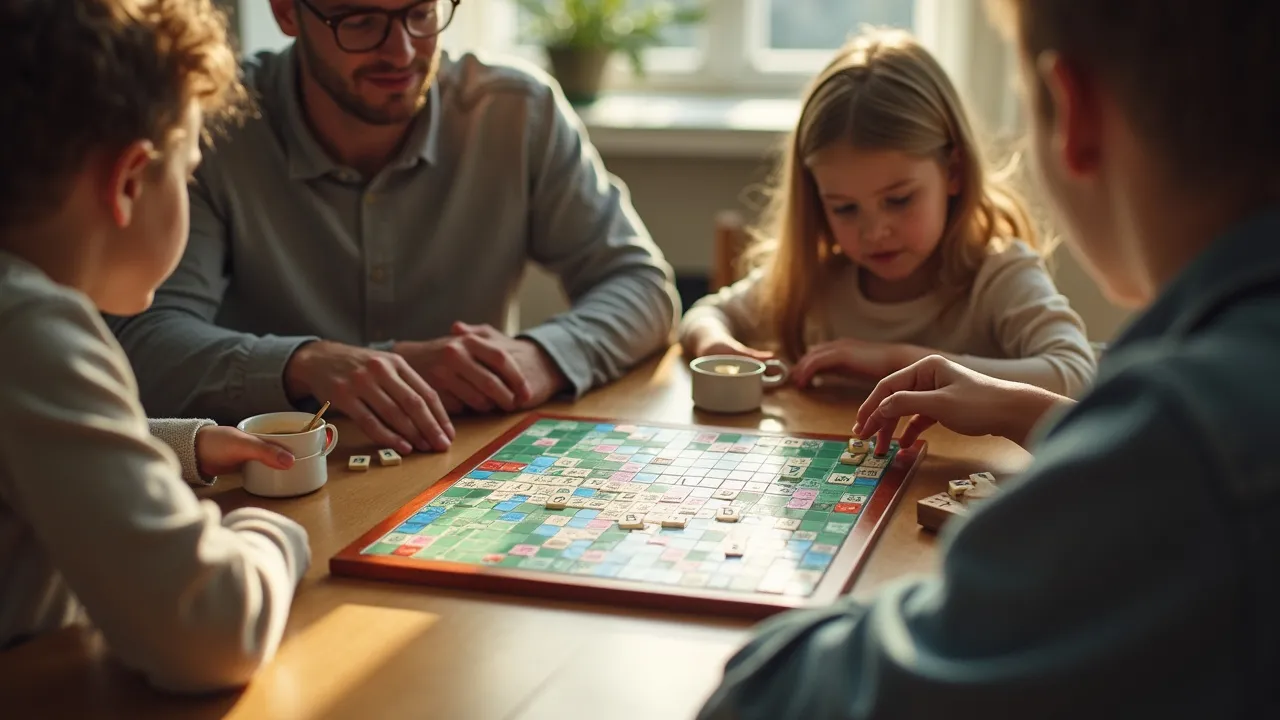
National Scrabble Day, observed on April 13th, celebrates the beloved word game invented by Alfred Mosher Butts. It honors the blend of vocabulary, strategy, and social interaction that has made Scrabble a global phenomenon.
The Historical Origins & Evolutionary Journey
National Scrabble Day, observed annually on April 13th, commemorates the birth of Alfred Mosher Butts, the inventor of Scrabble. This day is not only a tribute to Butts but also a celebration of the game that has captivated millions worldwide.
The Foundational Catalyst
In 1938, during the Great Depression, architect Alfred Mosher Butts sought to create a game that combined skill and chance. He analyzed the frequency of letters in the English language and designed a game originally called "Criss-Cross." The game featured a 15x15 grid and a set of letter tiles with different point values. Butts faced rejections from major game manufacturers but eventually sold the rights to James Brunot in 1948, who renamed it Scrabble and standardized the rules.
The Legislative/Official Adoption
Although National Scrabble Day is not a federally recognized holiday, it was officially established by Hasbro, Inc. in the early 2000s to honor Butts's legacy. The date of April 13th was chosen as it marks Butts's birthday in 1899. Since then, it has been celebrated by Scrabble clubs, schools, and families across the United States and beyond.
Modern Global Legacy
Today, Scrabble is played in over 120 countries and available in 30+ languages. The game has spawned competitive tournaments, online platforms, and even a world championship. National Scrabble Day serves as a rallying point for word enthusiasts to organize events, from casual games to formal competitions, and to reflect on the educational benefits of the game.
How to Celebrate National Scrabble Day
Celebrating National Scrabble Day is about more than just playing the game—it's about engaging with the Scrabble community and fostering a love of language. Here are key ways to participate:
For Individuals and Families
- Host a Scrabble night: Invite friends or family for a themed evening. Use a special board or time-limited rounds to add excitement.
- Learn a new word: Challenge yourself to memorize a high-scoring word like "quixotic" or "waltzes."
- Play online: Join platforms like Scrabble GO or Words With Friends to compete globally.
For Schools and Educational Institutions
- Organize a school-wide Scrabble tournament. Divide students into grade levels and award certificates.
- Incorporate Scrabble into lessons: Use the game to teach spelling, vocabulary, and math (score calculation).
- Hold a "Word of the Day" contest where students earn points for using new words in sentences.
For Organizations and Communities
- Host a charity tournament: Entry fees can benefit literacy programs or local libraries.
- Create a Scrabble club: Regular meetups can build community and improve cognitive skills.
- Social media challenge: Share your highest-scoring play using #NationalScrabbleDay.
Across the globe, different regions have unique traditions. In the UK, clubs often hold marathon games, while in India, school competitions are popular. The key is to make language fun and accessible to all.
Global Impact of Scrabble
Scrabble transcends borders, creating a universal language of friendly competition. Since its commercial launch in 1948, the game has sold over 150 million sets worldwide. National Scrabble Day highlights this global reach.
International Tournaments and Federations
The World Scrabble Championship began in 1991 and has been held in countries like Malaysia, France, and Australia. The National Scrabble Association (NSA) in the United States and the Association of British Scrabble Players (ABSP) organize regional events that culminate in international play. These tournaments feature top players who memorize dictionaries and employ advanced strategies like bingo plays (using all seven tiles).
Cultural Adaptations
Scrabble has been localized into dozens of languages, adapting tile distributions to match letter frequencies. For example, French Scrabble has a different letter set, and Hebrew Scrabble is written right to left. This adaptation has made the game a tool for language preservation and education in multilingual countries.
Online Revolution
Digital platforms have democratized Scrabble. Apps like Scrabble GO boast millions of users, allowing players to compete across time zones. During the COVID-19 pandemic, online Scrabble usage surged, and National Scrabble Day 2020 saw virtual tournaments with record participation.
Core Themes & Societal Benefits
National Scrabble Day underscores several core themes: literacy, strategic thinking, and social connection. The game offers numerous benefits:
Cognitive Enhancement
Studies have shown that Scrabble can delay cognitive decline by stimulating language centers in the brain. The need to recall vocabulary and calculate scores exercises memory and executive function.
Educational Value
Classrooms use Scrabble to teach spelling, vocabulary, and even basic math. The game encourages students to experiment with words and learn from mistakes in a low-pressure environment.
Social Bonding
Scrabble is inherently social. National Scrabble Day encourages face-to-face interaction, reducing screen time and building relationships. Family traditions often revolve around game nights.
Inclusivity
With versions for children, seniors, and non-native speakers, Scrabble is accessible. Braille and large-print editions ensure that visually impaired players can participate.
Scrabble Variants and Spin-offs
The popularity of Scrabble has spawned numerous variants that offer new challenges:
Official Variants
- Super Scrabble: A 21x21 grid with 200 tiles, allowing for longer words.
- Scrabble Junior: Simplified version for children ages 5+ with picture patterns.
- Scrabble Deluxe: Features a rotating game board and luxurious components.
Digital Extensions
- Words With Friends: A social app that reinvents Scrabble with different point values and power-ups.
- Scrabble GO: The official mobile app with solo and multiplayer modes, daily challenges, and word dictionaries.
House Rules and Custom Games
Many players invent their own rules, such as allowing proper nouns, double scoring for palindromes, or speed rounds. These customizations keep the game fresh for seasoned players.
Notable Tournaments and Champions
The competitive Scrabble scene is vibrant, with high-stakes tournaments showcasing extraordinary skill.
World Scrabble Championship
First held in 1991 in London, the championship brings together national champions from over 40 countries. Notable winners include Nigel Richards (New Zealand/Malaysia), who has won the title four times, and David Boys (Canada).
National Scrabble Championship (USA)
Organized by the NSA, this annual event has been held since 1978. Top players like Stefan Fatsis and Trey Wright have dominated. The championship features divisions for different skill levels.
Youth and School Tournaments
Many countries organize youth championships. The North American School Scrabble Championship has over 300 teams annually, promoting literacy and friendly competition.
Online Championships
With the rise of digital play, platforms like Scrabble GO host monthly tournaments with cash prizes, attracting casual and serious players alike.
Scrabble in Education
Scrabble is a powerful educational tool, and National Scrabble Day often emphasizes its role in classrooms.
Curriculum Integration
Teachers use Scrabble to reinforce various subjects:
- Language Arts: Build vocabulary, practice spelling, and learn prefixes/suffixes.
- Mathematics: Calculate scores, use multiplication for double/triple word scores, and track probabilities.
- Social Studies: Explore the etymology of words and their origins.
Special Education
Scrabble benefits students with dyslexia by allowing visual and kinesthetic learning. The tactile tiles help with letter recognition, and the game's repetitive nature reinforces spelling patterns.
ESL Programs
For English as a Second Language learners, Scrabble offers an interactive method to expand vocabulary. Modified rules, like using bilingual dictionaries, can reduce anxiety and encourage participation.
Research Findings
Several studies indicate that regular Scrabble play improves standardized test scores in reading and math. National Scrabble Day provides an annual impetus for schools to adopt game-based learning strategies.
Historical Timeline
Alfred Mosher Butts invents the game initially called 'Criss-Cross' based on letter frequency analysis.
James Brunot acquires the rights to the game, renames it 'Scrabble', and begins commercial production.
Scrabble goes global as the game is licensed for production in the United Kingdom and Australia.
The first National Scrabble Championship is held in the United States, organized by the National Scrabble Association.
The first World Scrabble Championship takes place in London, though it is not officially sanctioned.
The modern World Scrabble Championship series begins in London, with over 30 countries participating.
Hasbro officially designates April 13th as National Scrabble Day to honor Alfred Butts's birthday.
Scrabble GO (formerly Scrabble app) launches, bringing the game to millions of mobile users worldwide.
During the COVID-19 pandemic, online Scrabble usage surges, with virtual National Scrabble Day tournaments breaking participation records.
Scrabble celebrates its 75th anniversary with special edition boards and global events on National Scrabble Day.