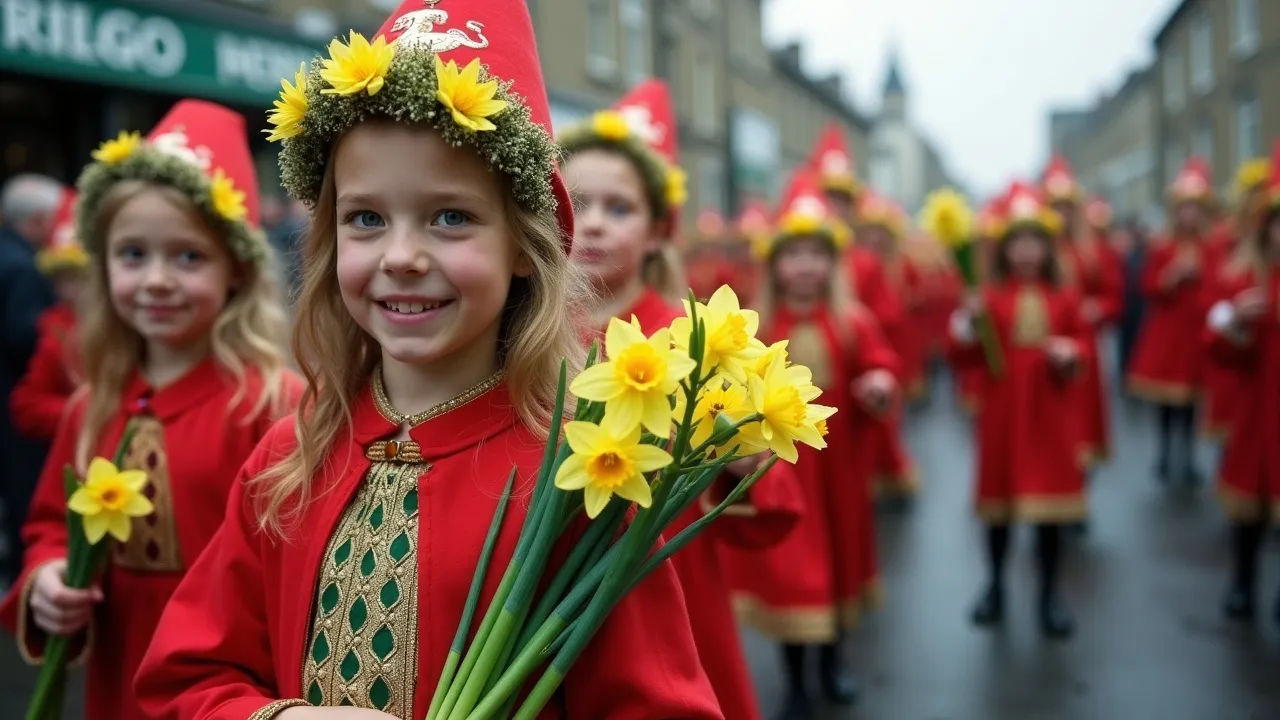
St. David's Day, March 1st, honors the patron saint of Wales. Celebrated with parades, daffodils, leeks, and traditional Welsh culture, it unites Welsh communities worldwide in a vibrant display of national pride.
The Historical Origins & Evolutionary Journey
St. David's Day, observed annually on March 1st, commemorates the death of Saint David (Dewi Sant), the patron saint of Wales. This day has evolved from a medieval religious feast into a global celebration of Welsh identity and culture.
The Foundational Catalyst
Saint David was a 6th-century Welsh bishop and monastic founder, known for his asceticism and miracles. He became the patron saint of Wales after his canonization in 1120 by Pope Callixtus II. According to legend, an angel foretold his birth, and his life was marked by extraordinary events, such as making the ground rise under him while preaching and restoring a blind man's sight. His teachings emphasized simplicity and vegetarianism.
The Legislative/Official Adoption
While St. David's Day was widely celebrated in Wales during the Middle Ages, it was never made a public holiday. In the 18th century, the day saw a revival through the Welsh cultural renaissance, with eisteddfodau and societies promoting Welsh language and traditions. In 2000, the Welsh Assembly debated but did not pass a bill to make it a bank holiday. Despite this, annual parades and events have grown, especially in Cardiff since 2005.
Modern Global Legacy
Today, St. David's Day is celebrated by Welsh expatriates and descendants around the world, from the United States to Argentina. The day serves as a focal point for Welsh heritage, featuring concerts, festivals, and traditional foods like cawl and Welsh cakes. The Red Dragon flag and national emblems—the daffodil and leek—are prominently displayed, reinforcing a sense of unity and pride.
How to Celebrate St. David's Day
St. David's Day offers a rich tapestry of traditions for individuals, schools, and organizations. Here are definitive strategies for a meaningful celebration, whether in Wales or abroad.
For Individuals and Families
- Wear the Emblems: Pin a daffodil or leek to your lapel. These symbols are rooted in legend—the leek came from a battle where Welsh soldiers wore leeks to distinguish themselves, while the daffodil is a national flower adopted in the 19th century.
- Prepare Traditional Foods: Cook dishes like cawl (lamb and leek stew), Welsh rarebit (cheese on toast), and Welsh cakes (griddle scones with currants). Share them with family or neighbors.
- Attend a Parade: Major parades in Cardiff, Swansea, and Aberystwyth feature marching bands, dragons, and costumed participants. Smaller villages often hold their own processions.
- Learn a Welsh Song: Singing traditional hymns or modern Welsh songs—like 'Calon Lân'—is a cherished practice. Many schools hold eisteddfodau (festivals of music and poetry).
For Schools and Communities
- Host an Eisteddfod: Organize competitions in recitation, singing, and art, emphasizing the Welsh language. Prizes can include daffodil posies or books about Welsh history.
- Decorate with Dragons: Create red dragon crafts, bunting, and displays. The dragon on the Welsh flag is one of the oldest national symbols in the world.
- Invite a Speaker: Ask a local historian or Welsh language expert to talk about Saint David or the importance of the day in modern Wales.
For Businesses and Organizations
- Support Welsh Products: Encourage staff to buy Welsh goods, or offer discounts on Welsh-made items. Some companies host a 'Welsh tea break' with bara brith (fruit loaf).
- Promote on Social Media: Share facts about Saint David, use hashtags like #StDavidsDay, and highlight Welsh achievements in your industry.
Cultural Significance of Symbols: Daffodils and Leeks
Two emblems dominate St. David's Day: the leek and the daffodil. Their origins are steeped in legend and history, representing courage, rebirth, and national identity.
The Leek
The leek is the older symbol, dating back to the 7th century when King Cadwaladr of Gwynedd ordered his soldiers to wear leeks on their helmets to distinguish allies from enemies during a battle against the Saxons. Saint David himself is said to have lived on a diet of leeks and water. Today, Welsh people pin leeks to their clothes, and the vegetable features prominently in traditional dishes like cawl.
The Daffodil
The daffodil, or Cenhinen Bedr (Peter's leek), gained popularity in the 19th century due to its association with Wales and the spring season. It was championed by David Lloyd George, the only British Prime Minister of Welsh origin, who wore a daffodil on St. David's Day. The flower symbolizes rebirth and new beginnings, fitting for the first day of March. Both emblems are worn proudly, often together, and appear on official Welsh regalia.
St. David's Day Around the World
The Welsh diaspora ensures that St. David's Day is celebrated far beyond Wales' borders. From Patagonia to the United States, communities gather to honor their heritage.
Patagonia, Argentina
Welsh settlers founded a colony in Patagonia in 1865, and their descendants maintain Welsh traditions fiercely. St. David's Day is marked with eisteddfodau, tea rooms serving Welsh cakes, and the display of the Welsh flag. The town of Gaiman holds a parade and a special church service.
United States
Cities with large Welsh populations, such as New York, Los Angeles, and Chicago, host banquets and cultural events. The Welsh Society of New York organizes an annual dinner and a service at St. David's Church. In Scranton, Pennsylvania, which has deep mining ties, a festival features Welsh choirs and genealogy workshops.
Australia and Canada
In Australia, Welsh societies in Sydney and Melbourne hold gatherings with traditional music and dance. Canada's Welsh community, especially in Vancouver and Toronto, celebrates with concerts and the raising of the Welsh dragon flag.
Saint David: The Man, His Miracles, and Teachings
Saint David (c. 500–589 AD) is the only native-born patron saint of the United Kingdom. His life and legacy are central to the observance.
Early Life and Monastery
Born in Pembrokeshire, David founded a monastery at Glyn Rhosyn (now St Davids) that followed a strict ascetic rule: monks pulled ploughs barefoot, drank only water, and ate only bread, herbs, and vegetables. David's diet earned him the nickname Aquaticus (water-drinker).
Miracles
Numerous miracles are attributed to him: raising a child from the dead, healing the blind, and causing the ground to rise under him while preaching at the Synod of Llanddewi Brefi so that all could see him. A dove perched on his shoulder became his symbol.
Last Words
His final sermon included the famous words, 'Do the little things in life' (Gwnewch y pethau bychain), which has become a guiding principle for many Welsh people. He died on March 1st, 589, and was buried at St Davids Cathedral.
Modern Welsh Identity and St. David's Day
St. David's Day is more than a religious feast; it is a celebration of Welsh language, culture, and political identity. In recent decades, the day has become a platform for campaigns for independence and cultural preservation.
Language Revival
The Welsh language, which faced decline, has seen a revitalization thanks to efforts like the Welsh Language Act 1993 and the establishment of the Welsh Parliament (Senedd) in 1999. St. David's Day events often feature Welsh-language performances, aiming to boost fluency and pride.
Public Holiday Campaigns
There have been repeated calls to make St. David's Day a national holiday in Wales, similar to St. Patrick's Day in Ireland. Petitions and parliamentary debates have occurred but not yet succeeded. Supporters argue it would boost tourism and celebrate Welsh distinctiveness.
Global Recognition
Welsh flags fly on government buildings in Wales, and the day is recognized internationally by Welsh associations. The Red Dragon, officially adopted in 1959, is a potent symbol flown from embassies and town halls worldwide on March 1st.
Historical Timeline
Saint David is born in Pembrokeshire, Wales.
Saint David dies on March 1st, establishing the date of his feast day.
Pope Callixtus II canonizes Saint David, making March 1st an official feast day in the Catholic Church.
King Henry VIII's Reformation suppresses many saint feast days, but St. David's Day survives in Wales.
Welsh cultural revival movement revives public celebrations, including eisteddfodau and the wearing of leeks.
The Welsh League of Youth (Urdd Gobaith Cymru) is founded, using St. David's Day for cultural activities.
Welsh Assembly debates making St. David's Day a public holiday; motion fails.
First official St. David's Day parade held in Cardiff, now an annual tradition attracting thousands.
Welsh Government announces that St. David's Day will be marked with a flag-flying ceremony at all public buildings.