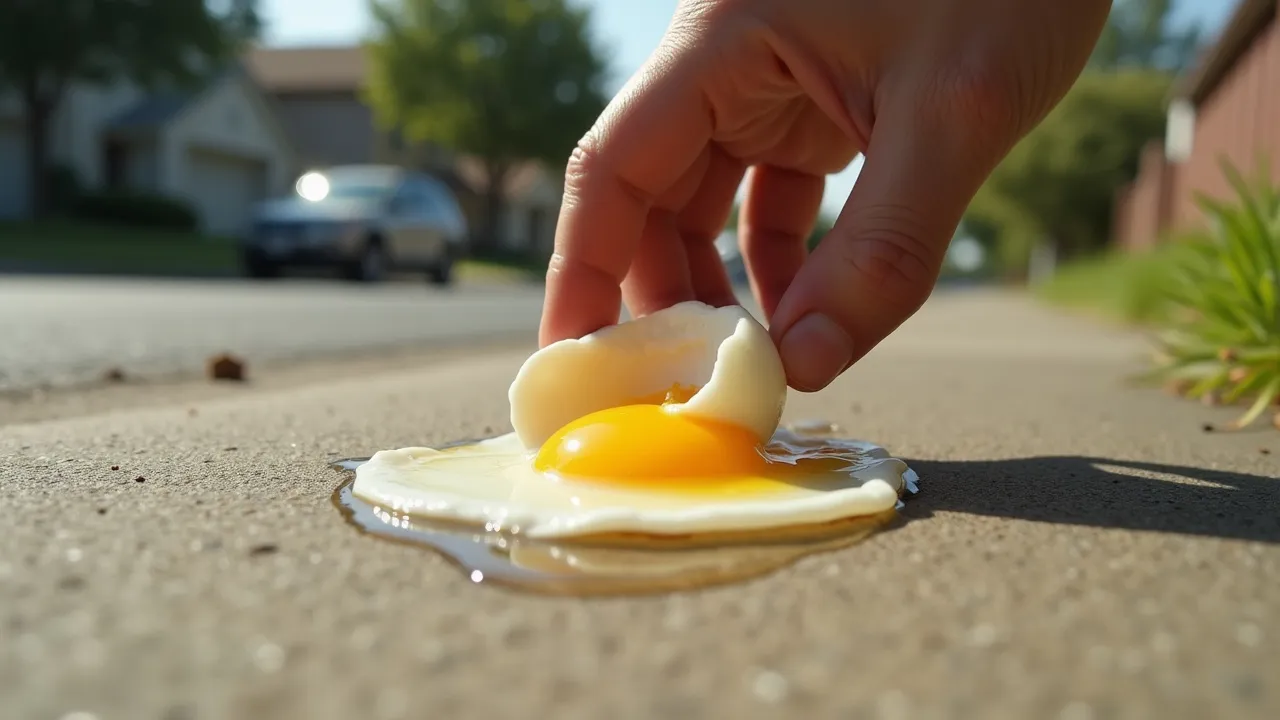
Celebrated on July 4th, Sidewalk Egg Frying Day is a playful American tradition where people test the intense summer heat by trying to fry an egg directly on the pavement. It's a quirky celebration of heat, humor, and culinary curiosity.
The Historical Origins & Evolutionary Journey
Sidewalk Egg Frying Day, observed annually on July 4th, is a lighthearted observance that challenges the common wisdom that "it's so hot you could fry an egg on the sidewalk." While the phrase has been part of American vernacular for decades, the specific holiday was formalized by Tom and Ruth Roy, founders of Wellcat Holidays, a company known for creating whimsical and often humorous observances. The Roys are responsible for many such days, including "Chocolate-Covered Anything Day" and "Measure Your Feet Day." Their goal was to provide a fun, low-stakes activity that celebrates the peak of summer heat in a safe and entertaining manner.
The Foundational Catalyst
The idea of frying an egg on a sidewalk likely originated as an exaggerated metaphor for extreme heat, particularly in the southern United States. Early recorded instances date back to the mid-20th century, where newspapers and folklore would recount stories of adventurous individuals trying to cook an egg on asphalt. One famous account from 1958 in Oatman, Arizona, involved a local claiming to have successfully fried an egg on the town's main street. This sparked a wave of similar experiments, often performed on July 4th during heatwaves. The holiday itself was likely inspired by these grassroots experiments.
The Formal Adoption
In the early 1990s, Wellcat Holidays officially designated July 4th as Sidewalk Egg Frying Day. The choice of date was intentional: July 4th is Independence Day in the United States, a day already associated with outdoor activities, barbecues, and hot weather. By piggybacking on this existing celebration, the Roys ensured maximum participation and media attention. The holiday quickly spread through word of mouth, early internet forums, and quirky news segments on local television. By the 2000s, it had become a staple of summer trivia lists and a popular social media challenge.
Modern Global Legacy
Today, Sidewalk Egg Frying Day is recognized in various forms around the world. While the date remains tied to the U.S. Independence Day, countries like Australia and Canada have adapted it to their summer months. In the United Kingdom, where July is often milder, enthusiasts sometimes use heated surfaces like car hoods or griddles placed on the ground. The holiday has also inspired scientific curiosity about the specific temperature required to denature egg proteins—generally around 158°F (70°C)—and whether pavement can realistically reach that threshold. Studies have shown that on a sunny day with ambient temperatures above 100°F (38°C), asphalt can reach up to 160°F (71°C), making a viable but tricky cooking surface. The holiday thus blends folk wisdom with empirical science, capturing the imagination of both casual participants and serious hobbyists.
How to Celebrate Sidewalk Egg Frying Day
Celebrating Sidewalk Egg Frying Day is simple, fun, and best done with safety precautions. The following guide provides actionable strategies for individuals, families, schools, and organizations.
Preparation Essentials
- Check the Weather: Ensure the forecast predicts high temperatures, ideally above 100°F (38°C), with direct sunlight and low humidity. A heatwave is optimal.
- Select the Surface: Use a dark, dry concrete or asphalt surface that has been in direct sun for at least two hours. Avoid metal surfaces that can cause uneven cooking.
- Gather Supplies: You'll need a fresh egg, a skillet or a piece of aluminum foil (to avoid messy cleanup), and a spatula. Some purists insist on cooking directly on the sidewalk, but using a barrier is recommended for hygiene.
Step-by-Step Cooking Process
- Test the Surface: Sprinkle a few drops of water on the pavement. If they sizzle and evaporate almost instantly, the surface is ready.
- Place the Egg: Crack the egg onto your chosen surface or foil. Avoid breaking the yolk for a classic sunny-side-up look.
- Wait and Observe: Depending on the heat, the egg may take anywhere from 10 to 30 minutes to cook through. The white will turn opaque and the yolk will begin to set.
- Flip if Desired: For a more evenly cooked egg, carefully flip it using a spatula after the bottom is firm.
- Serve or Document: Once cooked to your preference, transfer the egg to a plate (do not eat it directly from the sidewalk due to potential contaminants). Take photos or videos to share your success on social media using hashtags like #SidewalkEggFryingDay or #EggOnTheStreet.
Creative Variations and Challenges
For those seeking more than the basic egg, try these themed activities:
- Egg-Only Challenge: Cook multiple eggs simultaneously in a race to see which cooks fastest. Use different surface colors to compare heat absorption.
- Omelet in a Bag: Pour beaten eggs with vegetables into a sealed zip-top bag and place it on the hot sidewalk. The bag acts as a makeshift sous-vide cooker.
- Educational Experiment: Use a laser thermometer to measure surface temperature at intervals. Record data to see if your sidewalk reaches the critical 158°F (70°C) needed for egg coagulation.
Celebrating with Groups
- Schools and Science Clubs: Incorporate the egg-frying experiment into a lesson about heat transfer, insulation, and states of matter. Students can hypothesize, measure, and conclude.
- Community Events: Organize a neighborhood gathering where participants share their results, perhaps with a picnic nearby. Ensure safety by providing sunscreen, water, and shade.
- Corporate Team-Building: Companies can host a friendly competition between departments, with prizes for the best-cooked egg or most creative documentation.
Remember: The goal is fun and experimentation. Not every attempt will succeed, but the process of trying is the true spirit of Sidewalk Egg Frying Day.
The Science Behind the Sizzle: Thermal Dynamics of Pavement Cooking
Why Some Pavements Fry Better Than Others
The ability to fry an egg on a sidewalk hinges on surface temperature exceeding 158°F (70°C), the point at which egg whites coagulate. On a clear, hot day with ambient air temperatures around 100°F (38°C), asphalt can absorb solar radiation and reach temperatures up to 160°F (71°C) or more. However, several factors affect this:
- Color and Material: Darker surfaces absorb more heat. New asphalt (black) heats faster than aged concrete (gray). Metal surfaces like car hoods can get even hotter but conduct heat unevenly.
- Thermal Conductivity: Asphalt is a poor conductor but heats up quickly on the top layer. Concrete, while lighter, retains heat longer but may not reach peak temperatures.
- Wind and Humidity: Breezes cool the surface by evaporation; high humidity slows evaporation, reducing the surface's ability to get hot enough.
The Role of the Sun
Direct sunlight is critical. Cloud cover or shade can drop surface temperatures by 20°F or more. The angle of the sun also matters: midday sun (around 1-3 PM) provides the most direct radiation.
Studies conducted by the National Weather Service have shown that on a typical July afternoon in Phoenix, Arizona, a concrete sidewalk reaches about 140°F (60°C), while an asphalt parking lot can hit 165°F (74°C)—well within frying range. However, in cooler climates, the egg may only cook partially, resulting in a "sunny-side up" that is still raw in the middle.
Egg Chemistry
An egg contains protein chains that unravel and bond when heated, turning the translucent white into a solid. The yolk, with higher fat content, requires slightly higher temperatures to set. Thus, a fully cooked egg requires consistent heat over time. The sidewalk acts as a low-heat griddle, but the process is slow and prone to contamination from dirt and bacteria. This is why using a foil or skillet barrier is recommended.
Cultural Impact and Media Spotlight
Sidewalk Egg Frying Day has permeated American culture as a humorous benchmark for extreme heat. Meteorologists often reference the holiday during heatwaves, asking viewers if they "could fry an egg on the sidewalk today." The day has been covered by major media outlets including The Weather Channel, CNN, and local news stations, who often conduct live demonstrations.
Social Media and Viral Challenges
Platforms like TikTok, Instagram, and YouTube see an uptick in related content every July 4th. The hashtag #SidewalkEggFryingDay typically trends in the United States, with users posting time-lapse videos of their cooking attempts. Some influencers have turned the day into an annual tradition, competing for the most impressive egg cook.
Parody and Skepticism
Not everyone embraces the holiday; some view it as a waste of food or a gimmick. Critics point out that the high surface temperatures can damage pavement and that eating food cooked on the ground is unsanitary. Despite this, the holiday persists as a symbol of summer fun and American ingenuity.
International Adaptations
While primarily American, the concept has spread globally. In Australia, where January is summer, some celebrate on January 26th (Australia Day) instead. British participants often use car hoods or ironing boards placed in the sun. The holiday's adaptability shows its universal appeal: the simple challenge of cooking an egg with only the sun's heat.
Safety Considerations and Environmental Impact
Personal Safety Precautions
Attempting to fry an egg on a sidewalk involves exposure to extreme heat. Participants should take the following precautions:
- Hydrate: Drink plenty of water to avoid heat exhaustion. Avoid caffeine or alcohol during the experiment.
- Protect Skin: Wear sunscreen, a hat, and light clothing. The pavement can become hot enough to cause burns if touched barefoot.
- Supervise Children: Keep kids away from hot surfaces and ensure they do not ingest raw egg or touch hot pavement.
- Use Tools: Use long-handled spatulas and avoid direct contact with the cooking surface.
Environmental Considerations
While a single egg has minimal impact, mass participation can raise concerns:
- Surface Damage: Repeatedly cooking on the same spot can warp asphalt or leave residue that attracts pests.
- Food Waste: If the egg does not cook or is inedible, it should be disposed of properly, not left on the sidewalk.
- Cleanliness: Always clean up afterward to avoid attracting animals and to maintain public hygiene.
To be environmentally responsible, consider using a reusable silicone mat or a metal skillet instead of placing food directly on the pavement. This also makes cleanup easier.
Global Variations and Unique Traditions Around the World
While the United States is the epicenter of Sidewalk Egg Frying Day, other countries have developed their own traditions and interpretations.
United States
Americans embrace the holiday with backyard contests, social media challenges, and even official proclamations in some small towns. For instance, the city of Oatman, Arizona, holds an annual "Egg Frying Festival" on July 4th, complete with a competition to see who can fry an egg fastest on the historic Route 66.
Australia
Due to the Southern Hemisphere's opposite seasons, Australians sometimes celebrate during their summer months, particularly around Christmas or Australia Day (January 26th). The tradition is similar but often involves cooking on car hoods due to less available asphalt.
United Kingdom
British participants face cooler summers, so they often use heated surfaces like engine blocks or specially designed solar cookers. Some have created "sidewalk griddles"—metal plates that absorb heat and provide a sterile cooking surface.
Middle East
In desert countries like Saudi Arabia or Kuwait, where summer temperatures regularly exceed 120°F (49°C), frying an egg on the pavement is almost too easy. Some communities use the holiday as an opportunity to educate about heat safety and traditional desert survival skills.
These global adaptations show that the core idea—using solar energy to cook—is universally appealing, regardless of date or method.
The Future of Sidewalk Egg Frying Day: Climate Change and Innovation
Rising Temperatures and Participation
As global temperatures rise due to climate change, the feasibility of frying an egg on a sidewalk may increase in many regions. Hotter summers could make the holiday more accessible to a wider audience, possibly even extending to northern latitudes like Canada or Scandinavia. However, this also raises concerns about heatwaves and public health.
Technological Innovations
Modern cooks have developed specialized tools for sidewalk frying:
- Solar-Powered Skillets: Portable skillets with reflective surfaces that concentrate heat, allowing cooking even on milder days.
- Temperature Sensors: Smart thermometers that alert when the surface reaches optimal frying temperature, often linked to smartphones.
- Biodegradable Egg Containers: Eco-friendly, single-use foil pans that eliminate mess and are compostable.
The Holiday's Evolution
Looking ahead, Sidewalk Egg Frying Day may grow from a novelty into an educational tool for renewable energy and food science. Schools could incorporate it into curricula about solar power and heat transfer. Additionally, it might become an annual challenge for engineers to design the most efficient portable solar cooker. The holiday's lighthearted nature ensures it will continue to bring smiles and curiosity for generations.
Historical Timeline
Early recorded account in Oatman, Arizona, where a local claimed to have fried an egg on the sidewalk during a heatwave, sparking local folklore.
The phrase 'it's so hot you could fry an egg on the sidewalk' becomes a common American expression, used by weather forecasters and in popular culture.
Tom and Ruth Roy of Wellcat Holidays formally establish Sidewalk Egg Frying Day on July 4th, aiming to create a fun, heat-related observance.
The Weather Channel broadcasts a live segment on July 4th demonstrating egg frying from a parking lot in Dallas, Texas, bringing national attention.
YouTube viral videos of successful sidewalk egg frying amass millions of views, cementing the day's status as an internet phenomenon.
Oatman, Arizona, holds its first official 'Egg Frying Festival' on July 4th, featuring competitions and record-breaking attempts.
Due to the COVID-19 pandemic, many celebrate at home, leading to an increase in backyard and driveway egg frying experiments.
NASA's Jet Propulsion Laboratory releases a science guide on the thermodynamics of sidewalk egg frying, linking the holiday to educational outreach.