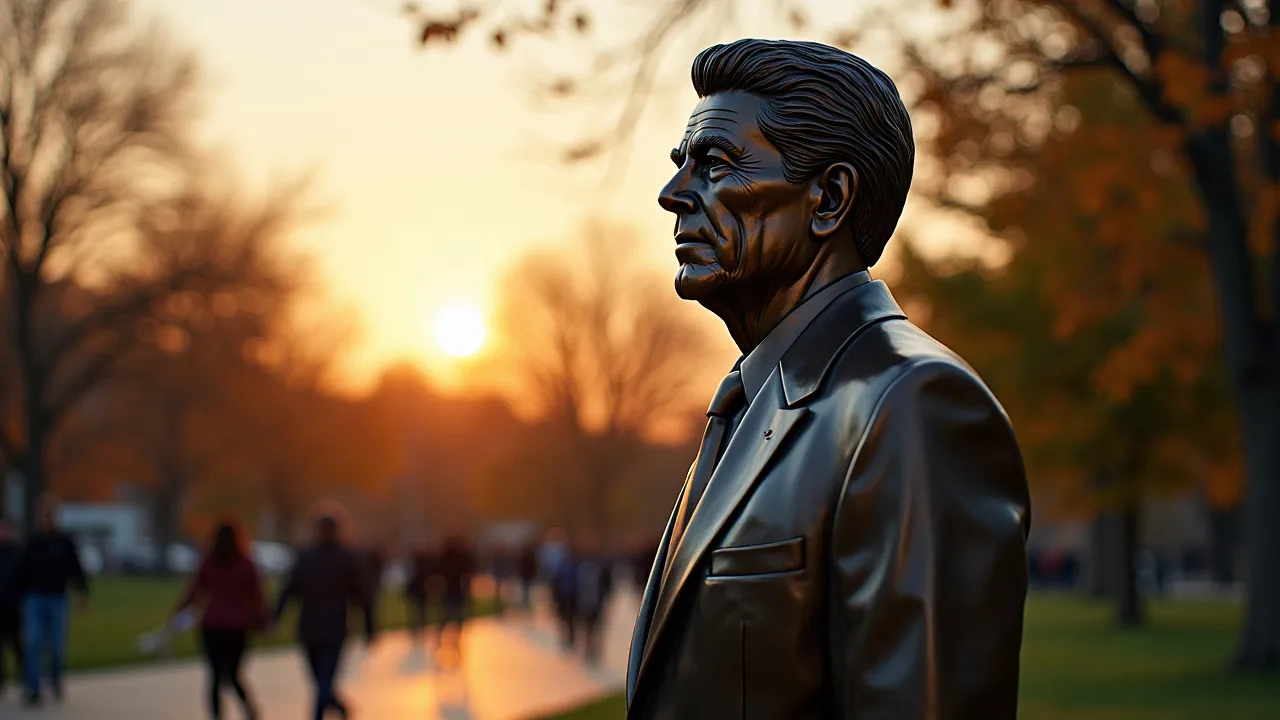
Ronald Reagan Day, observed each February 6th, honors the 40th President's legacy of conservative governance, economic revival, and pivotal role in ending the Cold War.
The Historical Origins & Evolutionary Journey
Ronald Reagan Day traces its roots to the birth of Ronald Wilson Reagan on February 6, 1911, in Tampico, Illinois. Initially a local observance in California, it gained official state recognition in 2011, when the California State Legislature designated each February 6 as a day to honor Reagan's contributions. The day's evolution mirrors Reagan's own journey from Hollywood actor to governor of California and ultimately the 40th President of the United States.
The Foundational Catalyst
Reagan's rise to national prominence began with his 1964 speech "A Time for Choosing" on behalf of Barry Goldwater, which showcased his conservative ideals. His two terms as California Governor from 1967 to 1975 provided a template for his later presidency. The catalyst for an official day came after his death in 2004, as admirers pushed for a lasting tribute. In 2010, the California legislature passed SB 944, making February 6 a state-recognized day. President Barack Obama also issued a presidential proclamation in 2011, encouraging Americans to observe the day with appropriate programs and activities.
Legislative/Official Adoption
Following California's lead, numerous states—including Texas, Florida, and Virginia—passed similar resolutions. The Ronald Reagan Presidential Foundation and Library in Simi Valley became the epicenter of annual celebrations. In 2011, the first official statewide events included wreath-laying ceremonies and educational forums. Over time, the day gained bipartisan recognition, with both Republicans and Democrats acknowledging Reagan's impact on tax reform, deregulation, and foreign policy.
Modern Global Legacy
Today, Ronald Reagan Day transcends national borders. In the United Kingdom, the Thatcher Foundation occasionally marks the day with seminars. In Poland, Reagan is remembered for his support of the Solidarity movement. The day serves as a platform to discuss free-market economics, limited government, and the triumph of democracy over communism. Social media campaigns using #RonaldReaganDay amplify his quotes and achievements, ensuring his legacy endures for new generations.
How to Celebrate Ronald Reagan Day
Celebrating Ronald Reagan Day involves reflecting on his principles and engaging in activities that promote freedom, leadership, and community service. Below are actionable strategies for individuals, schools, and organizations.
For Individuals
- Read Reagan's Speeches – Study his iconic addresses like the "Tear Down This Wall" speech at the Brandenburg Gate. Discuss their relevance today.
- Volunteer – Reagan emphasized individual responsibility. Spend the day volunteering at a local charity or veterans' organization.
- Write to Leaders – Draft letters to elected officials advocating for limited government and free enterprise, core tenets of Reagan's philosophy.
For Schools
- Host a Reagan Forum – Invite historians or former officials to discuss his presidency. Use multimedia resources from the Reagan Library.
- Debate Economic Policies – Organize a classroom debate on Reaganomics versus modern economic theories. Encourage students to research historical outcomes.
- Essay Contest – Prompt students to write about Reagan's impact on their state or community. Award prizes for the best entries.
For Organizations
- Film Screening – Show documentaries like "The Reagan Presidency" or "The Great Communicator." Follow with a Q&A session.
- Reagan Day Gala – Host a fundraising dinner with keynote speakers emphasizing his legacy. Proceeds can support civic education programs.
- Social Media Campaign – Share Reagan quotes and policy achievements using #RonaldReaganDay. Encourage employees to post personal reflections.
Regional Variations
While February 6 is the primary date in the United States, some conservative groups in Latin America observe the day with pro-democracy rallies. In California, the Reagan Library hosts an annual open house with free admission, while in Illinois (his birthplace), the Reagan Birthplace Museum offers special tours. International fans in Japan and South Korea, where Reagan is admired for his anti-communist stance, hold lecture series on democratic values.
Ronald Reagan's Economic Legacy
Reaganomics, the set of economic policies championed by Ronald Reagan during his presidency (1981–1989), continues to shape fiscal debates. The core pillars were tax cuts, deregulation, reduced government spending, and tight monetary policy to curb inflation. On Ronald Reagan Day, economists and policymakers revisit these ideas.
Tax Reform
The Economic Recovery Tax Act of 1981 slashed marginal income tax rates by 25% over three years. Later, the Tax Reform Act of 1986 simplified the tax code, reducing the top rate from 50% to 28%. Supporters credit these cuts with spurring a decade of economic expansion, while critics note increased income inequality. During Ronald Reagan Day, many organizations host panels analyzing the long-term effects of these tax policies on GDP growth and job creation.
Deregulation
Reagan dismantled price controls on oil and gas, reduced antitrust enforcement, and eased environmental regulations. This era saw the rise of the savings and loan crisis, which his administration had to address. Nevertheless, deregulation remains a hallmark of Reagan's legacy, often cited by advocates of free-market solutions. Schools and think tanks use the day to present case studies on the balance between regulation and innovation.
The day also highlights Reagan's supply-side economics theory, which posits that lower taxes boost productivity. While modern economists like Arthur Laffer (originator of the Laffer Curve) remain influential, critics point to growing deficits during the Reagan years. Discussions on Ronald Reagan Day often emphasize the need for fiscal responsibility alongside tax cuts.
Global Impact & the End of the Cold War
Ronald Reagan's foreign policy directly contributed to the peaceful dissolution of the Soviet Union. On Ronald Reagan Day, historians and diplomats reflect on how his aggressive stance toward the "Evil Empire" combined with diplomatic engagement to reshape global politics.
The Strategic Defense Initiative
Announced in 1983, SDI (dubbed "Star Wars") aimed to develop a missile defense shield. Though never fully realized, it forced the Soviet Union into an expensive arms race that strained its economy. Many scholars argue that SDI was a key factor in the USSR's collapse. During Ronald Reagan Day, lectures often explore the technical challenges and political fallout of the program.
Summit Meetings
Reagan's four summits with Soviet leader Mikhail Gorbachev—in Geneva, Reykjavik, Washington, D.C., and Moscow—reduced tensions and led to the Intermediate-Range Nuclear Forces (INF) Treaty in 1987. The Reykjavik summit nearly achieved complete nuclear disarmament. On the day, individuals watch documentaries like "Reagan and Gorbachev" to understand the human element behind high-stakes negotiations.
The fall of the Berlin Wall in 1989 is often linked to Reagan's bold challenge at the Brandenburg Gate in 1987: "Mr. Gorbachev, tear down this wall!" Ronald Reagan Day serves as an annual reminder of the power of clear moral leadership in foreign affairs. In countries like Poland, the Czech Republic, and the Baltic states, the day is celebrated with events highlighting Reagan's support for anti-communist movements such as Solidarity.
Media & Communication Mastery
The Great Communicator—a nickname earned by Reagan for his exceptional media skills. On Ronald Reagan Day, students of communication and politics analyze his rhetorical techniques. Reagan's background as a Hollywood actor and television host gave him a natural comfort with cameras, which he used to reshape presidential communication.
Use of Anecdotes and Humor
Reagan often defused tense situations with a joke. For example, before a debate with Walter Mondale, he quipped, "I will not make age an issue in this campaign. I am not going to exploit for political purposes my opponent's youth and inexperience." His speeches regularly included personal stories that made complex issues relatable. Speechwriters recall that Reagan insisted on plain language over jargon.
Saturday Radio Addresses
Reagan revived the weekly presidential radio address, which became a staple for communicating directly with the American public. These short, unfiltered talks allowed him to bypass the press and frame his agenda. On Ronald Reagan Day, many public affairs programs re-air these addresses, prompting discussions about the evolving relationship between the president and media.
His mastery of television was evident during the 1984 re-election campaign, where his ads like "Morning in America" emphasized optimism and patriotism. Today, political strategists study Reagan's ad campaigns as a blueprint for effective messaging. The day often features workshops on public speaking and media training inspired by Reagan's methods.
Cultural Depictions and Public Memory
Ronald Reagan's image permeates American culture through films, monuments, and annual events. On Ronald Reagan Day, institutions like the Smithsonian and the National Archives highlight artifacts from his life. This section explores how Reagan is remembered in artistic and commemorative contexts.
Monuments and Museums
The Ronald Reagan Presidential Library in Simi Valley, California, houses his presidential aircraft (Air Force One), a replica of the Oval Office, and an extensive archive. The library hosts the annual Reagan Day celebration with guest speakers and a wreath-laying ceremony. Additionally, the USS Ronald Reagan (CVN-76), a Nimitz-class aircraft carrier, serves as a floating tribute. On the day, veterans' groups often organize visits to these sites.
Film and TV Portrayals
Reagan has been portrayed in numerous movies and series, including "The Reagans" (2003) and the 2020 film "Reagan" starring Dennis Quaid. Documentaries like "The Reagan Years" provide historical context. On Ronald Reagan Day, television networks sometimes schedule marathons of these programs. Critics note that portrayals often reflect contemporary political biases, sparking debates about historical accuracy.
The day also sees social media trends where users share personal anecdotes or family photos from the Reagan era. Hashtags like #RememberReagan and #ReaganLegacy trend on platforms such as X (formerly Twitter). Museums and schools host art contests encouraging children to draw Reagan's life, from his ranch in Santa Barbara to his meetings with Gorbachev.
Historical Timeline
Ronald Wilson Reagan is born on February 6 in Tampico, Illinois, to Nelle and John Reagan.
Reagan is inaugurated as the 33rd Governor of California, serving until 1975, where he implements welfare reform and tax cuts.
Reagan becomes the 40th President of the United States; survives an assassination attempt on March 30.
The Tax Reform Act of 1986 is signed, simplifying the tax code and lowering top marginal rates.
Reagan gives the 'Tear Down This Wall' speech at the Brandenburg Gate in West Berlin.
Reagan leaves office; the Berlin Wall falls later that year, symbolizing the end of the Cold War.
Reagan dies on June 5 at his home in Bel Air, Los Angeles, after a long battle with Alzheimer's disease.
California officially recognizes February 6 as Ronald Reagan Day; President Obama issues a presidential proclamation.