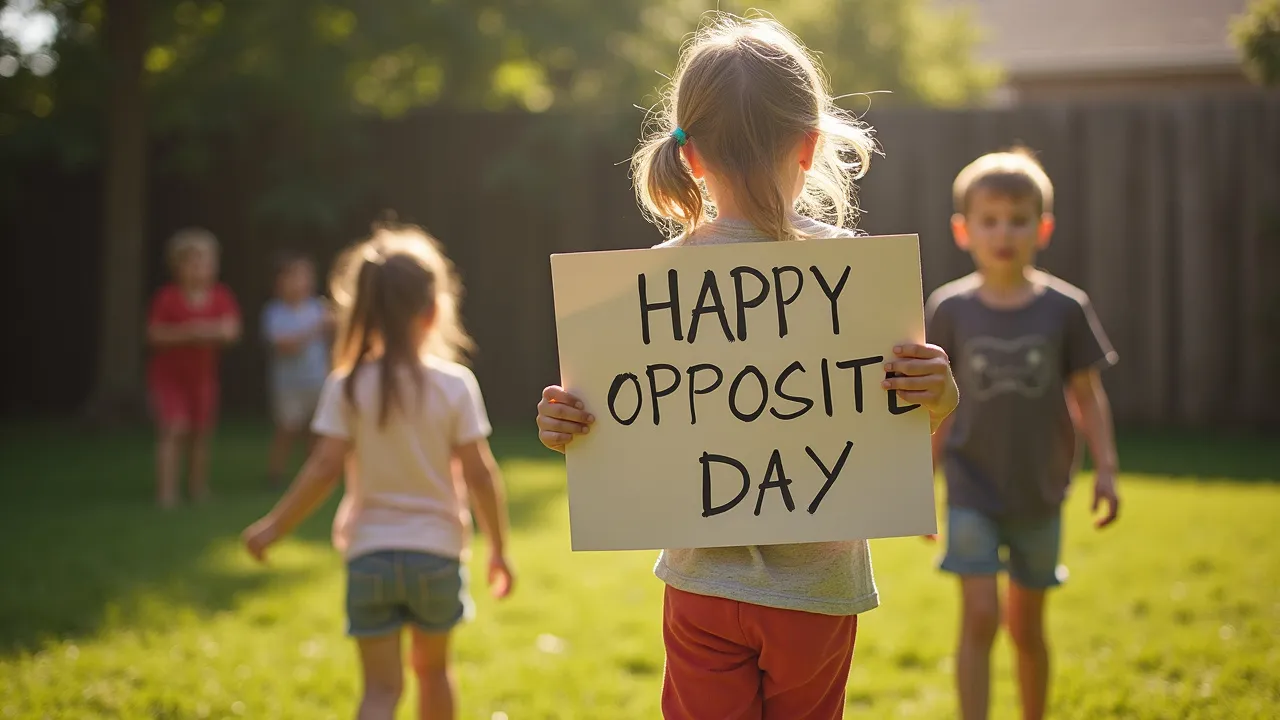
Celebrated on January 25th, Opposite Day is a playful holiday where people say and do the opposite of what they mean. Often observed in schools and among friends, it encourages humor, creativity, and a break from routine.
The Historical Origins & Evolutionary Journey
Opposite Day, observed annually on January 25th, is a whimsical observance with roots that trace back to early 20th-century childhood games and linguistic play. Unlike many formal holidays, Opposite Day lacks a single founder or legislative act, emerging organically from the universal human tendency to invert meaning for humor or emphasis. The first recorded mention appears in a 1928 article in the Pittsburgh Press, where a teacher described students declaring 'It's Opposite Day!' after giving incorrect answers. This suggests the concept was already a familiar playground custom.
The Foundational Catalyst
The concept of inverting language for comedic effect is ancient, but the specific phrase 'Opposite Day' gained traction in North American schools during the 1920s and 1930s. Children would use the phrase as a verbal loophole to take back statements or to engage in playful contradiction. Psychologists note this behavior helps children explore the boundaries of language and social rules. The first known institutional acknowledgment occurred in 1941 when a Wisconsin elementary school hosted an official Opposite Day event, asking students to wear clothes backwards and speak in opposites.
The Evolution of a Playful Tradition
By the 1950s, Opposite Day had spread across the United States through word of mouth and children's literature. Comic strips like Calvin and Hobbes later featured the concept, cementing its place in pop culture. In the 1990s, the holiday gained a fixed date of January 25th through internet meme culture and early online calendars, though some regional variations exist on other dates. The tradition has since evolved into a global internet phenomenon, with social media users participating in reverse challenges and ironic posts.
Modern Global Legacy
Today, Opposite Day is celebrated worldwide, especially in English-speaking countries. It serves as a low-stakes opportunity for social bonding and creative expression. Schools use it to teach irony, perspective-taking, and linguistic flexibility. While not an official holiday, its annual recurrence on January 25th provides a predictable moment for collective playfulness. The day's legacy lies in its simplicity: a reminder that sometimes it's fun to turn the world upside down.
How to Celebrate Opposite Day
Celebrating Opposite Day on January 25th is all about embracing inversion, reversal, and playful contradiction. Whether you're an individual, a family, a school, or a workplace, there are countless ways to participate. Below is the ultimate guide to making the most of this whimsical day.
For Individuals and Friends
- Speak in opposites: Say 'goodbye' when meeting, 'I hate you' when you love a gift, or 'that's boring' for exciting news. The key is to keep a straight face.
- Reverse your schedule: Eat dessert first, have breakfast for dinner, or stay up all night and sleep during the day (if your obligations allow).
- Wear clothing backwards or inside-out: Turn your cap backward, put your shirt on inside-out, or wear mismatched shoes.
- Communicate in reverse: Write messages backward, walk backwards, or read a sentence from right to left.
For Schools and Classrooms
- Organize an Opposite Day lesson plan: Teach math by giving wrong answers intentionally, then have students correct you. Read a story backwards or discuss the opposite of historical events.
- Hold a 'Backwards Spelling Bee': Spell words backwards—e.g., 'hello' becomes 'olleh'.
- Dress-up contest: Award prizes for the most creative opposite outfit, like wearing a swimsuit in winter or pajamas to school.
- Reverse roles: Let students become teachers for a period, delivering a lesson in opposites.
For Organizations and Workplaces
- Fun internal emails: Send announcements that say the opposite of what you mean, e.g., 'Mandatory meeting at 5 PM on Saturday' (meaning it's optional and rescheduled).
- Social media campaigns: Post ironic content, like 'We absolutely hate our customers' (with a smile), encouraging engagement.
- Team building: Hold a 'Reverse Brainstorming' session where you try to make problems worse, then invert solutions.
Global Variations
While January 25th is the primary date, some regions celebrate on different days. In parts of the UK, a similar 'Backwards Day' occurs on the last Friday of January. In Australia, some schools observe 'No Rules Day' on the same date, but with a focus on doing the opposite of school rules. Always check local customs, but the core idea of playful reversal remains universal.
Psychological and Social Impact
Opposite Day may seem like pure frivolity, but psychologists and sociologists recognize its deeper value in human development and social bonding. The act of deliberately inverting language and behavior engages multiple cognitive processes, from perspective-taking to flexible thinking.
Cognitive Benefits
Participating in Opposite Day exercises the brain's ability to handle contradictions. Children who engage in such play often show improved understanding of irony and sarcasm, which are advanced linguistic skills. A 2015 study in the Journal of Pragmatics found that children aged 6-8 who regularly played opposite games scored higher on theory of mind tests. The holiday also encourages divergent thinking—a key component of creativity—by forcing participants to consider alternatives to the norm.
Social Dynamics
Opposite Day creates a temporary 'safe space' for breaking social norms without real-world consequences. This can reduce anxiety about making mistakes and foster stronger group cohesion. In schools, the tradition often becomes a shared ritual that builds collective identity. For adults, participating in the office can lighten workplace culture and improve morale, provided it's done with sensitivity to those who may not wish to join.
Potential Pitfalls
While largely harmless, Opposite Day can cause misunderstandings if taken too far. Some individuals on the autism spectrum, for example, may struggle with the intentional inversion of meaning. It's important to communicate clearly that the day is voluntary and to avoid using opposites in serious contexts like safety instructions. The key is to ensure the day remains inclusive and fun for all.
Opposite Day in Popular Culture
Opposite Day has made numerous appearances in media, reflecting its status as a cultural touchstone. From comic strips to movies, the concept resonates because it taps into universal themes of rebellion and play.
Comics and Cartoons
The most famous depiction is in Bill Watterson's Calvin and Hobbes. In a 1991 strip, Calvin declares Opposite Day to take back a promise, leading to a circular argument with Hobbes. This strip became iconic and is often credited with popularizing the holiday among older audiences. Other comics like Peanuts and Garfield have also referenced the concept.
Television and Film
In the 2006 film John Tucker Must Die, the main characters use Opposite Day as a plot device. TV shows like The Simpsons and SpongeBob SquarePants have dedicated episodes to reverse-world scenarios. The 2012 episode 'Opposite Day' from the series Adventure Time explores a land where everything is inverted, mirroring real-world social norms.
Internet Culture
On social media platforms, Opposite Day trends annually with hashtags like #OppositeDay or #ReverseDay. Memes often feature ironic statements such as 'I love waking up early' or 'This day is terrible' (implying the opposite). The hashtag has been used millions of times on Twitter and Instagram, making it one of the most viral unofficial holidays online. Websites like Know Your Meme track its evolution from simple wordplay to a global internet ritual.
Educational Benefits and Classroom Activities
Teachers have long recognized Opposite Day as a valuable educational tool, not just for fun but for reinforcing key skills in literacy, critical thinking, and social studies.
Language Arts
Opposite Day provides a natural context for teaching antonyms, irony, and figurative language. Activities include:
- Antonym bingo: Create bingo cards with words; call out the opposite, students mark the word.
- Reverse writing: Students write a short story backward, from end to beginning, to understand narrative structure.
- Opposite poetry: Write poems where each line is the opposite of a well-known saying.
Math and Logic
Mathematics can be inverted for engagement:
- Backward math problems: Give answers and have students find the correct operations to reach them.
- Opposite day schedule: Teach time management by planning a day in reverse order.
Social Studies and Critical Thinking
Exploring historical events from opposite perspectives can deepen understanding. For example, debate whether the American Revolution should have been avoided, or discuss the benefits of colonialism (contrary to common teachings). This exercise fosters nuanced thinking and empathy.
Free resources are available on educational websites like Teachers Pay Teachers, where many educators share Opposite Day lesson plans. The key is to balance learning with laughter.
Global Variations and Regional Adaptations
While Opposite Day is most commonly associated with the United States and Canada on January 25th, similar concepts exist worldwide under various names and dates.
United Kingdom and Ireland
In the UK, 'Backwards Day' is often observed on the last Friday of January. Traditions include wearing clothes backwards and speaking in opposites, much like the American version. Some schools hold a 'No Uniform Day' but in reverse—students must wear formal attire instead of casual clothes.
Australia and New Zealand
In Australia, 'Opposite Day' is sometimes combined with 'Australia Day' celebrations on January 26th, creating a long weekend of contradiction. New Zealand has a similar 'Reverse Day' observed on the first Saturday of February, often involving community games where teams compete in backwards events.
Germany and Scandinavia
German-speaking countries have 'Verkehrte Welt' (Upside Down World) day, usually on February 1st. Traditions include children giving orders to adults and reversing meal courses. In Sweden, 'Motsatsernas dag' (Day of Opposites) on January 25th is celebrated with surrealist art displays and comedy shows.
Japan
In Japan, a consumer-focused 'Opposite Day' (逆の日, Gyaku no Hi) occurs on January 25th, promoted by retailers as a day to do the opposite of normal shopping behavior—e.g., buy winter items in summer styles. It has no connection to the Western tradition but shares the name.
Other Regions
In Brazil, 'Dia do Contrário' is celebrated on October 12th alongside Children's Day, with reverse games and language play. Many indigenous cultures have traditions of 'trickster days' that involve role reversal, similar in spirit to Opposite Day. These varied practices show that the desire to invert the ordinary is a near-universal human impulse.
Historical Timeline
The first known printed mention of 'Opposite Day' appears in the Pittsburgh Press, describing a classroom game where children use the phrase to take back wrong answers.
A Wisconsin elementary school holds the first recorded official Opposite Day celebration, with students wearing clothes backwards and speaking in opposites.
Opposite Day spreads across US schools via word of mouth and children's books; it becomes a staple of playground culture.
Bill Watterson's 'Calvin and Hobbes' comic strip features a famous Opposite Day strip, boosting the holiday's pop culture recognition.
Internet forums and early online calendars standardize January 25th as the official date for Opposite Day, leading to global recognition.
The film 'John Tucker Must Die' includes a plotline based on Opposite Day, introducing the concept to a wider movie audience.
The animated series 'Adventure Time' airs an episode titled 'Opposite Day', further cementing the holiday in pop culture.
Opposite Day trends on social media with millions of #OppositeDay posts, becoming one of the most viral unofficial holidays worldwide.