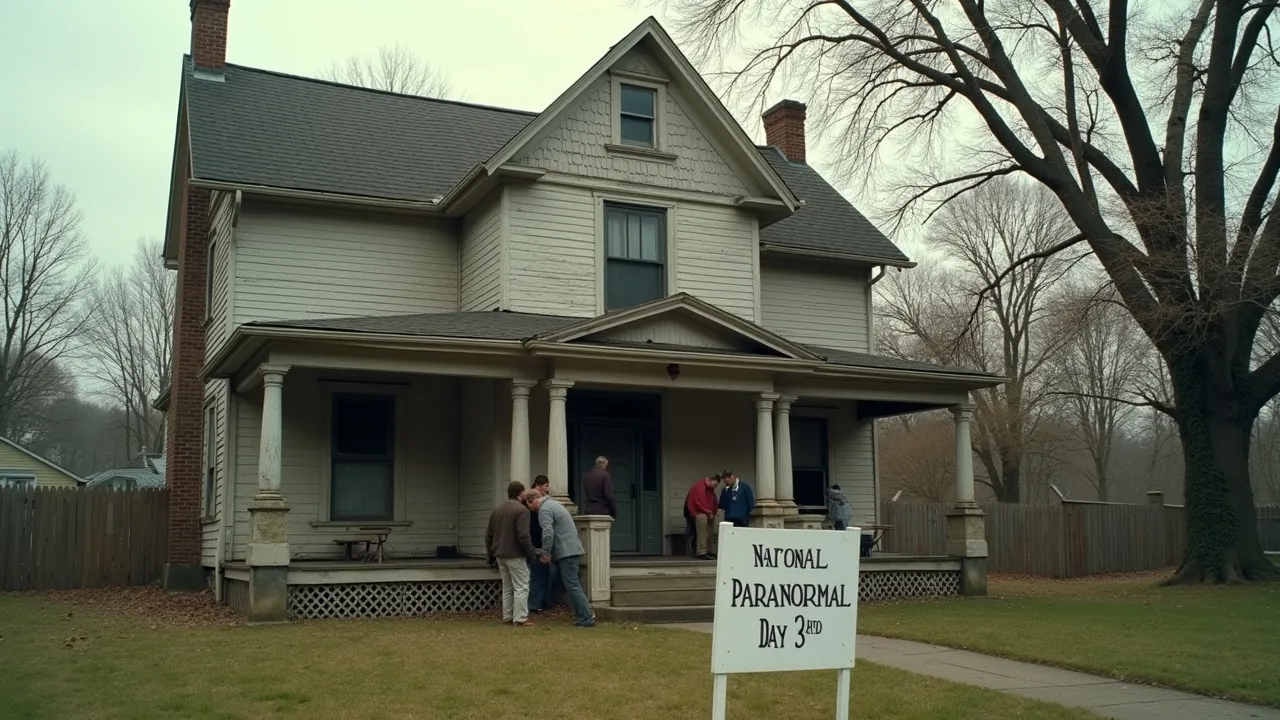
National Paranormal Day on May 3rd celebrates unexplained phenomena and ghostly encounters. Join investigators and enthusiasts in exploring the mysteries of the supernatural through events, research, and storytelling.
The Historical Origins & Evolutionary Journey
National Paranormal Day, observed annually on May 3rd, traces its roots to the growing public fascination with the unknown. Founded in 2014 by a coalition of paranormal investigators and enthusiasts known as the Paranormal Enthusiasts Organization (PEO), the day was established to encourage open-minded exploration of paranormal phenomena while promoting scientific curiosity and respect for cultural traditions.
The Foundational Catalyst
The early 2010s saw a surge in paranormal reality TV shows and ghost-hunting equipment becoming mainstream. The founders sought to create a day that would separate sensationalist entertainment from genuine investigation. They chose May 3rd to coincide with the anniversary of the first recorded paranormal investigation club in the United States, formed in 1952 at Duke University.
Legislative and Official Adoption
While not federally recognized, National Paranormal Day gained traction through social media campaigns and local proclamations. By 2018, over 20 U.S. cities had issued official recognitions. The day has since expanded globally, with events in the UK, Japan, and Brazil, each adding local folklore and traditions.
Modern Global Legacy
Today, National Paranormal Day serves as a platform for serious researchers to share findings, for skeptics to engage in dialogue, and for storytellers to preserve ghost lore. It emphasizes critical thinking, historical context, and the importance of cultural heritage in understanding unexplained experiences.
How to Celebrate National Paranormal Day
National Paranormal Day offers a variety of ways to engage with the paranormal world, from solitary reflection to community events. Below are actionable strategies for individuals, groups, and organizations.
For Individuals
- Read or Research: Dive into classic paranormal literature, such as "The Amityville Horror" or works by Hans Holzer. Explore online databases like the Parapsychological Association archives.
- Visit a Local Haunted Location: Many historic sites offer daytime tours on May 3rd. Always respect property rules and seek permission.
- Conduct a Home Investigation: Use simple tools like a voice recorder for EVP sessions or a compass for electromagnetic fluctuations. Document your findings for personal records.
For Groups and Clubs
- Organize a Ghost Walk: Arrange a guided tour of local landmarks with documented paranormal history. Include a Q&A session with a paranormal investigator.
- Host a Movie Night: Screen classic paranormal films like "Poltergeist" (1982) or "The Others" (2001) and follow with a discussion.
- Workshop on Paranormal Research Methods: Invite a local expert to teach proper use of EMF detectors, infrared cameras, and debunking techniques.
For Schools and Libraries
Educational institutions can organize a Paranormal Day Fair with booths on local folklore, scientific skepticism, and the history of paranormal investigation. Encourage students to write and share their own ghost stories.
Cultural Impact and Global Traditions
National Paranormal Day has evolved into a global phenomenon, with each region adding unique flavors based on local beliefs. In Japan, the day is marked by yokai storytelling sessions and visits to temples known for supernatural encounters. In Brazil, practitioners of Espiritismo hold workshops on mediumship and spiritual communication. The United States sees a mix of ghost tours, paranormal conferences, and even themed escape rooms.
The day also influences pop culture; each year on May 3rd, streaming platforms curate playlists of paranormal documentaries. Social media trends like #ParanormalDay encourage users to share unexplained photos or experiences. Critics argue the day commercializes fear, but proponents highlight its educational value in preserving folklore and promoting historical awareness.
Scientific Perspectives on Paranormal Phenomena
The Research Landscape
Parapsychology, the scientific study of paranormal claims, has existed for over a century. Institutions like the Institute of Noetic Sciences and the Princeton Engineering Anomalies Research (PEAR) lab have conducted experiments on telepathy, psychokinesis, and precognition. However, mainstream science remains skeptical due to reproducibility issues.
Common Explanations
- Psychological Factors: Sleep paralysis, suggestion, and pattern recognition can create illusions of ghostly encounters.
- Environmental Causes: Infrasound, mold toxins, and electromagnetic fields have been linked to sensations of presence.
- Cultural Conditioning: Many experiences are shaped by cultural narratives and popular media.
National Paranormal Day encourages a balanced view, welcoming both believers and skeptics to engage in respectful dialogue.
Ethical Considerations and Responsible Investigation
With popularity comes responsibility. The day promotes ethical guidelines for paranormal investigation: always obtain permission before entering private property, avoid disturbing historical artifacts, and respect the beliefs of others. Misleading claims or staged evidence harm the credibility of the field. The Paranormal Enthusiasts Organization provides a code of conduct emphasizing integrity, transparency, and respect for cultural heritage.
Educational components of the day focus on critical thinking, teaching participants to differentiate between natural phenomena and genuine anomalies.
Notable Paranormal Cases and Their Legacy
National Paranormal Day often revisits iconic cases that shaped the field.
- The Enfield Poltergeist (1977): One of the most documented poltergeist cases in England, later scrutinized for potential hoax elements.
- Amityville Horror (1975): A case that sparked a media frenzy and multiple books/films, later disputed by investigators.
- Zener Cards Experiments (1930s): J.B. Rhine's early parapsychology studies at Duke University, which remain controversial.
These cases serve as teaching tools for understanding evidence evaluation and the interplay between media and paranormal belief.
Historical Timeline
Spiritualism movement peaks in the United States with the Fox Sisters, who claimed to communicate with spirits through rapping sounds.
Society for Psychical Research founded in London, one of the first organizations to scientifically investigate paranormal claims.
J.B. Rhine establishes the Parapsychology Laboratory at Duke University, pioneering statistical research on ESP.
The Enfield Poltergeist case begins in London, drawing extensive media coverage and investigation by the Society for Psychical Research.
The concept of 'National Paranormal Day' is first proposed in an online forum, though not officially adopted.
Paranormal Enthusiasts Organization officially establishes National Paranormal Day on May 3rd, with initial events in four U.S. cities.
Paranormal Day gains international recognition with events in the UK, Japan, and Australia, and over 50 U.S. cities issuing proclamations.
National Paranormal Day partners with the Society for Psychical Research to launch a global 'Ghost Census' project, collecting anonymous reports of unexplained experiences.