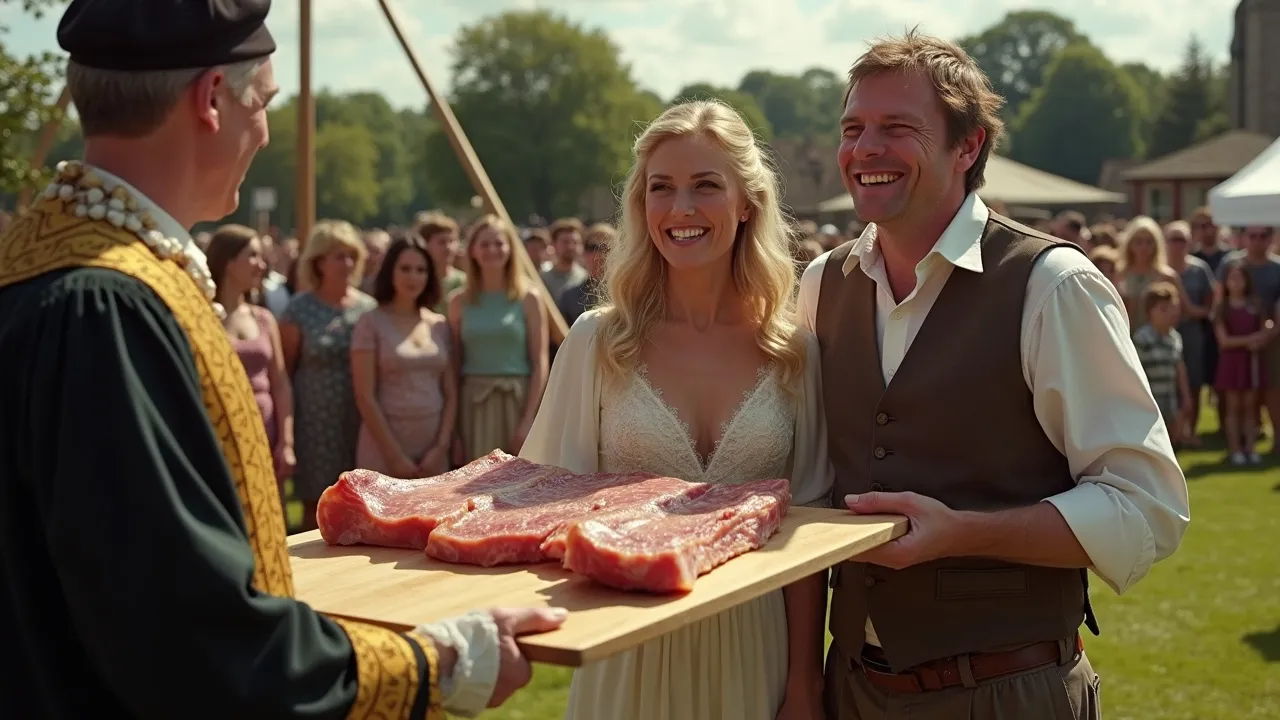
Flitch Day, observed on July 19th, celebrates the ancient English tradition of awarding a flitch of bacon to married couples who prove a year and a day of marital harmony. Originating from the Dunmow Flitch trial, it promotes fidelity and community spirit.
The Historical Origins & Evolutionary Journey
Flitch Day, tied to the legendary Dunmow Flitch trial, is a centuries-old English custom rooted in medieval matrimonial ideals. The tradition promises a side of bacon—a flitch—to any couple who can swear before a jury that they have not quarreled or regretted their marriage for a year and a day.
The Foundational Catalyst
The earliest recorded reference dates to 1104, when the Prior of Dunmow, Robert Fitzwalter, allegedly offered a flitch to encourage marital fidelity. However, the first documented trial occurred in 1445, when a couple named Richard and Katherine Wright claimed the prize. The custom was enshrined in local folklore and became a periodic event in Great Dunmow, Essex.
The Legislative/Official Adoption
By the 18th century, the trial had faded, but a revival in 1751 sparked renewed interest. The event was formalized with a wooden bench and jury. In 1855, a more structured ceremony was established by the local vicar, and the trial became a quadrennial highlight. Official rules were codified, requiring claimants to kneel on pointed stones and recite an oath.
Modern Global Legacy
Today, Flitch Day is celebrated not only in Dunmow but also in other parts of the UK and abroad. The trial remains a symbol of marital harmony, attracting couples from around the world. In 2008, the event was recognized by the Guinness World Records as the longest-running marital contest.
How to Celebrate Flitch Day
Flitch Day offers a range of celebratory activities for individuals, couples, and communities. Here are actionable strategies to embrace the spirit of the day.
For Couples
- Take the Flitch Vow: Spend the day reflecting on your relationship. Write a pledge to avoid quarrels for a year and a day.
- Cook a Bacon Feast: Prepare a traditional English breakfast or a dish highlighting bacon, such as bacon-wrapped dates or a flitch roast.
- Attend a Local Trial: If near Dunmow, attend the quadrennial trial. Check local listings for reenactments elsewhere.
For Schools and Communities
- Host a Medieval Faire: Organize a fete with period costumes, maypole dancing, and a mock flitch trial.
- Educational Workshops: Teach children about the history of marriage customs and the role of bacon in medieval economy.
- Bacon Recipe Contest: Invite participants to submit their best bacon dish for judging.
Corporate and Social Rituals
- Team Building: Encourage employees to share stories of partnership and teamwork, akin to the marital bond.
- Charity Bacon Drive: Donate bacon or funds to local food banks in the name of harmony.
The Dunmow Flitch Trial: Ceremony and Traditions
The centerpiece of Flitch Day is the trial itself, steeped in ritual and symbolism.
The Oath
Claimants must swear on a Bible that they have not regretted their marriage or had a domestic quarrel for a year and a day. The oath is administered by a robed steward.
The Jury
A jury of six bachelors and six maidens—or sometimes married couples—adjudicates the claims. They question the couple and listen to testimonies from neighbors.
The Prize
A flitch of bacon (cured side of pig) is presented on a wooden board, along with a ceremonial kiss and a certificate. The couple is often carried around the town on a chair.
Historical Artifacts
The original flitch trial chair, dating from the 18th century, is preserved in Dunmow. It features iron spikes on the seat to test the couple's sincerity.
Flitch Day Around the World
Though rooted in England, Flitch Day has inspired similar customs globally.
United States
In the 20th century, some American towns adopted flitch trials as a novelty. The town of Ipswich, Massachusetts, held a contest in the 1930s, awarding bacon to long-married couples.
Canada
Canadian communities, particularly in Ontario, have hosted flitch-style events as part of heritage festivals, often substituting bacon with local ham.
Australia
In Victoria, a flitch trial was held during the 150th anniversary of the gold rush, emphasizing marital endurance.
Ireland
Irish variations replace bacon with a side of corned beef, reflecting local cuisine.
Cultural Impact and Literary References
The Dunmow Flitch has permeated English literature and culture for centuries.
Chaucer and Chaucerians
Geoffrey Chaucer referenced the flitch in his Canterbury Tales ('The Wife of Bath's Tale'), though apocryphally. Later poets like John Gay and Robert Southey wrote verses about the custom.
Stage and Screen
In the 18th century, a play titled The Flitch of Bacon by John Till Allingham was a London hit. More recently, the event has been featured in BBC documentaries and local news.
Proverbs
The phrase 'bring home the bacon' is often linked to the flitch tradition, though its etymology is debatable. The custom also inspired the saying 'a flitch of matrimony' for a harmonious marriage.
Modern Revival and Contemporary Observances
In recent decades, Flitch Day has experienced a resurgence, driven by nostalgia and heritage tourism.
The 1951 Revival
After a hiatus during the wars, the trial was revived in 1951 as part of the Festival of Britain. It has been held every four years since, attracting thousands of spectators.
Digital Age
Social media has spread the tradition, with couples sharing their 'flitch-worthy' stories online. Virtual flitch trials were held during the pandemic.
Tourism Impact
The event boosts local economy, with hotels and pubs in Dunmow reporting full bookings. The flitch is now a protected heritage practice under English custom.
Symbolism of the Flitch of Bacon
The flitch itself carries deep symbolic meaning beyond mere food.
Abundance and Sustenance
Bacon, a staple of medieval diet, represented prosperity. The gift of a flitch symbolized the community's support for the couple's future together.
Purity and Preservation
Cured bacon, able to last without refrigeration, mirrored the enduring nature of a relationship free from conflict.
Community Bonding
The public trial and feast reinforced social cohesion, reminding all that marriage is a communal concern.
Historical Timeline
Legend holds that Robert Fitzwalter, the Prior of Dunmow, established the flitch of bacon custom to promote marital harmony.
First recorded trial: Richard and Katherine Wright successfully claim the flitch, as documented in local parish records.
Poet John Gay publishes 'The Flitch of Bacon', a ballad that popularizes the tradition across England.
Revival of the trial after a period of decline; a new wooden chair with spikes is introduced for claimants.
Formal ceremony established by Reverend Charles Stephens; trial held every four years thereafter.
Trial suspended due to World War I; not held again until 1920.
Flitch trial revived as part of the Festival of Britain, drawing international media attention.
900th anniversary of the tradition celebrated with a special trial and festival in Dunmow.
Due to COVID-19, a virtual flitch trial is held via video conference, with a symbolic bacon prize mailed to winners.