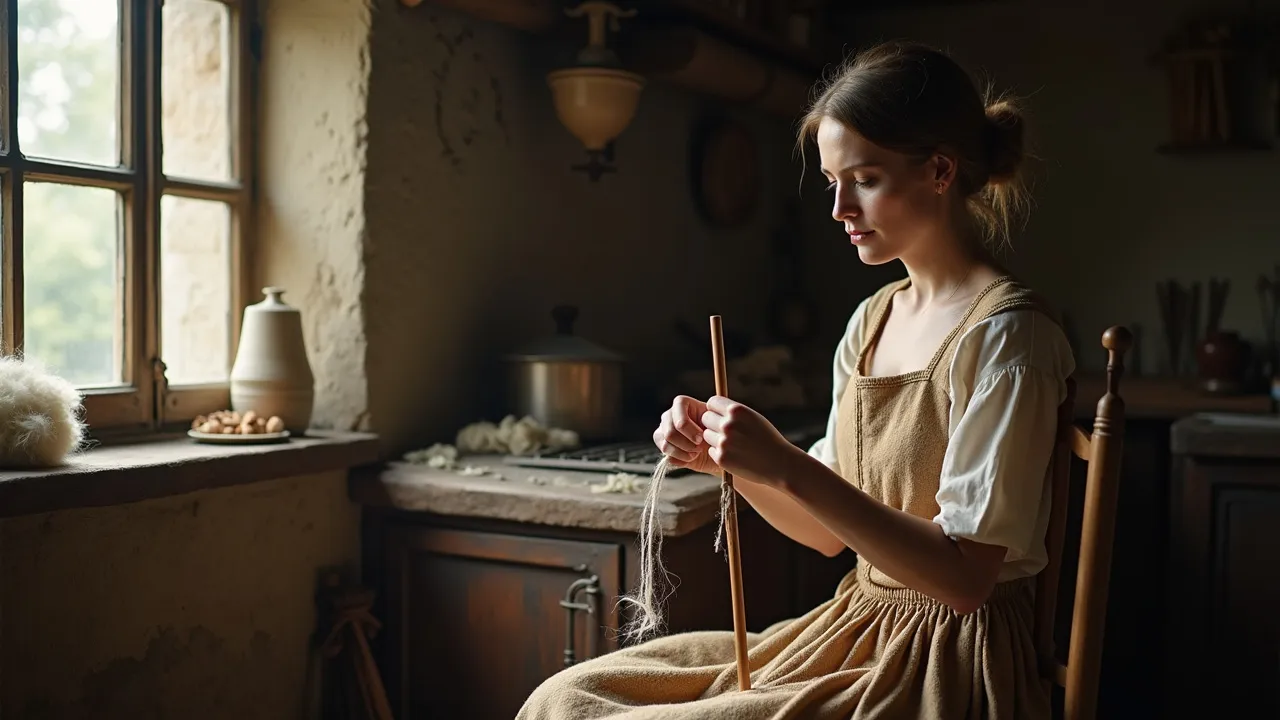
Distaff Day, observed on January 7th, marks the traditional end of the Christmas season and the resumption of women's spinning work. Rooted in medieval European folk customs, it celebrates the distaff, a symbol of female industry and domestic labor.
The Historical Origins & Evolutionary Journey
Distaff Day, falling on January 7th, is the first day after the Twelve Days of Christmas (Epiphany) and traditionally marked the resumption of women's work, particularly spinning. The term 'distaff' refers to the staff used to hold fibers like wool or flax for spinning. In medieval Europe, Christmas festivities ended on Twelfth Night (January 5th or 6th), and the next day, men returned to the fields (Plough Monday) while women returned to their spinning. Distaff Day was thus a day of mixed celebration and duty.
The Foundational Catalyst
The origin lies in agrarian calendars: after the long winter break, communities needed to restart production. Spinning was a year-round task, but the Christmas period was a rare respite. Distaff Day served as a psychological and practical transition. Folk customs included 'distaff-wetting'—men would surreptitiously wet the women's distaffs to tease them, and women would retaliate by throwing water on the men. This gender-based jesting mirrored Plough Monday's male antics.
The Legislative/Official Adoption
Distaff Day never had formal legislative backing; it was a customary observance. However, it appears in early English literature, such as Robert Herrick's poem 'The Star Song' (1648) and references in the works of John Aubrey. In many regions, it was unofficially known as 'St. Distaff's Day,' a pseudo-saint's day, though no actual Saint Distaff exists. The name 'Rock Day' comes from the Old English 'rock' meaning distaff.
Modern Global Legacy
With the Industrial Revolution, home spinning declined, and Distaff Day faded from mainstream practice. However, it has seen a revival among historical reenactors, textile artists, and neopagan communities. In some Catholic and Anglican traditions, January 7th is still observed as the end of the Christmas season. Modern celebrations focus on handicrafts, spinning demonstrations, and women's work heritage. The day also serves as a reminder of the hidden labor that sustained pre-industrial households.
How to Celebrate Distaff Day
Distaff Day can be celebrated in numerous ways that honor its historical roots and promote handcraft skills. Below is a definitive guide for individuals, schools, and organizations.
Individual and Family Traditions
- Spinning or Fiber Arts: Try your hand at spinning using a drop spindle or spinning wheel. Even knitting or crocheting qualifies as a nod to the day.
- Distaff Wetting Ceremony: Reenact the playful tradition: wet a distaff (or a symbolic stick) and gently tease family members. Use water pistols for fun.
- Host a 'Rock Day' Potluck: Invite friends to share food and stories about women's work. Each guest can bring a handmade item.
School and Educational Activities
- History Lesson: Teach students about medieval life, the role of spinning, and the division of labor by gender.
- Fiber Arts Workshop: Organize a drop-spindle workshop with local spinners. Provide wool roving.
- Museum Visit: Take a field trip to a living history museum that demonstrates spinning.
Organizational and Corporate Rituals
- Wear Handmade Clothes Day: Encourage employees to wear something knitted, woven, or crocheted.
- Charity Drive: Collect handspun or knitted items for local shelters.
- Team-Building Craft Session: Offer a lunch-hour spinning introduction.
Internationally, variations exist: in some parts of the UK, January 7th is also 'Plough Monday' (first Monday after Twelfth Night), and men drag a plow through the village. Distaff Day is sometimes merged with Plough Monday festivities. In Scandinavia, similar traditions called 'Tjugondag Knut' (Twentieth Day Christmas) on January 13th include parties and dismantling decorations.
Global Impact and Cultural Significance
Though largely unknown today, Distaff Day influenced the calendar of women's work across Europe. It represents a rare moment when women's labor was publicly acknowledged. The term 'distaff' itself became a metonym for women's work or the female line in genealogy (as opposed to 'spear side' for men). In folklore, the day symbolized the transition from festive leisure to productive labor. Modern gender studies use Distaff Day to highlight how seasonal rhythms shaped gender roles. Additionally, the revival of interest in slow fashion and sustainable textiles has brought attention to traditional spinning techniques. Events like 'Worldwide Knit in Public Day' echo the communal spirit of Distaff Day.
In literature, Thomas Hardy's novel The Return of the Native references Distaff Day customs. The day also appears in the song 'St. Distaff's Day' by the group 'The Watersons.'
Core Societal Themes and Symbolism
Distaff Day embodies several themes:
- Gender Roles: It explicitly demarcated women's work from men's work (Plough Monday). Modern interpretations examine how these roles evolved.
- Cycle of Labor and Rest: It reinforced the necessity of downtime and the return to productivity after holidays.
- Community Bonds: The playful water-fights and communal spinning bees strengthened social ties.
- Resilience of Craft: Spinning is a meditative, skilled practice that connects makers to history.
Symbols of Distaff Day
The distaff itself is the primary symbol. Other symbols include fleece, wool roving, drop spindles, and water (representing the wetting ritual). The colors often associated are natural wool tones (cream, brown) and blues or greens (traditional spinning dress).
Regional Variations and Related Observances
Distaff Day's primary date is January 7th, but variations exist:
- Plough Monday: In England, the first Monday after Epiphany (often January 7th or later) is Plough Monday, when men pulled a plow and collected money. Distaff Day sometimes merged with it.
- Rock Day: In some parts of northern England and Scotland, January 7th was called Rock Day or 'Rox' Day.
- Handsel Monday: In Scotland, the first Monday of the old New Year (January 13th) was a day for gifts and starting work.
- St. Knut's Day: In Sweden and Finland, January 13th (Tjugondag Knut) marks the end of Christmas with tree-plundering parties.
Industry Transformations and Modern Relevance
The decline of home spinning in the 19th century led to the near extinction of Distaff Day. However, the 21st century has seen a resurgence of interest in handcrafts as a reaction against fast fashion. Spinning guilds, fiber festivals, and online communities (e.g., Ravelry) celebrate Distaff Day with virtual events. The day is now often used by textile museums and historical societies for special programs. In the context of sustainable living, the day promotes self-sufficiency and slow fashion. Some feminist circles reinterpret Distaff Day as a celebration of women's historical contributions to the economy and family.
The craft beer industry has also tapped into the term—several breweries produce 'Distaff Ale' for the day. Moreover, the word 'distaff' is used in horse racing to denote the female line of a pedigree, showing its enduring linguistic legacy.
Historical Timeline
First recorded references in English folk tradition: Distaff Day established as the day after Epiphany when women resumed spinning.
Robert Herrick's poem 'The Star Song' mentions 'St. Distaff's Day,' cementing the term in literature.
John Aubrey writes about Distaff Day customs in his 'Remaines of Gentilisme and Judaisme,' describing water-throwing rituals.
Industrial Revolution nearly eliminates home spinning; Distaff Day begins to fade from common practice.
Revival of interest in traditional crafts and folk customs; historical reenactments of Distaff Day begin in England.
Online craft community Ravelry launches, featuring Distaff Day events and challenges among users.
Virtual Distaff Day celebrations grow due to pandemic, with spinners sharing videos and tutorials online.