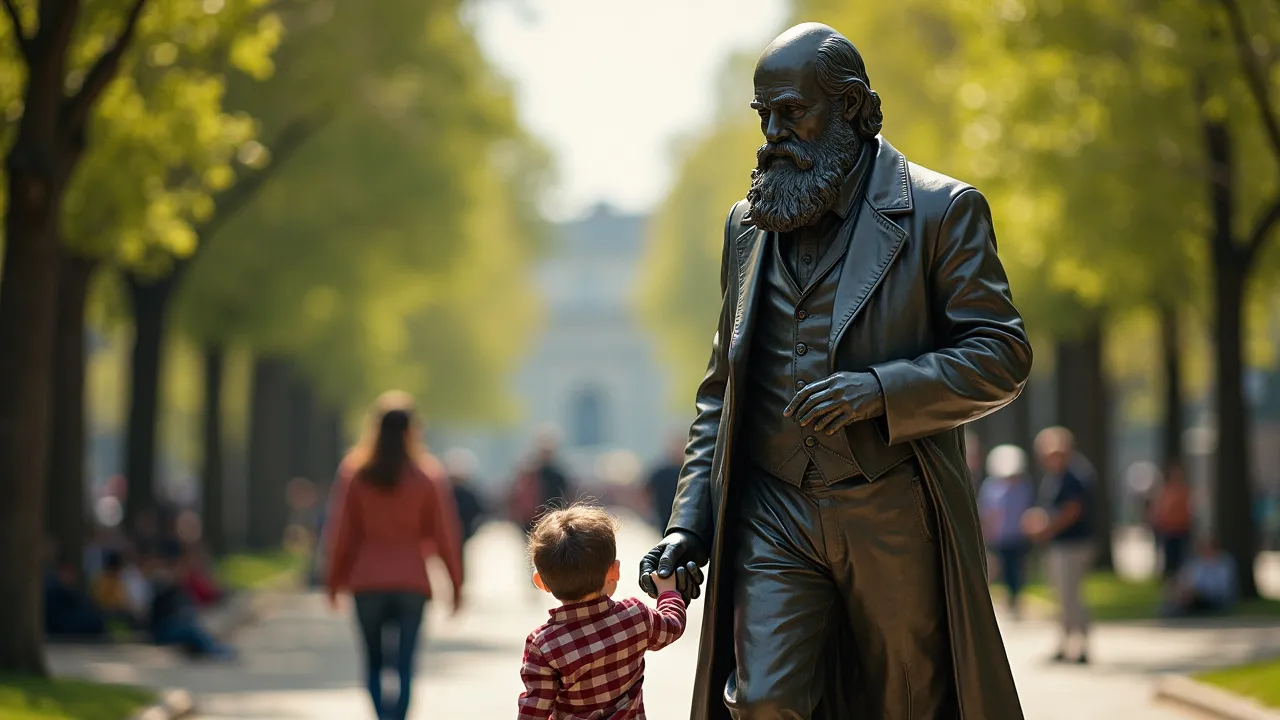
Darwin Day, observed on February 12th, honors the birth of Charles Darwin and celebrates his contributions to evolutionary biology. It promotes scientific inquiry, critical thinking, and the appreciation of natural science.
The Historical Origins & Evolutionary Journey
The Foundational Catalyst
Charles Darwin was born on February 12, 1809, in Shrewsbury, England. His seminal work, On the Origin of Species (1859), introduced the theory of evolution by natural selection, fundamentally altering the scientific worldview. Darwin's meticulous observations during the HMS Beagle voyage (1831-1836) provided the empirical foundation for his theories.
The Legislative/Official Adoption
The push for an official day began in the 1990s, led by Dr. Robert Stephens of the Humanist Community. In 1995, the first public Darwin Day events were organized. Over time, resolutions were introduced in various state legislatures in the U.S. In 2001, a resolution was introduced in the U.S. House of Representatives (H.R. 540) but did not pass. Nonetheless, many states and municipalities now issue proclamations. Internationally, the United Nations Educational, Scientific and Cultural Organization (UNESCO) has recognized the day.
Modern Global Legacy
Today, Darwin Day is celebrated in over 50 countries through lectures, museum exhibits, debates, and educational activities. It has become a rallying point for science advocates and a day to counter misinformation about evolution. The celebration continues to grow, especially in academic and humanist communities.
How to Celebrate Darwin Day
For Individuals
Celebrate by reading about evolution, watching documentaries, or visiting natural history museums. Share facts about Darwin on social media using #DarwinDay.
For Schools & Educators
- Organize classroom activities about natural selection.
- Host a film screening of The Voyage of the Beagle or Inherit the Wind.
- Invite speakers from local universities.
For Organizations & Corporations
- Host a science fair or hackathon focused on biological research.
- Donate to evolutionary biology programs.
- Issue a press release highlighting contributions to science.
Global Variations
In the UK, events are held at Down House, Darwin's home. In the U.S., many secular and humanist groups host Darwin Day dinners. In Australia, evolutionary biology talks are common. In recent years, online events have enabled global participation.
The Impact of Darwin's Theory on Science and Society
Scientific Revolution
Darwin's theory unified biology, providing a mechanism for the diversity of life. It influenced fields from genetics to ecology, and even psychology through evolutionary psychology.
Societal Influence
The concept of 'survival of the fittest' (coined by Herbert Spencer) was misapplied in social Darwinism, but modern understanding distinguishes biological evolution from social policy. Darwin's work also challenged religious doctrines, sparking ongoing debates between science and faith.
Modern Applications
Today, evolutionary principles are used in medicine (antibiotic resistance), agriculture (crop breeding), and conservation biology. Darwin Day underscores the continued relevance of his ideas.
Controversies and Misconceptions About Evolution
Common Misconceptions
- "Evolution is just a theory" - In science, a theory is a well-substantiated explanation. Evolution is a fact supported by overwhelming evidence.
- "Humans evolved from monkeys" - Humans and apes share a common ancestor; we did not evolve from modern apes.
- "Evolution violates the Second Law of Thermodynamics" - The Second Law applies to isolated systems; Earth is not isolated as it receives energy from the sun.
Controversies
Creationism and intelligent design have been promoted as alternatives, but they lack empirical support. The Scopes Trial (1925) and Kitzmiller v. Dover (2005) are landmark legal cases that upheld the teaching of evolution in U.S. schools. Darwin Day often serves as a platform to defend science education.
Darwin Day in Education: Promoting Science Literacy
Classroom Resources
Teachers use Darwin Day to introduce natural selection activities, such as simulating peppered moth populations or analyzing finch beak adaptations. Many lesson plans are available from the National Center for Science Education.
Public Outreach
Museums and universities host open houses with fossil displays and DNA workshops. Online platforms like evolution.berkeley.edu provide interactive tutorials. Darwin Day is a key date for evolutionary biology outreach globally.
Future of Darwin Day: Growing Recognition
Legislative Progress
Efforts to make Darwin Day a national holiday in the U.S. continue through resolutions. In 2021, a new bill (H.R. 540) was reintroduced. Internationally, several countries have declared it a day of science.
Expanding Celebrations
With the rise of secularism and science advocacy, Darwin Day events are increasing. The day is also used to promote climate change awareness and biodiversity conservation, linking evolution to current environmental challenges. The future likely includes more digital and interactive celebrations.
Historical Timeline
Charles Darwin born on February 12 in Shrewsbury, England.
Darwin serves as naturalist on HMS Beagle, gathering key observations.
Publication of 'On the Origin of Species'.
Darwin dies and is buried in Westminster Abbey.
First official Darwin Day events organized by the Humanist Community.
U.S. House of Representatives introduces resolution H.R. 540 for Darwin Day.
Darwin Day celebrated in over 50 countries; UNESCO acknowledges the day.