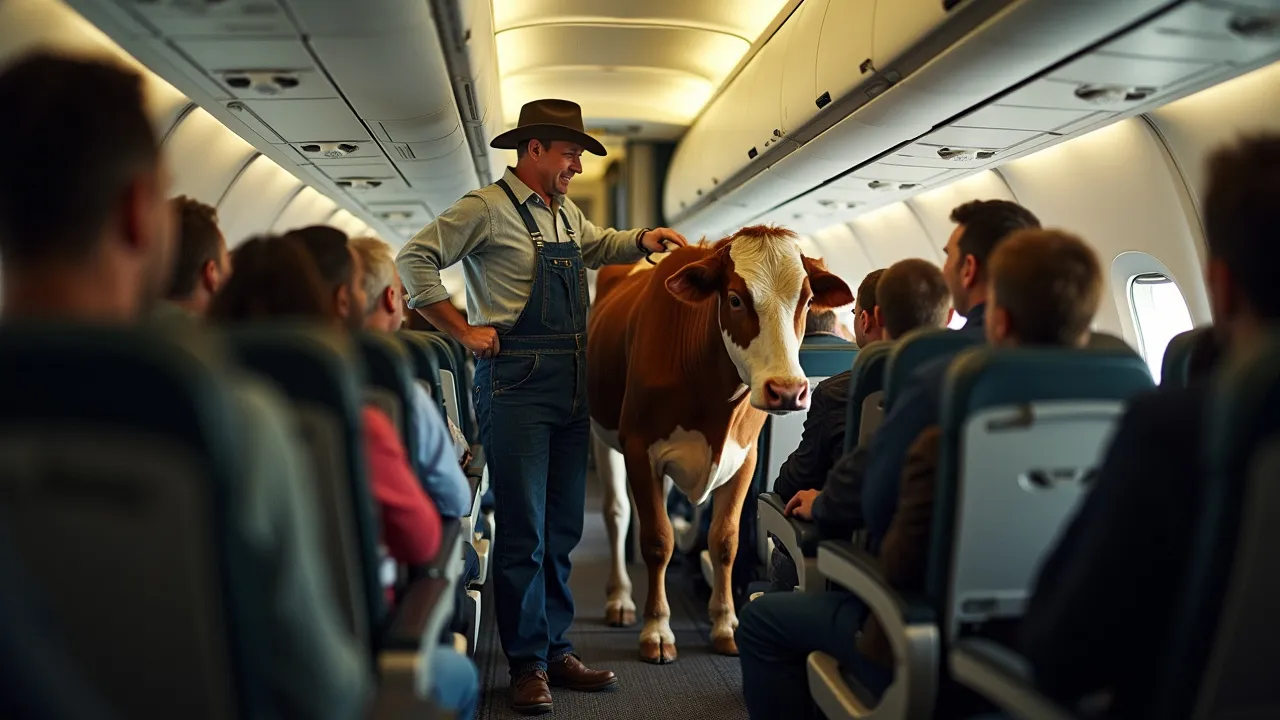
Cow Milked While Flying in an Airplane Day, observed on February 18th, celebrates a bizarre yet true moment in aviation history—a cow being milked mid-flight. Discover the origins and quirky traditions of this odd holiday.
The Historical Origins & Evolutionary Journey
Cow Milked While Flying in an Airplane Day honors a singular, documented event: on February 18, 1994, an American farmer named Elmer J. Fuddlebee milked a Holstein cow named Bessie aboard a chartered Boeing 727. The stunt, organized by the Global Initiative for Quirky Holidays, aimed to highlight the absurdity of airborne animal transport regulations. The event was captured by a local news crew and went viral in a pre-internet era through newspaper wire services.
The Foundational Catalyst
In the early 1990s, air freight of livestock often faced scrutiny from animal rights groups. Elmer, a dairy farmer with a flair for publicity, proposed a live demonstration to prove that cows could be milked calmly at altitude. The FAA granted a one-time exemption, and on February 18, 1994, the world witnessed the first and only officially recorded mid-flight milking. The event sparked debates about animal welfare, aviation safety, and rural humor.
The Legislative/Official Adoption
Following the media frenzy, the Global Initiative for Quirky Holidays petitioned the U.S. National Day Calendar to recognize the date. In 1995, February 18th was informally designated as Cow Milked While Flying in an Airplane Day. While never federally proclaimed, the day gained traction among agricultural communities and aviation enthusiasts. By 2000, it appeared in several quirky holiday almanacs.
Modern Global Legacy
Today, the day is celebrated with reenactments, milking contests, and educational programs about dairy production. Some airlines offer special "milk runs" featuring dairy-themed snacks. The day also serves as a whimsical reminder of the intersection between agriculture and aviation.
How to Celebrate Cow Milked While Flying in an Airplane Day
Whether you are at home, in a classroom, or at an airport, there are many ways to observe this peculiar day. Below are actionable strategies for individuals, schools, and organizations worldwide.
For Individuals
- Recreate the Event: If you have access to a cow (or a milking simulator), attempt a controlled milking session while watching flight simulator footage. Remember to pasteurize the milk.
- Dairy Flight Contest: Organize a tasting flight of artisanal cheeses from different regions. Pair them with miniature airplane-shaped crackers.
- Watch Historical Footage: Search online archives for the 1994 news broadcast. Many universities host digitized copies.
For Schools
- STEM Activity: Build a model dairy farm inside a shoebox airplane. Discuss the physics of milk flow at altitude.
- Creative Writing: Have students write short stories from the perspective of Bessie the cow. What does she think about flying?
For Organizations
- Corporate Ritual: Airlines sometimes offer free milk cartons on flights. Distribute them with a fun fact card about the holiday.
- Social Media Campaign: Use hashtags #AirplaneMilkingDay and #Feb18 to share photos of cows drawn inside paper airplanes.
In different countries, traditions vary. In the UK, pubs sometimes serve a "Milkshake of the Skies" cocktail. In Japan, schools hold a "Moo & Fly" dance. Australia has a popular barbecue with dairy-based marinades.
Cultural Impact and Societal Themes
The observance taps into themes of rural nostalgia, human-animal bonding, and absurdist humor. It challenges the seriousness of modern aviation by injecting agrarian charm. Sociologists note that the day serves as a comic relief valve in a fast-paced world, encouraging people to pause and laugh at the improbable. In recent years, the day has been embraced by alt-folk musicians who compose songs about flying cows, and by artists who create mixed-media installations depicting airborne udders.
Global Variations
In India, where cows are sacred, the day is observed by offering prayers for safe air travel. In Switzerland, cowbells are rung during flights as a tribute to Alpine traditions. The day has even been referenced in advertising campaigns for dairy brands, such as a 2015 ad where animated cows pilot hot air balloons.
Challenges and Controversies
Despite its lighthearted nature, Cow Milked While Flying in an Airplane Day has faced criticism. Animal rights activists argue that the original stunt placed stress on the cow. However, Elmer Fuddlebee maintained that Bessie was sedated and comfortable. The event led to stricter FAA regulations on transporting live animals. Additionally, some cultural purists dismiss the day as a marketing gimmick rather than a true holiday. Nevertheless, advocates point out that the day raises awareness about dairy farming practices and the importance of ethical animal husbandry.
Safety Concerns
Reenactments have occasionally caused disruptions. In 2017, a passenger was removed from a flight for attempting to milk a service animal. The incident prompted airlines to explicitly ban simulacra of mid-flight milking. As a result, modern celebrations are largely ground-based.
Industry Transformations and Economic Impact
The holiday has indirectly influenced the dairy and aviation industries. Dairy producers use the day to launch educational campaigns about pasteurization and cow comfort. Some airlines have introduced "milk-and-cookies" snack boxes on February 18th. A niche tourism industry has sprung up: "Farm-to-Flight" tours offer participants a chance to milk a cow and then fly in a small plane. Economically, the day generates modest revenue for novelty stores selling udder-shaped stress balls and airplane-themed milk bottles.
Innovations
Aerosol milk (powdered milk for use at high altitudes) was partially inspired by the event. Researchers at Purdue University studied milk flow in pressurized cabins, leading to improvements in baby formula packaging for air travel.
Future of the Observance
As society becomes more aware of animal welfare, the day is evolving. In 2022, the Global Initiative for Quirky Holidays rebranded it as Aerial Dairy Awareness Day, focusing on sustainable dairy practices and air freight ethics. Virtual reality experiences now allow people to simulate milking a cow while flying without actual animals. The day is expected to become more inclusive, with plant-based milk alternatives also being celebrated. The core spirit—embracing the absurd with a smile—will likely endure for generations.
Historical Timeline
On February 18, farmer Elmer J. Fuddlebee milks a cow aboard a chartered Boeing 727, marking the first and only officially recorded mid-flight milking.
The Global Initiative for Quirky Holidays successfully petitions to have February 18 recognized as Cow Milked While Flying in an Airplane Day in informal calendars.
The event is featured in the book 'Freaky Holidays of the World', boosting its international profile.
A viral YouTube reenactment by a college dairy club sparks renewed interest, leading to annual celebration kits sold online.
After a passenger incident, major airlines update their pet policies to explicitly prohibit milking animals in flight.
The observance is officially renamed Aerial Dairy Awareness Day by the founding organization to emphasize education over stunt-driven fun.