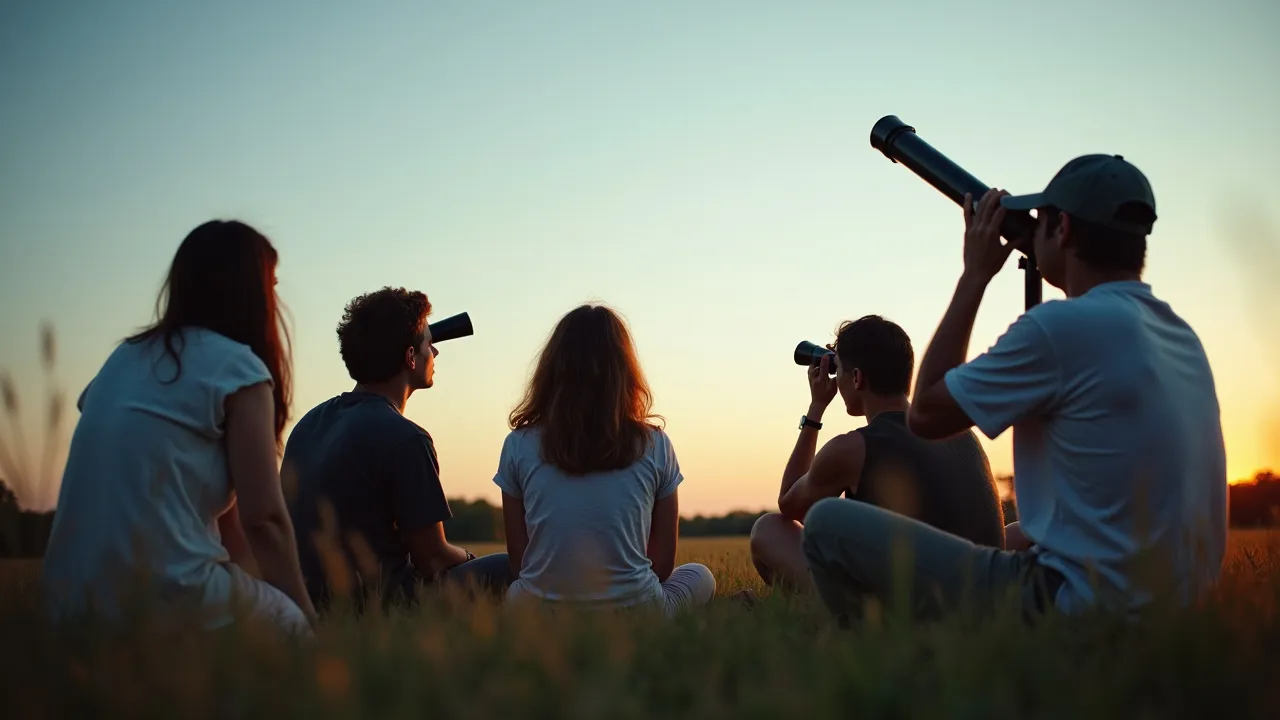
World UFO Day, observed on July 2nd, encourages global curiosity about unidentified flying objects and extraterrestrial life. It commemorates the 1947 Roswell incident and promotes open-minded scientific inquiry.
The Historical Origins & Evolutionary Journey
The Foundational Catalyst
World UFO Day's roots lie in the Roswell incident of July 2, 1947, when an unidentified object crashed on a ranch near Roswell, New Mexico. The U.S. military initially reported capturing a "flying disc," then quickly retracted, claiming it was a weather balloon. This contradiction fueled public suspicion and became a cornerstone of UFO lore. Over subsequent decades, the incident inspired countless investigations, documentaries, and a lasting cultural fascination with extraterrestrial visitations.
The Legislative/Official Adoption
In 2001, the World UFO Day Organization (WUFODO) officially declared July 2 as World UFO Day, aiming to encourage governments to declassify UFO files and promote scientific study. The date was chosen to honor the Roswell incident's anniversary, while an alternative observance on June 24th commemorates Kenneth Arnold's 1947 sighting over Mount Rainier—often cited as the first modern UFO report. The June 24th variant is more popular in some regions, but July 2 remains the primary global date.
Modern Global Legacy
Today, World UFO Day serves as a platform for ufologists, skeptics, and the curious to share evidence, host sky-watching events, and advocate for transparency. Governments including the UK, France, and the US have released declassified UFO reports, partly driven by public pressure amplified through this observance. The day also fosters interdisciplinary dialogue between astronomers, historians, and intelligence analysts.
How to Celebrate World UFO Day
World UFO Day offers diverse ways to engage, from solitary stargazing to community events. Below are actionable strategies for individuals, schools, and organizations.
Individual Celebrations
- Night Sky Observation: Use telescopes or binoculars to scan for unusual aerial phenomena. Document sightings with photos or notes.
- UFO Documentary Marathon: Watch trusted documentaries like The Phenomenon (2020) or Unacknowledged (2017).
- Read Declassified Files: Explore government UFO archives from the CIA, NSA, or UK Ministry of Defence.
School & Community Events
- Sky-Watch Party: Organize a local gathering at a park. Provide telescopes, star maps, and expert speakers.
- UFO Art & Essay Contest: Encourage creative expression about extraterrestrial possibilities.
- Guest Lectures: Invite astronomers or ufologists to discuss scientific perspectives.
Corporate & Organizational Involvement
- Transparency Campaigns: Advocate for further declassification of UFO records through petitions or social media.
- Research Funding Drives: Support nonprofit organizations like the SETI Institute or the Mutual UFO Network (MUFON).
Internationally, observances vary: in Japan, enthusiasts hold sky lantern events, while in Brazil, the day is marked with public discussions on the Varginha incident. Always respect local regulations and safety.
The Cultural Impact of UFOs
UFOs have profoundly shaped global culture, influencing literature, film, religion, and public policy. Science fiction tropes—from alien invasions to first contact—originated as responses to the post-war UFO wave. Films like The Day the Earth Stood Still (1951) and Close Encounters of the Third Kind (1977) drew directly from reported sightings. Religious movements such as the Raelians and Heaven's Gate incorporated UFO narratives into their doctrines. Meanwhile, the 2017 revelation of the US Navy's UAP Task Force brought the topic into mainstream politics, leading to congressional hearings and formal reports. World UFO Day capitalizes on this cultural resonance to push for normalization of UFO research within academia.
Scientific Perspectives and Research
While UFOs often evoke pseudoscientific claims, legitimate scientific inquiry exists. Astrobiology explores the potential for extraterrestrial life through exoplanet atmospherics and extremophiles. SETI (Search for Extraterrestrial Intelligence) uses radio telescopes to detect artificial signals. In 2022, NASA initiated a formal study of Unidentified Aerial Phenomena (UAPs) to apply scientific rigor. Key challenges include lack of verifiable data, sensor anomalies, and cognitive biases. World UFO Day promotes critical thinking: skeptics and advocates alike emphasize the need for transparent, peer-reviewed research.
Key Research Organizations
- SETI Institute: Private nonprofit focused on signal detection.
- Mutual UFO Network (MUFON): Largest civilian UFO investigation group.
- U.S. All-domain Anomaly Resolution Office (AARO): Government office coordinating UAP data collection.
Global Observance and Regional Variations
Although July 2 is the internationally recognized date, alternative observances exist. June 24th—the anniversary of Kenneth Arnold's 1947 sighting—is celebrated by some ufology groups, especially in the United States. In Australia, events often coincide with the Wycliffe Well UFO hotspot. United Kingdom enthusiasts focus on the Rendlesham Forest incident, while Mexico commemorates the 1975 Sonora UFO sightings. China has seen growing interest, with state media occasionally covering the subject. World UFO Day itself is increasingly used as a lobbying tool for government transparency, with petitions in multiple countries demanding release of classified files.
UFOs in Media and Pop Culture
From tabloid headlines to blockbuster movies, UFOs permeate media. The 1947 Roswell event birthed a subgenre of alien conspiracy theories. Television series like The X-Files (1993–2018) popularized the phrase "The truth is out there" and created a template for skeptical investigators. Viral videos, such as the Pentagon's 2020 UAP clips, have fueled online communities on Reddit and Twitter. Podcasts like Mysterious Universe and Where Did the Road Go? attract millions of listeners. World UFO Day leverages this media saturation to encourage responsible journalism and fact-checking, pushing back against disinformation.
Iconic UFO Incidents
- Roswell (1947)
- Betty and Barney Hill abduction (1961)
- Phoenix Lights (1997)
- USS Nimitz encounters (2004)
The Future of UFO Studies
The field of UFO research, now often termed UAP studies, is undergoing rapid transformation. With the establishment of the All-domain Anomaly Resolution Office (AARO) in the U.S. and similar bodies in Europe and Japan, governments are taking the topic more seriously. Technological advances—like high-resolution satellite imagery, AI-driven data analysis, and networked sensors—promise more credible data. World UFO Day serves as a yearly checkpoint for progress, urging transparency and international collaboration. The next decade may witness a paradigm shift in our understanding of aerial phenomena, whether of terrestrial or extraterrestrial origin.
Regional Traditions and Unique Celebrations
Different countries have developed their own World UFO Day traditions. In Japan, participants release paper lanterns into the sky, symbolizing communication with potential aliens. Brazil focuses on the Varginha incident (1996), with town festivals featuring UFO-themed parades and lectures. In Canada, the St. Stephen UFO festival draws crowds to the claimed landing site. India sees gatherings at the mystery spot of Nagaon. These regional events underscore the universal human curiosity about the unknown, and World UFO Day acts as a unifying global hashtag and moment of shared exploration.
Historical Timeline
Kenneth Arnold reports seeing nine crescent-shaped objects near Mount Rainier, sparking the term 'flying saucer' and the modern UFO era.
The Roswell incident occurs on July 2; initial reports of a 'flying disc' are retracted, fueling conspiracy theories.
The Washington D.C. UFO incident: Multiple unidentified objects appear on radar and are sighted by pilots over the capital.
The University of Colorado's Condon Committee begins a controversial UFO study, concluding in 1969 that further research is unwarranted.
The 'Phoenix Lights' event: Thousands witness a massive V-shaped formation of lights over Phoenix, Arizona.
World UFO Day is officially established on July 2 by the World UFO Day Organization to promote awareness and declassification.
The New York Times publishes leaked US Navy UAP videos, leading to government acknowledgment of ongoing investigations.
The Pentagon officially releases three previously classified UAP videos, confirming their authenticity.
NASA announces a formal scientific study of UAPs, marking a shift toward mainstream acceptance.