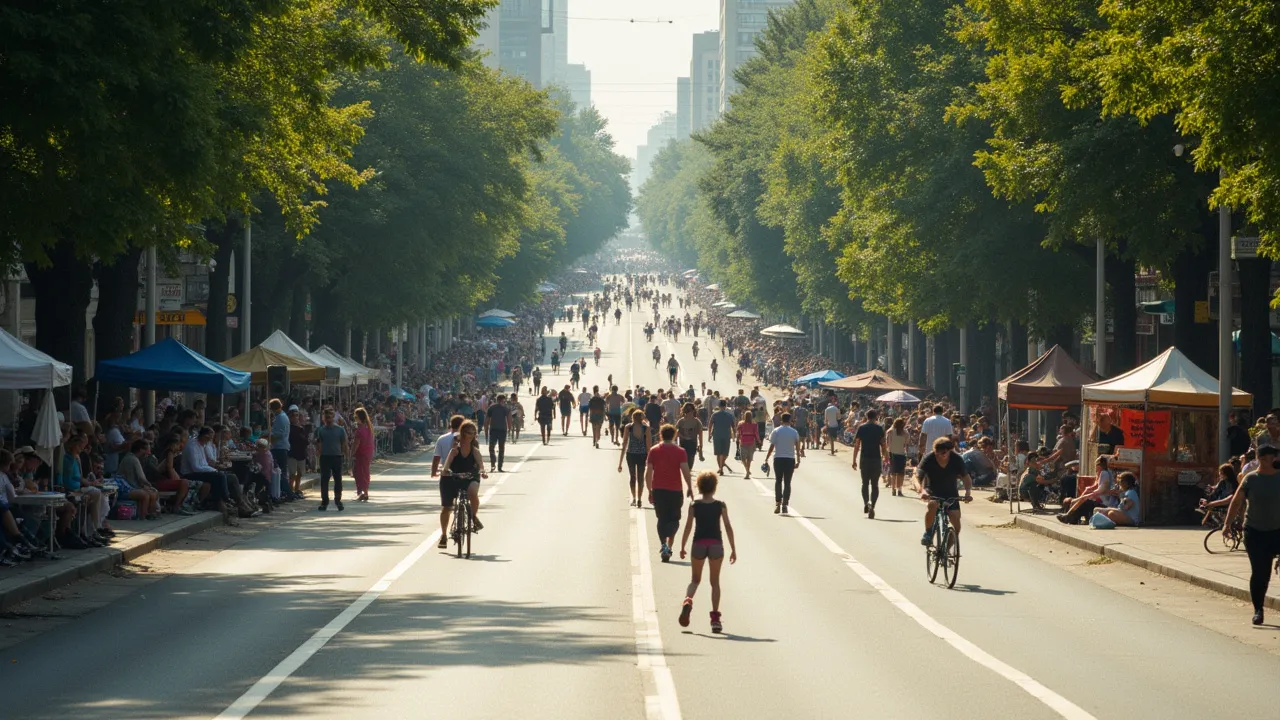
World Car-Free Day on September 22 encourages motorists to give up their cars for a day to promote sustainable transport, reduce emissions, and reclaim urban space for people. Over 1,500 cities worldwide participate annually.
The Historical Origins & Evolutionary Journey
World Car-Free Day, observed annually on September 22, is a global initiative that urges drivers to leave their vehicles at home for one day in favor of walking, cycling, public transit, or carpooling. The concept emerged from the broader car-free movement, which gained traction in the late 20th century as a response to growing concerns about urban air pollution, traffic congestion, and oil dependence. This section traces the day’s origins, from grassroots protests to official recognition by the European Union and eventual worldwide adoption.
The Foundational Catalyst
The seeds of a car-free day were first planted in the 1970s during the oil crisis, when several European countries held “car-free Sundays” to conserve fuel. However, the modern movement began in 1998 with a grassroots campaign in France called “En ville, sans ma voiture?!” (In town, without my car?!). The idea was simple: for one day, cities would close certain streets to motor vehicles, allowing residents to experience a quieter, cleaner, and safer urban environment. The event was a hit, and by 2000 the European Commission officially adopted the concept, launching the first continent-wide “European Car-Free Day” on September 22 of that year.
The Legislative/Official Adoption
The European Union’s Directorate-General for Environment spearheaded the initiative, providing funding and coordination. In 2002, the event was renamed “European Mobility Week,” with September 22 designated as the culminating “Car-Free Day.” The success of EU-backed campaigns inspired cities outside Europe to join, and in 2005 the World Carfree Network (WCN) helped organize the first global iteration, now known as World Car-Free Day. Key milestones include the inclusion of major metropolises like Bogotá, Jakarta, and Shanghai, which began closing large sections of their downtowns to traffic.
Modern Global Legacy
Today, World Car-Free Day is observed in over 1,500 cities across 50 countries. It serves as both a symbolic protest against car-centric urban planning and a practical experiment in sustainable mobility. Many cities use the day to launch permanent car-free zones, expand bike lanes, or promote public transit. The event has also inspired sister initiatives such as “Park(ing) Day,” where metered parking spots are temporarily transformed into mini-parks, and “Bike to Work Day.” While critics argue that a single day is insufficient to change behavior, advocates point to research showing that participation in car-free days can lead to long-term modal shifts, especially when combined with infrastructure improvements. The legacy of September 22 continues to grow as climate urgency and urban livability demands increase.
How to Celebrate World Car-Free Day
World Car-Free Day offers a unique opportunity to experience your city from a different perspective—on foot, two wheels, or public transit. Whether you’re an individual, a school, or a corporate organization, there are countless ways to participate meaningfully. Below is a comprehensive guide to celebrating the day, with actionable tips and examples from around the world.
For Individuals
- Choose an alternative mode of transport: Walk, cycle, skate, or take the bus, tram, or subway. If you live too far, consider carpooling with colleagues or neighbors.
- Plan a car-free errand day: Combine multiple stops along a walking or transit route. Use apps like Google Maps transit directions to optimize your route.
- Participate in local events: Many cities organize street festivals, bicycle parades, and open-street activities. Check your city’s official website or social media for scheduled events.
- Document your experience: Share photos or videos on social media using hashtags like #WorldCarFreeDay or #CarFreeDay to inspire others.
For Schools and Universities
- Hold a “Walk to School” day: Encourage students, parents, and teachers to walk, cycle, or use public transport. Offer prizes for the class with the highest participation.
- Organize educational workshops: Invite local transportation planners or environmental activists to speak about the benefits of car-free living.
- Set up a temporary “car-free zone” on campus for the day, with games and activities that promote physical activity.
For Corporations and Organizations
- Offer incentives: Provide rewards (like coffee vouchers or early leave) for employees who commute without a car on September 22.
- Host a “Trek to Work” challenge: Track miles walked or cycled by employees and donate to a sustainability charity based on collective distance.
- Telecommute or stagger work hours: Reduce rush hour pressure by allowing remote work or flexible start times.
Regional Celebrations Around the World
Different countries put their own spin on the day. In France, many cities close historic centers completely, with events like vintage bicycle rides and street art. India’s “Raahgiri Day” movement has turned Car-Free Day into a weekly community celebration in cities like Delhi and Gurugram, featuring yoga, dance, and local vendors. Japan sees organized “Car-Free Sunday” events in cities like Tokyo, where major boulevards become pedestrian paradises. In Brazil, the “Dia Sem Carro” movement is linked to the country’s strong cycling culture, with mass bike rides and educational campaigns against air pollution. Regardless of location, the core message remains the same: reclaiming streets for people, not cars.
Environmental Impact: Reducing Emissions and Air Pollution
One of the primary motivations behind World Car-Free Day is to highlight the environmental cost of car dependency. Transportation is a major contributor to greenhouse gas emissions, accounting for approximately 24% of global CO2 emissions from fuel combustion. Cars and light trucks are responsible for nearly half of that share. On September 22, the temporary reduction in traffic offers a tangible glimpse of a cleaner future.
Short-Term Effects
Studies in cities like Paris and Bogotá have shown that on Car-Free Days, ambient air pollutants such as nitrogen dioxide (NO2) and particulate matter (PM2.5) can drop by 20-50% within the designated zones. Noise pollution also decreases significantly, allowing for quieter public spaces. These reductions, though temporary, demonstrate what’s possible with sustained car-free policies.
Long-Term Behavioral Shifts
More importantly, World Car-Free Day serves as a catalyst for lasting change. Surveys conducted by the European Commission indicate that up to 30% of participants report using alternative transport more frequently in the months following the event. Cities that consistently host car-free days often see increased investments in bike lanes, pedestrian infrastructure, and public transit. For example, after years of hosting Car-Free Day, Paris launched its “Plan Vélo” and “15-Minute City” initiative, which prioritize active mobility and local living.
Global Emission Reduction Potential
If every car owner in the United States participated just one day a year, it would save roughly 4 million metric tons of CO2—equivalent to taking 850,000 cars off the road for a year. While symbolic, the day underscores the need for systemic change, such as carbon pricing, vehicle emission standards, and investment in clean public transport. Advocates use the visibility of September 22 to pressure policymakers and corporations to adopt more sustainable practices year-round.
Urban Transformation: Reclaiming Streets for People
World Car-Free Day is also a powerful tool for reimagining urban space. Throughout the 20th century, cities were designed around the automobile, leading to sprawling suburbs, wide roads, and parking lots that eroded public life. On September 22, many municipalities close entire streets to traffic, allowing citizens to experience their city as a place for people rather than cars. This temporary transformation often inspires permanent changes.
Permanent Car-Free Zones
Several iconic car-free zones got their start as part of Car-Free Day experiments. Times Square, New York City, for example, was partially pedestrianized in 2009 following a pilot project during the city’s Summer Streets event—a series of car-free Saturdays that echoes Car-Free Day values. Copenhagen’s Strøget, one of the world’s longest pedestrian streets, evolved from a series of traffic restrictions that began in the 1960s. More recently, Bogotá’s Ciclovía—a weekly car-free event on major roads—has become a model for cities worldwide, demonstrating that temporary closures can lead to permanent infrastructure adjustments.
Economic Benefits
Contrary to fears that car-free streets hurt businesses, evidence shows that pedestrianized zones often increase foot traffic and retail sales. A study of car-free days in San Francisco found that sales in participating areas rose by 6-10% on event days. Restaurants and cafes benefit from expanded outdoor seating, and street vendors gain visibility. The day also promotes local tourism, as residents and visitors alike explore neighborhoods they might otherwise drive through.
Health and Well-being
Reduced traffic noise and air pollution translate directly to health benefits. The World Health Organization links prolonged exposure to traffic-related pollution with respiratory diseases, cardiovascular issues, and premature death. By providing a safe, clean environment for physical activity, car-free days encourage walking and cycling, which combat sedentary lifestyles. Cities often organize free fitness classes, recreational sports, and workshops to further promote well-being.
Global Participation and Cultural Significance
World Car-Free Day is observed in a diverse range of countries, each adapting the concept to local contexts. From Europe, where the tradition began, to Asia, Africa, and the Americas, the day reflects a universal desire for more sustainable and people-centric cities. Below is a snapshot of how different regions celebrate.
Europe
- France: As the birthplace of the modern car-free day, France sees widespread participation. Major cities like Paris, Lyon, and Marseille close central roads and host cultural events. The day often coincides with the European Heritage Days, adding historical tours.
- Germany: Many cities join the “Autofreier Sonntag” tradition, with car-free Sundays in select city centers. Berlin, Hamburg, and Munich close large areas to traffic, pairing it with environmental fairs.
- Italy: “Giornata Senza Auto” is popular in cities like Milan, which introduced “Area C” (congestion charge) and uses Car-Free Day to promote its success.
Asia
- India: The “Raahgiri” movement has taken off, with multiple cities hosting monthly car-free mornings that include yoga, zumba, and street art. Delhi’s “Car-Free Day” in some residential colonies has become a regular event.
- China: Beijing and Shanghai have experimented with car-free zones during major events, but the public car-free day is less common. Still, environmental NGOs push for awareness.
- Japan: Tokyo’s “Car-Free Day” is called “Dōro no hi” (Road Day) in some neighborhoods, focusing on safe streets for children and elderly.
North America
- United States: While not as widely observed as in Europe, cities like Portland, San Francisco, and New York host “Car-Free Day” events with street closures and bike rides. The “Open Streets” movement often overlaps.
- Canada: Toronto and Vancouver have celebrated Car-Free Day with block parties and cycling campaigns, often tied to “Bike to Work” initiatives.
Latin America
- Colombia: Bogotá’s Ciclovía is a weekly event, but the city also participates in World Car-Free Day with extra programming. Medellín uses the day to promote its cable-car and metro systems.
- Brazil: “Dia Mundial Sem Carro” is marked by mass bike rides in São Paulo, Rio de Janeiro, and Brasília, along with debates on urban mobility.
The cultural significance of the day lies in its ability to unite people across borders under a common goal: a future where cities are designed for human connection, not traffic jams.
Criticisms and Challenges: Is One Day Enough?
Despite its popularity, World Car-Free Day has faced criticism. Some argue that a single day of car-free streets is merely symbolic and does little to address the structural car dependency in most cities. Critics point out that air pollution and congestion quickly return the following day, and that the event can be seen as a PR stunt by municipalities that continue to invest in highway expansions and parking infrastructure. Additionally, low participation rates in some regions—especially where public transit is inadequate—undermine the message. However, supporters counter that the day is a vital tool for raising awareness and building political will. Research from the University of Oxford suggests that well-organized car-free days can shift public opinion and spur long-term policy changes, especially when paired with citizen engagement and media coverage. The key challenge is to leverage the momentum of September 22 into sustained advocacy for permanent car-free zones, better transit funding, and walkable urban design.
Historical Timeline
The first 'En ville, sans ma voiture?!' (In town, without my car?!) is held in La Rochelle, France, on September 22. It is considered the direct precursor to World Car-Free Day.
The European Commission formally launches 'European Car-Free Day' on September 22, with participation from over 700 cities across the European Union. The initiative is part of the European Mobility Week.
The European Commission expands the campaign into 'European Mobility Week,' with September 22 designated as a permanent Car-Free Day. Over 1,300 cities participate.
The World Carfree Network (WCN) organizes the first global iteration, renaming the event 'World Car-Free Day.' Cities outside Europe, such as Bogotá, Colombia, and Jakarta, Indonesia, join for the first time.
Paris, France, closes its Champs-Élysées and several other major boulevards to traffic, setting a new record for car-free street length. The event inspires similar closures in other global capitals.
New Delhi, India, holds its first large-scale Car-Free Day in the Connaught Place area, though low participation sparks debate. The city later adapts the concept into regular 'Raahgiri Day' events.
The United Nations includes sustainable urban mobility in its Sustainable Development Goals (SDG 11.2), indirectly boosting the profile of car-free initiatives. Over 1,500 cities now participate in World Car-Free Day.
The COVID-19 pandemic disrupts traditional celebrations, but many cities pivot to 'pop-up' bike lanes and pedestrian zones, further validating the car-free concept. Virtual events and social media campaigns replace physical closures.