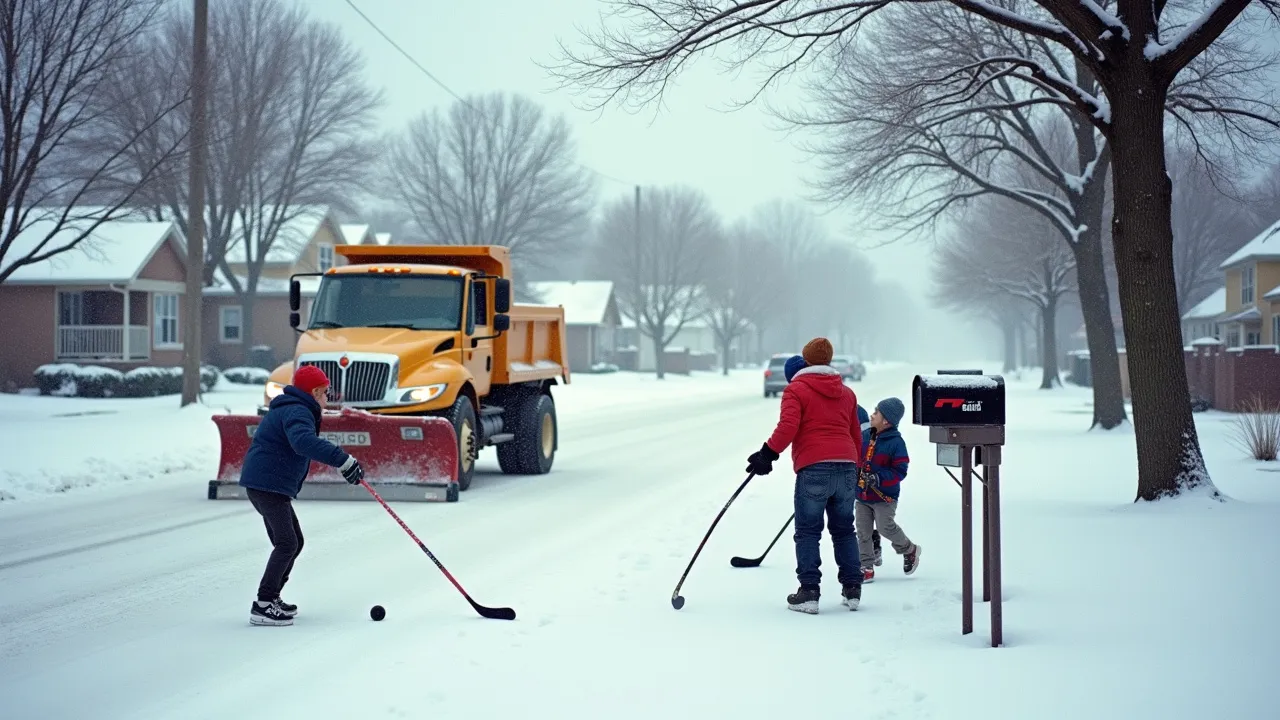
Snowplow Mailbox Hockey Day on January 23rd celebrates the quirky Canadian tradition of playing street hockey around snowplows and mailboxes. It honors winter community spirit, improvisation, and the joy of spontaneous play.
The Historical Origins & Evolutionary Journey
Snowplow Mailbox Hockey Day traces its roots to the frosty suburbs of Canada in the early 2000s. The observance emerged from a blend of two quintessentially Canadian pastimes: street hockey and the winter battle against snow. For decades, children across the Great White North would shovel driveways and clear rinks on frozen ponds, but the arrival of a snowplow often spelled the end of a carefully constructed street rink. Enterprising young players soon discovered that the plow's wake created fresh, smooth surfaces—ideal for impromptu games. The humble mailbox, a fixture of every suburban street, became an unlikely goal marker.
The Foundational Catalyst
The official spark came in 2007 in Moose Jaw, Saskatchewan. A group of friends, led by local hockey enthusiast Brad Tremblay, noticed how the town's snowplow drivers would wave and slow down near mailboxes. Inspired, they organized an informal tournament using mailboxes as nets and the plow's path as the playing surface. The event grew organically, with the first unofficial "Snowplow Mailbox Hockey Day" taking place on January 23, 2008. The date was chosen because it was typically the height of winter, ensuring ample snow cover and plow activity.
The Legislative/Official Adoption
Word spread through social media and local news. By 2010, several small municipalities in Saskatchewan and Manitoba recognized the day as a community-building event. In 2012, the Canadian Hockey Enthusiast Collective (CHEC) formally registered January 23 as Snowplow Mailbox Hockey Day, promoting safety guidelines and encouraging friendly competition. The observance has since been adopted by hockey communities in northern US states like Minnesota and Michigan, and even in parts of Scandinavia.
Modern Global Legacy
Today, Snowplow Mailbox Hockey Day is celebrated not only on streets but also in designated community rinks that simulate the plow experience. It has become a day to appreciate municipal workers, foster neighborly bonds, and enjoy the simple thrill of hockey without expensive equipment. The event also raises awareness for safe play around snow removal equipment and encourages physical activity during winter months.
How to Celebrate Snowplow Mailbox Hockey Day
Celebrating Snowplow Mailbox Hockey Day is about embracing winter's unpredictability and community fun. Here are the essential steps and traditions:
Individuals & Families
- Check Local Plow Schedule: Coordinate with neighbors to know when the snowplow is due. Typically, the best time is early morning after an overnight snowfall.
- Set Up the 'Rink': Clear a stretch of street (with permission) and designate mailboxes as goals. Use safety cones to mark boundaries.
- Use Appropriate Gear: Wear helmets, gloves, and warm clothing. Use hockey sticks and a lightweight puck or tennis ball.
- Follow Safety Rules: Never play directly in front of a moving plow. Appoint a spotter to watch for approaching traffic and plows.
Schools & Community Groups
- Organize a Tournament: Host a 3-on-3 tournament in a cleared parking lot or cul-de-sac. Award trophies made from recycled mailboxes.
- Invite Snowplow Drivers: Many municipal drivers participate by honking or displaying the official Snowplow Mailbox Hockey Day flag.
- Fundraise for Local Rinks: Charge a small fee to play and donate proceeds to community ice rink maintenance.
Corporate & Social Rituals
- Office Hockey: Some companies in snowy regions encourage employees to take a short break for a few minutes of street hockey.
- Social Media Challenge: Share photos using #SnowplowHockeyDay, showing creativity in setting up mailbox goals.
International Variations
- Canada: The heartland of the tradition, with many towns hosting official events and offering hot chocolate.
- United States (Minnesota, Michigan): Embraced by hockey-loving communities, often combined with pond hockey festivals.
- Scandinavia: In Sweden and Finland, the day is adapted to include snowplow as the 'goaltender' and mailboxes replaced by wooden sleds.
No matter how you celebrate, the core values are creativity, safety, and camaraderie.
Cultural Significance & Community Bonding
Snowplow Mailbox Hockey Day is more than a whimsical observance; it symbolizes the resilience and inventiveness of winter communities. In a world increasingly dominated by digital entertainment, the day encourages outdoor physical activity and neighborly interaction. The mailbox, often a symbol of communication, becomes a goal—a metaphor for targeting shared experiences. The snowplow, typically an agent of disruption, transforms into an enabler of play. This inversion of ordinary objects reflects the Canadian spirit of making the best of harsh conditions. Many families use the day as a reason to host a block party, building stronger social networks in an era of isolation.
Essential Gear & Safety Guidelines
Proper preparation ensures the day is fun and injury-free.
Recommended Equipment
- Hockey sticks (plastic or wooden, no metal blades)
- Lightweight puck or tennis ball
- Helmets for all participants
- Reflective vests for visibility
- Cones or markers for boundaries
Safety Rules
- Never play on a street with active traffic; use side streets or cul-de-sacs with low speed limits.
- Designate an adult supervisor to watch for approaching vehicles and plows.
- Keep at least 10 feet away from mailboxes to avoid collisions.
- Stop play immediately if a snowplow enters the street; wait until it passes and the snow settles.
- Wear warm, layered clothing and take breaks to prevent frostbite.
Always obtain permission from neighbors if using their mailbox as a goal, and respect property boundaries.
Environmental & Economic Impact
The observance promotes environmentally friendly winter fun with minimal resource consumption. Players use existing snow cover and equipment, reducing the need for energy-intensive ice rinks. Economically, the day highlights the role of snowplow operators and municipal services. Some towns use the celebration to thank snow removal crews with small tokens. Local businesses near celebration sites often see increased foot traffic from families buying hot drinks or snacks. Overall, the day's economic footprint is modest but positive, reinforcing community spending during a typically slow retail season.
Global Expansion & Adaptation
While rooted in North America, Snowplow Mailbox Hockey Day has found resonance in other snowy regions. In Japan's Hokkaido region, where snow removal is a major winter activity, communities have adapted the tradition using local mailboxes and modified hockey sticks. In Russia, some villages hold 'Plow Hockey' tournaments on frozen streets, often with a mailbox-shaped trophy. However, the day remains most prominent in Canada and the northern USA. The rise of social media has helped standardize the date and share creative variations, ensuring that even without snow, people can simulate the game with cardboard boxes and leaf blowers.
Historical Timeline
Brad Tremblay and friends in Moose Jaw, Saskatchewan, conceive the idea of street hockey using snowplow tracks and mailboxes as goals.
First informal Snowplow Mailbox Hockey Day celebrated on January 23 in Moose Jaw with around 30 participants.
Several towns in Saskatchewan and Manitoba officially recognize the day; local media coverage spreads awareness.
Canadian Hockey Enthusiastic Collective formalizes the observance, publishes safety guidelines, and registers January 23 as annual date.
First cross-border celebration in Minnesota, USA; joint events held in International Falls and Fort Frances, Ontario.
The day gains traction in Scandinavia, with Sweden hosting its first official Plow Hockey tournament in Kiruna.
COVID-19 pandemic leads to many small, family-only celebrations, but also increased social media sharing under #SnowplowHockeyDay.
Over 200 communities in 5 countries report holding events; the day is used to promote winter physical activity by public health agencies.