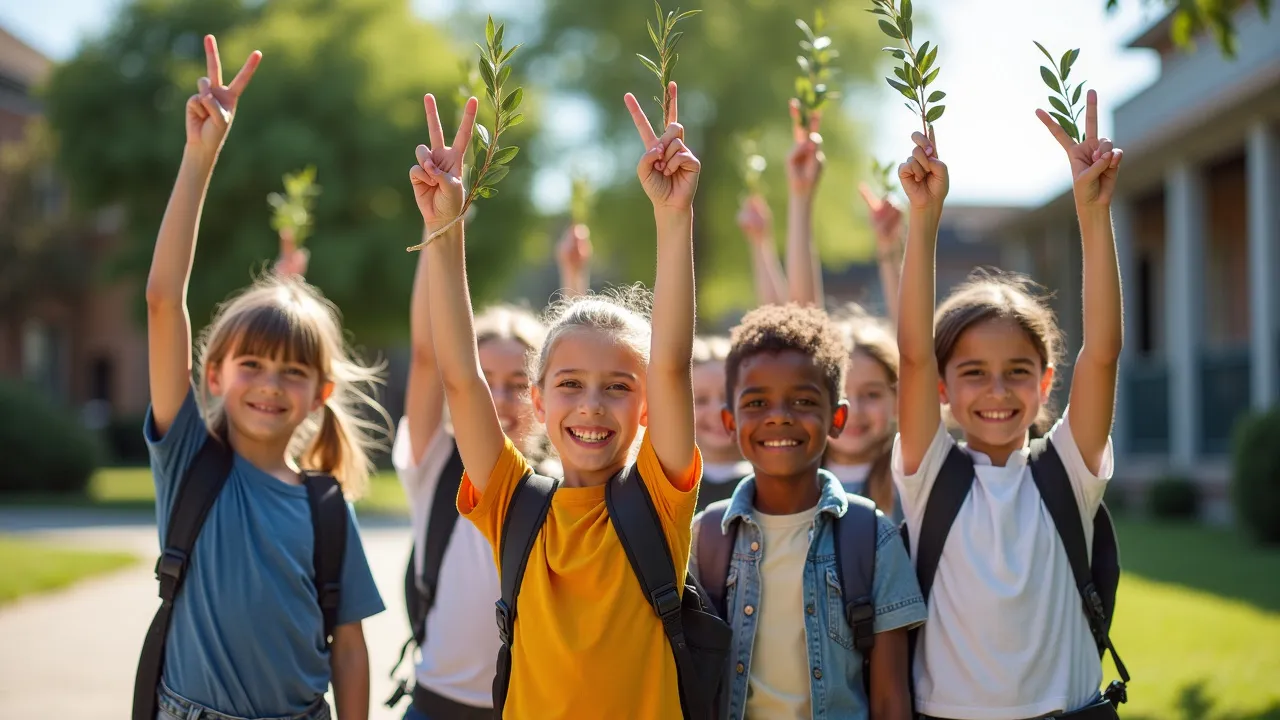
Observed annually on January 30th, the School Day of Non-violence and Peace (DENIP) promotes peace education and non-violence in schools worldwide. Founded by Spanish poet Llorenç Vidal in 1964, it marks the anniversary of Mahatma Gandhi's assassination.
The Historical Origins & Evolutionary Journey
The School Day of Non-violence and Peace, known globally by its acronym DENIP (from the Catalan: Dia Escolar de la No-violència i la Pau), is a pioneering educational observance that has shaped peace education for over half a century. Its roots trace back to 1964, when Spanish poet, educator, and pacifist Llorenç Vidal Vidal envisioned a day dedicated to fostering a culture of peace and non-violence in schools.
The Foundational Catalyst
Llorenç Vidal, born in 1936 in Mallorca, was deeply influenced by the teachings of Mahatma Gandhi and the non-violent civil rights movements of the 1960s. He observed that traditional education often neglected the ethical and spiritual dimensions of human coexistence. In 1964, while working as a teacher in Palma de Mallorca, he proposed setting aside a day each year to reflect on peace and non-violence. He chose January 30th, the anniversary of Gandhi's assassination in 1948, as a symbolic date for the observance. The first official celebration took place in 1964 at several schools in the Balearic Islands, Spain.
The Legislative/Official Adoption
DENIP gained momentum throughout the 1970s and 1980s. In 1976, the Spanish Ministry of Education officially recognized the day and encouraged schools across Spain to participate. The observance spread to Latin America, and by the 1990s, it was observed in dozens of countries. In 1993, the United Nations Educational, Scientific and Cultural Organization (UNESCO) formally endorsed DENIP as a global educational initiative, integrating it into the International Decade for a Culture of Peace and Non-Violence for the Children of the World (2001–2010).
Modern Global Legacy
Today, DENIP is celebrated in over 50 countries. While Spain remains the epicenter, countries such as Argentina, Mexico, Colombia, Brazil, India, and many European nations actively participate. The observance has evolved to incorporate digital tools, with virtual peace pledges and online inter-school collaborations. The core message remains unchanged: peace education is essential for a sustainable future.
How to Celebrate School Day of Non-violence and Peace
This day is not merely a symbolic event but an active call to integrate peace values into daily school life. Below are detailed, actionable strategies for students, teachers, and communities worldwide.
For Students and Classrooms
- Peace Pledge Ceremony: Students write and sign individual or class pledges committing to non-violence. These can be displayed on a ‘peace tree’ or mural.
- Conflict Resolution Workshops: Role-play scenarios teaching mediation and active listening.
- Art and Essay Contests: Create posters, poems, or short stories around themes of peace and tolerance.
For Schools and Educators
- Whole-School Assembly: Feature guest speakers (local peace activists or historians) and a minute of silence for Gandhi.
- Curriculum Integration: Dedicate the week to lessons on non-violence, covering figures like Martin Luther King Jr., Nelson Mandela, and Jane Addams.
- Service Projects: Organize a school-wide charity drive or community service event emphasizing cooperation.
Global Variations in Celebration
In Spain, schools often release white balloons or doves as symbols of peace. In Latin America, massive murals are painted on school walls. In India, students participate in peace marches and spin khadi cloth on a charkha (spinning wheel) to honor Gandhi. In Japan, schools fold 1,000 origami cranes and send them to the Hiroshima Peace Memorial Park. These diverse practices highlight the universal yet locally adapted nature of DENIP.
The Core Themes & Philosophical Underpinnings
The School Day of Non-violence and Peace is rooted in several key philosophical and educational principles.
Non-violence as a Way of Life
Drawing heavily from Gandhi's ahimsa (non-harm), the day teaches that non-violence is not passivity but an active force for social change. It encourages students to reject bullying, discrimination, and violence in all forms.
Universal Human Rights
The observance aligns with the Universal Declaration of Human Rights (1948), emphasizing the right to education, peace, and dignity. Schools use this day to explore issues like child labor, gender equality, and refugee rights.
Intercultural and Interfaith Understanding
DENIP promotes dialogue among different cultures and religions. Activities often include learning about peace traditions in Christianity, Islam, Buddhism, and other belief systems, fostering mutual respect.
Global Impact & Educational Transformation
Over six decades, DENIP has influenced education policy and practice worldwide.
Integration into National Curricula
Several countries, including Spain, Mexico, and the Philippines, have embedded peace education into their official curricula. Schools are required to dedicate at least one day per year to peace-related lessons.
Reduction in School Violence
Studies in Spain and Argentina show that schools actively participating in DENIP report up to 30% decrease in bullying incidents and disciplinary referrals. The emphasis on emotional intelligence and conflict resolution creates a safer school climate.
Empowerment of Student Activists
DENIP has inspired student-led movements for peace, such as the 'Schools for Peace' networks in Latin America and the 'Peace Club' initiatives in India.
Comparative Observances & Related Days
DENIP is part of a broader ecosystem of peace-oriented observances.
- International Day of Peace (September 21): UN-established global day for ceasefire and non-violence.
- World Peace Day (January 1): Catholic celebration of peace.
- Martin Luther King Jr. Day (Third Monday of January): US federal holiday emphasizing non-violent social change.
Unlike these, DENIP is uniquely school-focused and emphasizes educational reform.
Challenges & Criticisms
While widely praised, DENIP faces certain challenges.
Superficial Participation
Some schools treat the day as a token event without integrating its values into daily practice. Critics call for sustained peace education rather than a one-day event.
Cultural Sensitivity
In some regions, peace education is seen as politically sensitive or anti-authority. Teachers must navigate local contexts carefully.
Resource Constraints
Many underfunded schools lack materials to organize meaningful activities. NGOs and UNESCO have stepped in to provide free resources.
Historical Timeline
Spanish educator Llorenç Vidal founds the School Day of Non-violence and Peace, first celebrated in schools in the Balearic Islands, Spain.
Spanish Ministry of Education officially recognizes DENIP and encourages nationwide participation.
UNESCO endorses DENIP as a global peace education initiative.
United Nations launches the International Decade for a Culture of Peace and Non-Violence for the Children of the World, integrating DENIP activities.
Over 50 countries now observe DENIP, with dedicated online resource portals launched in multiple languages.
50th anniversary of DENIP; major celebrations in Spain and Latin America include intercontinental video conferences among schools.
Due to COVID-19, many schools shift to virtual peace pledges and online peace art exhibitions, expanding digital engagement.