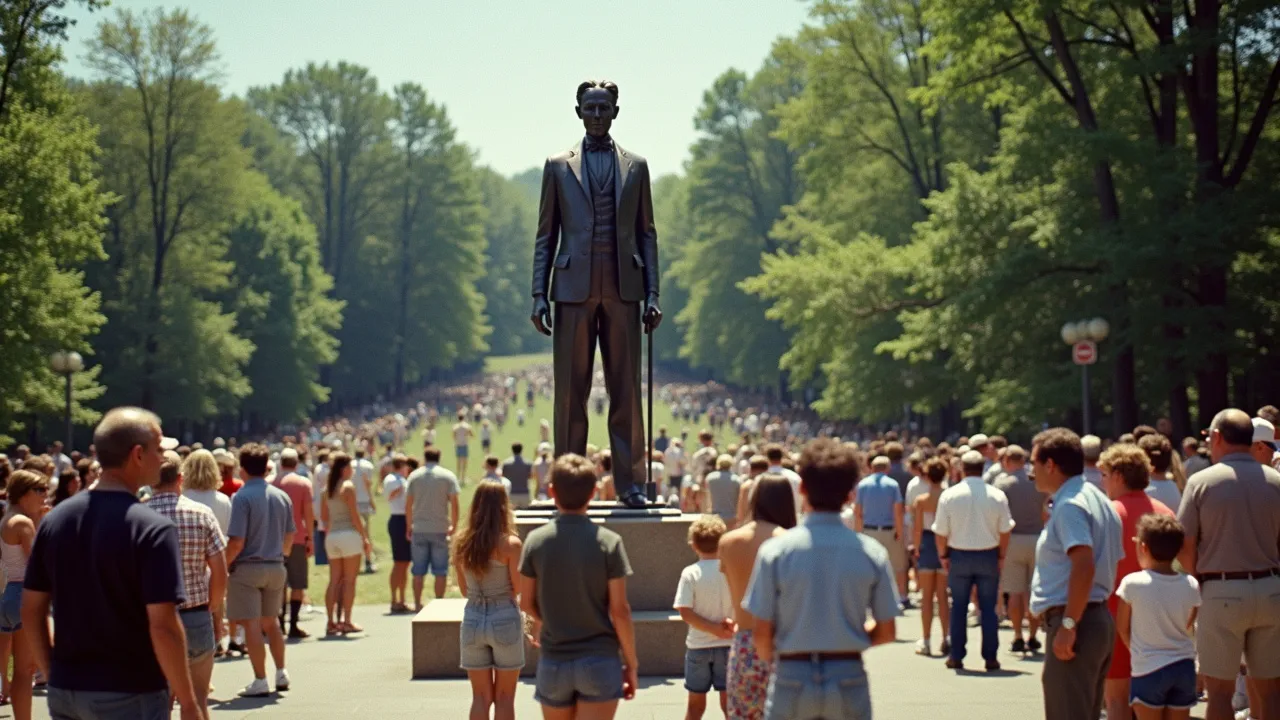
Nikola Tesla Day is celebrated on July 10th, the birthday of the visionary inventor. It honors his groundbreaking contributions to electricity and modern technology, inspiring global events and educational activities.
The Historical Origins & Evolutionary Journey
The Foundational Catalyst
Nikola Tesla Day, observed annually on July 10th, commemorates the birth of one of history's most prolific inventors. Tesla was born on July 10, 1856, in Smiljan, Croatia (then part of the Austrian Empire). His revolutionary work in alternating current (AC) power systems, wireless communication, and electromagnetism laid the foundation for modern electrical engineering.
The Legislative/Official Adoption
The push for an official day began in the early 2000s. The Tesla Science Foundation at Wardenclyffe initiated a campaign to honor Tesla's legacy. In 2006, the foundation organized the first Nikola Tesla Day event at the Wardenclyffe site. Serbia officially declared July 10 as National Nikola Tesla Day in 2010, followed by Croatia. In 2016, the United States House of Representatives passed a resolution recognizing the day, though it remains an unofficial observance in many countries.
Modern Global Legacy
Today, Nikola Tesla Day is celebrated worldwide through science fairs, lectures, and exhibitions. Museums like the Nikola Tesla Museum in Belgrade offer free admission. The day has become a symbol of innovation and the pursuit of knowledge, with events ranging from Tesla coil demonstrations to academic symposia.
How to Celebrate Nikola Tesla Day
There are many ways to honor Tesla's legacy on July 10th. Below are actionable strategies for individuals, schools, and organizations.
For Individuals
- Visit a local Tesla museum or science center. Many offer special exhibits on Tesla's life.
- Watch documentaries or read biographies about Tesla's inventions and his rivalry with Thomas Edison.
- Experiment with a small Tesla coil kit to understand electromagnetic principles.
For Schools
- Organize a science fair focused on electricity and wireless energy.
- Host a lecture series featuring engineers or historians discussing Tesla's impact.
- Encourage students to recreate simple versions of Tesla's experiments, like a Jacob's ladder.
For Organizations & Companies
- Partner with local museums to sponsor free admission days.
- Hold an inventor's competition inspired by Tesla's creativity.
- Use social media to share facts about Tesla's innovations with the hashtag #NikolaTeslaDay.
Global Traditions
In Serbia, official ceremonies include wreath-laying at Tesla's statue and a visit from dignitaries. In Croatia, Smiljan holds a festival with cultural performances and science workshops. In the United States, the Tesla Science Center at Wardenclyffe hosts an open house with guided tours and Tesla coil demonstrations.
Global Impact and Cultural Significance
Nikola Tesla Day transcends borders, uniting people in appreciation of science and innovation. Tesla's inventions have shaped modern civilization, from the global power grid to radio and remote control. The day highlights the importance of funding basic research and recognizing unsung heroes of technology. Countries like India, China, and Japan also participate through online events and educational programs. The day serves as a reminder that one visionary can change the world.
The Legacy of Tesla's Inventions
AC Power Systems
Tesla's polyphase AC system revolutionized electricity distribution. His patents (U.S. 381,968 and others) enabled long-distance power transmission, leading to the electrification of cities. Today, the entire grid still relies on his fundamental designs.
Wireless Communication
Tesla's work on radio waves preceded Marconi. In 1893, he demonstrated wireless transmission at the World's Columbian Exposition. His concepts paved the way for modern Wi-Fi, Bluetooth, and RFID.
Other Innovations
- Tesla coil: Used in radio transmission and now a staple of science demonstrations.
- Remote control: Patented the first radio-controlled vessel in 1898.
- X-rays: Early experiments contributed to X-ray imaging.
Tesla's Influence on Modern Technology
Today, Tesla's ideas are more relevant than ever. Wireless power charging for smartphones and electric vehicles echoes his Wardenclyffe dream. Companies like Tesla Inc. (named in his honor) advance sustainable energy. Nikola Tesla Day encourages young engineers to think boldly. It also sparks debates about how to protect intellectual property and support independent inventors.
Educational Initiatives and Community Events
On Nikola Tesla Day, educational institutions host workshops on electricity and magnetism. Community centers organize documentary screenings and panel discussions. The day is an opportunity to promote STEM careers, especially for underprivileged students. Many libraries create special displays of Tesla's patents and writings.
Virtual Events
Since 2020, online webinars and virtual tours of the Tesla Museum have expanded global participation. Live-streamed Tesla coil performances attract thousands of viewers worldwide.
Historical Timeline
Nikola Tesla is born on July 10 in Smiljan, Croatia.
Tesla arrives in the United States and begins working for Thomas Edison.
Tesla invents the Tesla coil, a high-voltage transformer used in radio transmission.
At the World's Columbian Exposition in Chicago, Tesla demonstrates AC power and wireless lighting.
Tesla conducts high-voltage experiments in Colorado Springs, creating artificial lightning.
Construction of the Wardenclyffe Tower begins, aimed at wireless global communication.
Tesla dies alone in New York City on January 7 at age 86.
First Nikola Tesla Day celebration at Wardenclyffe, organized by the Tesla Science Foundation.
Serbia officially declares July 10 as National Nikola Tesla Day.
U.S. House of Representatives passes a resolution recognizing Nikola Tesla Day.
UNESCO lists Tesla's archive in the Memory of the World Register.