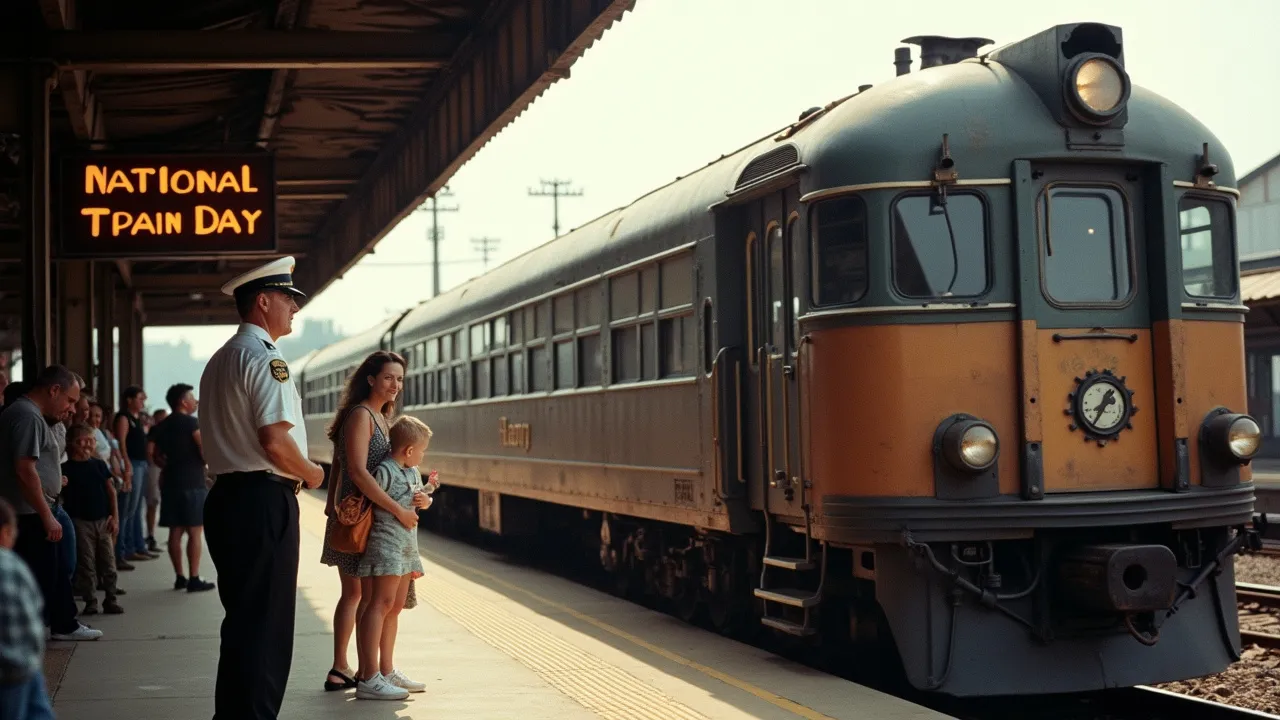
National Train Day celebrates the rich history and future of rail travel in the United States. Observed on the Saturday closest to May 10, it honors the completion of the Transcontinental Railroad and promotes the benefits of train travel.
The Historical Origins & Evolutionary Journey
National Train Day commemorates the profound impact of railroads on American society, economy, and culture. The observance was established by Amtrak in 2008 to coincide with the anniversary of the completion of the First Transcontinental Railroad on May 10, 1869. This day not only honors the past but also highlights the modern renaissance of rail travel.
The Foundational Catalyst
The driving force behind National Train Day is the monumental achievement of the Transcontinental Railroad. Connecting the Central Pacific and Union Pacific railroads at Promontory Summit, Utah, it revolutionized transportation, reducing cross-country travel from months to days. This event catalyzed westward expansion, trade, and communication, shaping the United States into a unified nation.
The Legislative/Official Adoption
In 2008, Amtrak officially launched National Train Day as a grassroots celebration to promote the benefits of train travel—environmental sustainability, comfort, and convenience. The date was chosen to honor the Golden Spike ceremony. While not a federal holiday, it gained widespread support from rail enthusiasts, museums, and communities across the country. Amtrak hosted events at major stations, offering free rides, exhibits, and educational programs.
Modern Global Legacy
Though primarily a U.S. observance, National Train Day has inspired similar events worldwide. Countries like Canada, the United Kingdom, and Japan celebrate their own rail heritage days. The day now serves as a platform to advocate for high-speed rail investments, historic preservation, and the future of sustainable transportation. Amtrak continues to host annual events, and rail advocacy groups use the day to engage the public.
How to Celebrate National Train Day
National Train Day offers countless ways for individuals, families, schools, and organizations to participate. Below are actionable strategies grouped by audience.
For Individuals and Families
- Take a Train Trip: Book a short journey on Amtrak or a scenic railroad. Many routes offer discounts or special events on this day.
- Visit a Train Museum: Explore historic locomotives, model layouts, and interactive exhibits. Museums often host open houses and family activities.
- Ride a Heritage Railway: Experience vintage steam or diesel trains operated by preservation societies.
- Host a Movie Night: Watch classic train films like The Polar Express or Murder on the Orient Express.
- Read About Rail History: Dive into books or documentaries covering the golden age of railroads.
For Schools and Educational Groups
- Field Trip: Organize a visit to a local train station or rail museum. Request a behind-the-scenes tour.
- Classroom Activities: Teach railroad history using lesson plans from Amtrak or the Smithsonian. Build model bridges or create timeline projects.
- Guest Speakers: Invite a railroad historian or retired conductor to share stories.
For Organizations and Businesses
- Employee Rail Day: Encourage car-free commutes by subsidizing train tickets for employees.
- Sponsor a Rail Society: Donate to a railway preservation group or volunteer for track maintenance events.
- Social Media Campaign: Share user-generated content using hashtags like #NationalTrainDay and #WorldTrainDay.
Globally, countries celebrate with unique traditions. In Japan, the Shinkansen bullet train is celebrated with special runs and station festivals. In the UK, heritage railways host steam galas. Germany’s Tag der Schiene (Day of the Rail) includes open trains and depot tours.
The Evolution of Passenger Rail in America
Passenger rail in the United States has undergone dramatic transformations from its 19th-century heyday to modern revival. The industry peaked in the early 1900s when railroads were the primary mode of long-distance travel. However, the rise of automobiles and aviation after World War II led to a steep decline. The creation of Amtrak in 1971 nationalized intercity passenger service, preserving a skeletal network. Today, Amtrak carries over 30 million passengers annually along 21,000 miles of track. Meanwhile, commuter rail systems in cities like New York, Chicago, and Boston move millions daily. High-speed rail remains limited, with only the Northeast Corridor achieving speeds above 150 mph. Recent federal funding aims to expand high-speed corridors in California, Texas, and the Pacific Northwest, signaling a new era for American passenger rail.
Key Milestones
- 1827: Baltimore and Ohio Railroad, first U.S. common carrier railroad.
- 1869: Transcontinental Railroad completed.
- 1971: Amtrak created by the Rail Passenger Service Act.
- 2000: Acela Express launches in the Northeast Corridor.
Economic and Environmental Impact of Train Travel
Rail travel offers significant economic and environmental advantages over other modes. Economically, it generates jobs in construction, operations, and tourism. The Association of American Railroads estimates freight railroads support over 1.1 million jobs and contribute $274 billion to the economy annually. Passenger rail, though subsidized, provides vital connectivity for rural and urban areas, reducing highway congestion and lowering infrastructure costs. Environmentally, trains are among the most fuel-efficient modes. Amtrak emits 83% less carbon dioxide per passenger-mile than flying and 73% less than driving. A single train can remove hundreds of cars from the road. National Train Day emphasizes these benefits to advocate for investment in rail infrastructure. Studies show that every $1 invested in rail generates $4 in economic returns, making it a smart public policy choice.
Iconic Train Routes and Stations in the U.S.
America boasts several legendary train routes and architecturally stunning stations that are celebrated on National Train Day. Trains like the California Zephyr (Chicago to Emeryville) cross the Rockies and Sierra Nevadas, offering breathtaking views. The Empire Builder connects Chicago to the Pacific Northwest along the northern tier. The Coast Starlight runs from Seattle to Los Angeles hugging the Pacific coastline. Among stations, Grand Central Terminal in New York City is a Beaux-Arts masterpiece and a major tourist attraction. Union Station in Washington, D.C., and 30th Street Station in Philadelphia are both listed on the National Register of Historic Places. These landmarks are often venues for National Train Day events, including guided tours, photo exhibitions, and live music.
The Future of Rail Technology and High-Speed Trains
National Train Day also looks forward to innovations reshaping rail travel. High-speed rail (HSR), defined as trains operating above 155 mph, is expanding globally. Japan’s Shinkansen, France’s TGV, and China’s high-speed network set benchmarks for speed, safety, and frequency. In the U.S., the California High-Speed Rail project aims to connect San Francisco and Los Angeles by 2033, using electric trains at 220 mph. The Texas Central project plans a Dallas-to-Houston line inspired by Japan’s Shinkansen. Brightline in Florida currently operates the only private intercity passenger rail in the U.S., with plans to extend to Orlando. Future technologies include hyperloop concepts and hydrogen-powered trains. Amtrak is upgrading its Northeast Corridor with a new fleet of Avelia Liberty trainsets. These advancements promise faster, greener, and more comfortable travel, aligning with the sustainability goals highlighted on National Train Day.
Historical Timeline
The First Transcontinental Railroad is completed at Promontory Summit, Utah, with the driving of the Golden Spike, revolutionizing cross-country travel and trade.
Amtrak (National Railroad Passenger Corporation) is established by the U.S. Congress to take over intercity passenger rail service, preserving a national network.
Amtrak launches the first official National Train Day on May 10 (closest Saturday) to celebrate rail travel and the anniversary of the Transcontinental Railroad.
National Train Day events expand to over 200 locations across the country, including station tours, train rides, and educational exhibits.
Amtrak discontinues large-scale official celebrations, but rail museums and advocacy groups continue to host grassroots events each year.
President Biden's Infrastructure Law allocates $66 billion for rail improvements, sparking renewed interest in National Train Day as a platform for advocacy.