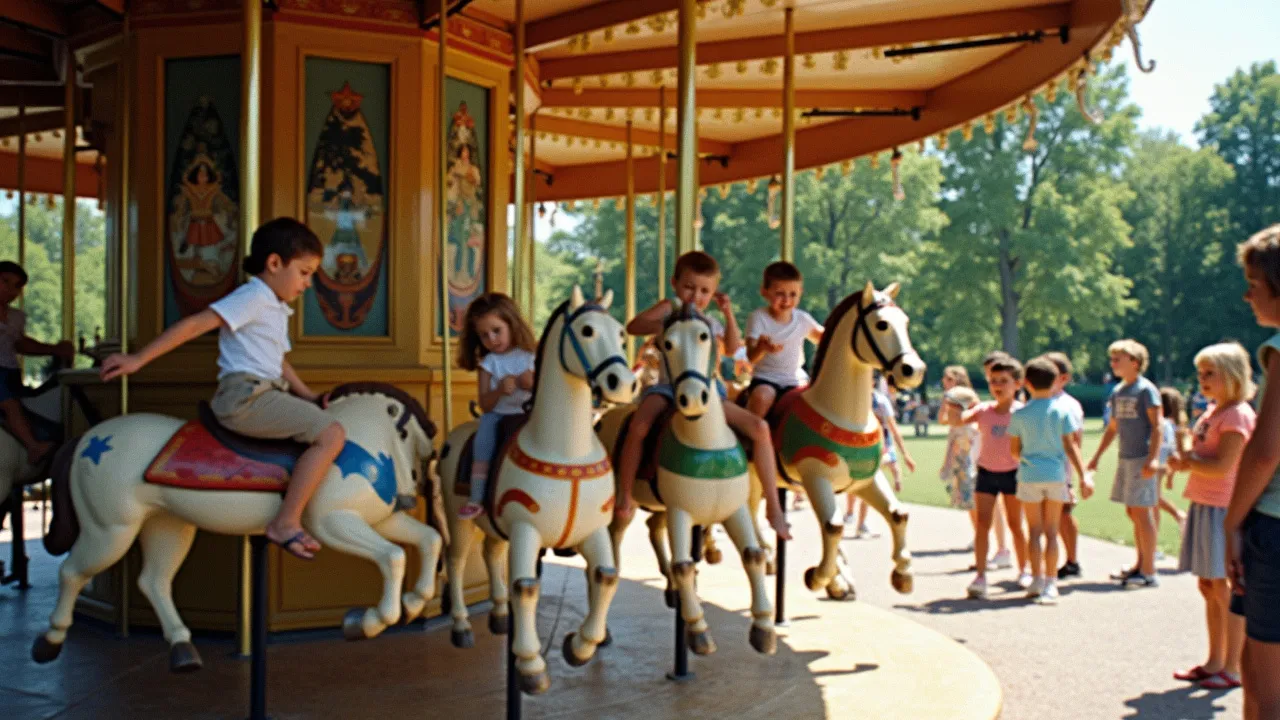
Celebrate National Merry-Go-Round Day on July 25th by enjoying the timeless joy of carousels. Discover their rich history, from 19th-century origins to modern-day preservation and community celebrations worldwide.
The Historical Origins & Evolutionary Journey
National Merry-Go-Round Day, celebrated each year on July 25th, honors one of the most beloved amusement rides in history. This day was established by the National Carousel Association (NCA) in 2012 to raise awareness about the cultural and historical significance of carousels, and to encourage their preservation for future generations.
The Foundational Catalyst
The earliest carousels, or "roundabouts," originated in Europe during the 18th century as a training exercise for knights. Riders would toss rings or catch balls while riding wooden horses mounted on a rotating platform. By the 19th century, carousels evolved into public amusements, powered first by horses or mules, then by steam engines. The first steam-powered carousel appeared in 1861 in England, invented by Thomas Bradshaw. This innovation allowed for larger, faster, and more elaborate machines.
The Legislative/Official Adoption
In the United States, carousels experienced a golden age from the 1880s to the 1920s, with master carvers like Gustav Dentzel, Charles Looff, and Marcus Illions creating intricately carved animals. The NCA, founded in 1973, began advocating for carousel preservation. In 2012, the NCA officially declared July 25th as National Merry-Go-Round Day, chosen because it falls midway between the start of summer and the start of the school year in many regions, offering a perfect time for family outings.
Modern Global Legacy
Today, carousels are cherished worldwide, from vintage hand-carved models at amusement parks to modern, brightly lit versions. National Merry-Go-Round Day promotes not only riding but also learning about the craftsmanship, restoration, and history of these rotating masterpieces. Many museums, such as the Carousel Museum in Bristol, Connecticut, and the Merry-Go-Round Museum in Sandusky, Ohio, host special events on this day.
How to Celebrate National Merry-Go-Round Day
Whether you are an individual, a school, or an organization, there are many meaningful ways to participate in National Merry-Go-Round Day. The key is to combine fun with education and preservation.
For Individuals and Families
- Visit a local carousel: Find a historic or operating carousel near you. Many offer discounted rides on July 25th. Use the NCA's website to locate one.
- Learn the history: Read books or watch documentaries about carousel art and mechanics. Discuss with children the craftsmanship behind the carved animals.
- Host a merry-go-round-themed party: Decorate with carousel motifs, play calliope music, and serve classic fair treats like cotton candy and popcorn.
For Schools and Community Groups
- Organize a field trip: Arrange a visit to a carousel museum or a working carousel. Many museums offer educational programs for students.
- Art projects: Have children design their own carousel animal or miniature carousel model. Discuss different carving styles.
- Fundraising for preservation: Host a bake sale or carousel-themed event to raise money for a local carousel restoration project.
For Organizations and Businesses
- Sponsor a free ride day: Partner with a carousel operator to offer complimentary rides, promoting community engagement.
- Educational workshops: Invite carousel historians or restorers to give talks about the importance of preserving these artifacts.
- Social media campaigns: Use hashtags like #NationalMerryGoRoundDay and #PreserveTheCarousel to share photos and stories.
Around the world, celebrations vary. In the United States, many historic parks host events. In Europe, particularly in the UK and Germany, old-fashioned fairs set up temporary carousels. In Japan, modern electronic carousels in urban centers attract families. The common thread is the joy of the ride.
Global Impact and Cultural Significance
Carousels are more than just amusement rides; they are cultural icons that reflect the art, technology, and social history of their time. From the grand carousels of Coney Island to the portable fairground rides in rural India, these rotating platforms have brought joy to millions.
Cultural Symbolism
In many cultures, the carousel symbolizes nostalgia, childhood innocence, and the cyclical nature of life. The repetitive motion and vibrant colors evoke a sense of timelessness. Literature and film often use carousels as metaphors for journeys or transitions, such as in the movie Mary Poppins or the novel The Carousel by Richard Paul Evans.
Economic Impact
Carousels are significant tourist attractions, especially in historic seaside resorts. They contribute to local economies by drawing visitors. Preservation efforts also create jobs for craftsmen, carpenters, and painters. The NCA estimates that the annual economic impact of operating and restoring classic carousels in the U.S. alone exceeds $50 million.
Preservation Movements
As many vintage carousels face closure due to maintenance costs, preservation groups like the NCA and local historical societies work to restore and maintain them. National Merry-Go-Round Day raises awareness and funding for these efforts. The day also highlights the importance of documenting oral histories from former carousel operators and carvers before they are lost.
Craftsmanship and Artistic Styles
The artistry of carousel animals is a unique American folk art form that reached its peak between 1890 and 1920. Each carousel is a gallery of hand-carved wooden figures, often featuring horses, but also including rabbits, pigs, dragons, and chariots.
Master Carvers and Their Styles
- Gustav Dentzel: A German immigrant, considered the father of American carousel carving. His style was realistic, with naturalistic poses and detailed anatomy.
- Charles Looff: Known for lively, spirited horses with flowing manes and tails. Looff's animals often have intricate saddles and trappings.
- Marcus Illions: A Lithuanian immigrant whose work featured elegant, elongated bodies and fine detailing, often with medieval or romantic themes.
Regional Variations
American carousels are often classified by the region where they were built. The Philadelphia style (Dentzel, Muller) features realistic animals with jumping poses. The Coney Island style (Stein & Goldstein, Illions) shows more flamboyant, prancing figures. The Midwest style (Mangels, Herschell) often includes more whimsical, colorful animals with simpler carving due to mass production.
Modern Revival
While many vintage carousels are preserved, new carousels are still being built using traditional techniques. Artists like the Tussaud family in the UK and Ron Seale in the U.S. keep the craft alive. Carving a single horse can take up to six months, reflecting the dedication to this endangered art form.
The Science of the Ride: Mechanics and Design
Behind the beauty lies ingenious engineering. Carousels are complex machines that have evolved from simple horse-powered platforms to sophisticated electric rides with elaborate lighting and sound systems.
Power and Motion
Traditional carousels use a central drive shaft powered by an electric motor. The animals are mounted on poles that move up and down using a crankshaft mechanism, mimicking a galloping motion. This up-and-down movement is called the "gallop" and was a defining innovation of the 19th century. Some carousels have both stationary and jumping horses.
Music and Lighting
Most classic carousels feature a band organ (calliope) that produces music via paper rolls or MIDI controllers. The sound is often synchronized with the ride. Lighting designs use thousands of incandescent bulbs, with vintage carousels often showcasing colorful glass lenses. Modern LED systems are now common, offering energy efficiency and vibrant effects.
Safety and Maintenance
Preserving a carousel requires constant maintenance. Wooden animals must be protected from weather and pests. Mechanical parts need lubrication and replacement. The NCA provides guidelines for safe operation. Riders with disabilities can enjoy adapted chariots or specially designed animals. National Merry-Go-Round Day promotes safe riding practices and appreciation for the engineering that makes these rides possible.
Notable Carousels Around the World
From Europe to Asia, iconic carousels captivate visitors. Here are some of the most famous examples that embody the spirit of National Merry-Go-Round Day.
- The Carousel at the Musée des Arts Forains (Paris, France): A beautifully restored 19th-century carousel with unique figures, part of a museum of fairground arts.
- Santa Monica Pier Carousel (California, USA): A classic 1920s carousel with 44 horses, featured in many films.
- The Wiener Riesenrad Carousel (Vienna, Austria): Housed near the famous Ferris wheel, this carousel is a favorite among families.
- Jan & Jan’s Carousel (Efteling, Netherlands): A modern, hand-carved wooden carousel built in the 1990s, continuing the tradition.
- Tokyo Disneyland Carousel (Japan): A Disney-themed carousel with whimsical characters, showcasing modern craftsmanship.
These sites often hold special activities on July 25th, such as behind-the-scenes tours and collector meetups.
Historical Timeline
Early carousels emerge in Europe as knight training devices, with riders using lances to catch rings.
Thomas Bradshaw builds the first steam-powered carousel in England, revolutionizing speed and scale.
Golden Age of American carousels: master carvers like Gustav Dentzel and Charles Looff create iconic hand-carved animals.
Great Depression leads to closure of many carousels; mass-produced metal and fiberglass animals become common.
National Carousel Association (NCA) founded to preserve historic carousels and promote their history.
NCA establishes National Merry-Go-Round Day on July 25th to celebrate carousels and encourage public engagement.
Hundreds of carousels worldwide participate in National Merry-Go-Round Day with special rides, educational events, and preservation fundraisers.