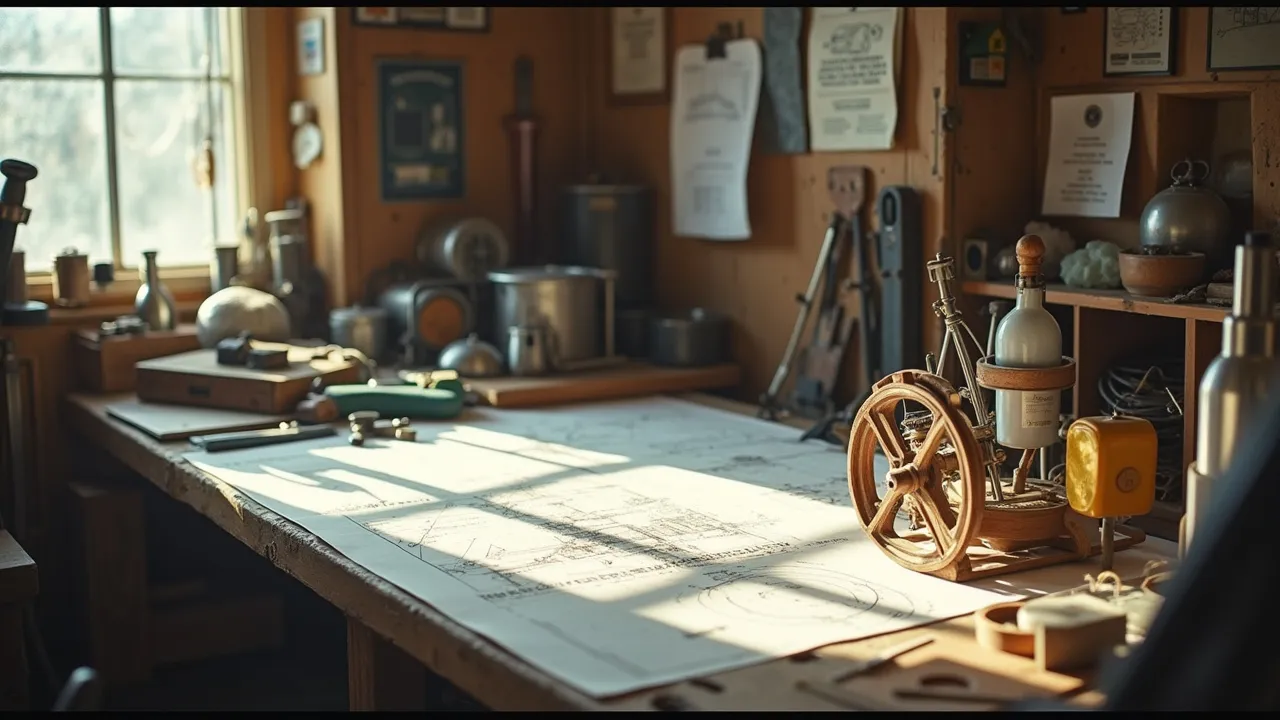
National Inventors' Day on February 11th honors the spirit of innovation and the contributions of inventors throughout history. Established to coincide with Thomas Edison's birthday, the day celebrates creativity and problem-solving.
The Historical Origins & Evolutionary Journey
National Inventors' Day is an American observance that pays tribute to the ingenuity and perseverance of inventors who have shaped the modern world. The day was officially proclaimed by President Ronald Reagan on February 11, 1983, chosen to coincide with the birthday of one of history's most prolific inventors, Thomas Alva Edison (born February 11, 1847).
The Foundational Catalyst
The idea for a dedicated day to honor inventors emerged from the recognition that innovation drives economic growth and societal progress. Thomas Edison, with over 1,000 US patents, epitomized the American inventive spirit. His work on the electric light bulb, phonograph, and motion picture camera transformed daily life globally. The choice of his birthday as the observance date underscores the value placed on creative thinking and practical problem-solving.
The Legislative/Official Adoption
In 1983, the US Congress passed a joint resolution, and President Reagan issued Proclamation 5013, designating February 11 as National Inventors' Day. The proclamation called upon the American people to celebrate the day with appropriate ceremonies and activities, encouraging schools, businesses, and communities to highlight the contributions of inventors. The US Patent and Trademark Office (USPTO) has since played a key role in promoting the day, often hosting events and educational programs.
Modern Global Legacy
While National Inventors' Day is primarily observed in the United States, similar days exist in other countries. For example, Argentina celebrates Inventor's Day on September 29 (birthday of László Bíró, inventor of the ballpoint pen), and several European nations have their own inventor celebrations. The core theme of fostering innovation remains universal. In the US, the day has evolved to include STEM education initiatives, patent workshops, and the recognition of young inventors through programs like the National Inventors Hall of Fame.
How to Celebrate National Inventors' Day
National Inventors' Day offers a unique opportunity to engage with the process of invention and inspire future creators. Here are actionable strategies for individuals, schools, and organizations:
For Individuals
- Explore Your Creativity: Spend time brainstorming ideas for a new gadget, process, or solution to a daily problem. Keep an inventor's journal to document your thoughts.
- Visit a Museum or Science Center: Many institutions host special exhibits on inventors. The National Inventors Hall of Fame in Ohio is a must-see.
- Read About Inventors: Delve into biographies of famous inventors like Marie Curie, Nikola Tesla, or Hedy Lamarr to understand their journeys.
- Share Your Invention: If you have an invention, consider applying for a patent or sharing it on platforms like Instructables or YouTube.
For Schools and Educators
- Invention Challenges: Organize a class-wide invention contest with simple materials (e.g., paper, tape, recycled items). Encourage problem-solving for real-world issues.
- Guest Speakers: Invite local engineers, patent attorneys, or entrepreneurs to discuss the invention process.
- Field Trips: Arrange visits to patent offices, research labs, or innovation hubs.
- Curriculum Integration: Teach about the history of patents and the role of intellectual property in protecting ideas.
For Organizations and Companies
- Patent Workshops: Host seminars on how to file patents or protect intellectual property.
- Innovation Awards: Celebrate employees' inventive contributions with recognition and prizes.
- Community Events: Partner with local libraries to host maker fairs, Hackathons, or invention showcases.
- Support STEM Programs: Donate to or sponsor initiatives that encourage young inventors, such as FIRST Robotics or Science Olympiad.
Across different cultures, celebration styles vary. In the US, the day often includes social media campaigns using hashtags like #NationalInventorsDay. In other countries, such as India (celebrated on March 15, the birth anniversary of Sir M. Visvesvaraya), the focus is on engineering and architectural innovations. The key is to emphasize the iterative process of trial and error that defines true invention.
The Impact of Inventors on Modern Society
Inventions have fundamentally reshaped every aspect of human existence. From the wheel to the internet, each breakthrough builds upon prior knowledge. National Inventors' Day serves as a reminder of this cumulative innovation.
Technological Revolutions
The Industrial Revolution (18th-19th centuries) brought steam engines, textile machinery, and mass production. The Digital Revolution (20th-21st centuries) introduced computers, smartphones, and artificial intelligence. Inventors like Tim Berners-Lee (World Wide Web), Steve Jobs (personal computing), and Grace Hopper (programming languages) are celebrated for their vision.
Medical Breakthroughs
Inventions in medicine have saved millions of lives. Key examples include:
- Vaccines (Edward Jenner, Louis Pasteur)
- Penicillin (Alexander Fleming)
- Medical imaging (Wilhelm Röntgen - X-rays, Raymond Damadian - MRI)
- Insulin synthesis (Frederick Banting, Charles Best)
Everyday Conveniences
Many inventions improve daily life:
- The telephone (Alexander Graham Bell)
- The light bulb (Thomas Edison, Joseph Swan)
- The automobile (Karl Benz, Henry Ford)
- Refrigeration (John Gorrie, Carl von Linde)
Environmental Innovations
Modern inventors focus on sustainability: solar panels, electric vehicles, water purification systems, and biodegradable materials. The day encourages thinking about inventions that address climate change and resource scarcity.
Famous Inventors and Their Legacy
National Inventors' Day shines a spotlight on both historical and contemporary inventors. Recognizing their contributions inspires future generations.
Thomas Edison (1847–1931)
Inventor of the phonograph, motion picture camera, and practical electric light bulb. He held 1,093 US patents and founded General Electric. His Menlo Park laboratory became a model for modern R&D facilities.
Nikola Tesla (1856–1943)
A pioneer of alternating current (AC) electricity, Tesla's inventions include the Tesla coil, radio (contested with Marconi), and wireless transmission. His visionary ideas influenced many modern technologies.
Marie Curie (1867–1934)
Two-time Nobel laureate who discovered radium and polonium, pioneered research into radioactivity, and developed mobile X-ray units during World War I.
Hedy Lamarr (1914–2000)
Known as a Hollywood actress, she co-invented a frequency-hopping spread spectrum technology that later formed the basis for Wi-Fi, Bluetooth, and GPS.These inventors exemplify the diverse backgrounds and fields from which innovation springs. Their legacies highlight the importance of perseverance, often overcoming skepticism and failure. The day encourages us to recognize that invention is not limited to a single gender, race, or culture.
Modern Relevance: Inventing in the 21st Century
In today's fast-paced world, invention is more critical than ever. National Inventors' Day acts as a catalyst for discussions on intellectual property, innovation ecosystems, and the role of government in fostering creativity.
The Role of Patents
Patents protect inventors' rights and encourage disclosure of new ideas. The US Patent and Trademark Office grants over 300,000 patents annually. Understanding the patent process is essential for modern inventors.
Open Innovation and Collaboration
Unlike the lone inventor archetype of the past, many modern inventions emerge from collaborative efforts, open-source projects, and corporate R&D teams. Examples include the Linux operating system and the CRISPR gene-editing technology.
Challenges and Opportunities
Key challenges include securing funding, navigating regulatory hurdles, and ensuring ethical use of technology. However, platforms like crowdfunding (Kickstarter), rapid prototyping (3D printing), and online learning (MOOCs) have democratized invention. National Inventors' Day promotes initiatives like STEM education, maker spaces, and innovation hubs that nurture the next generation of inventors.
Global Perspectives and Regional Variations
While National Inventors' Day is a US observance, many countries have their own inventor days, often tied to a notable national inventor's birthday.
- Argentina: Inventor's Day on September 29 (László Bíró’s birthday).
- India: National Technology Day on May 11 (1998 nuclear tests), but also Engineer's Day on March 15 (M. Visvesvaraya). Some schools celebrate inventor days on various dates.
- Hungary: Hungarian Inventors' Day on June 13 (Albert Szent-Györgyi’s birthday).
- Slovenia: Inventors' Day on December 7 (birthday of Otto von Guericke).
In the US, the official observance is February 11, but many organizations extend celebrations throughout the week. The day also coincides with International Day of Women and Girls in Science (February 11) which was established by the UN to promote gender equality in STEM. This overlap reinforces the importance of inclusive innovation.
Historical Timeline
Thomas Alva Edison, the most prolific American inventor, is born on February 11. His inventions include the phonograph, motion picture camera, and practical electric light bulb.
President Ronald Reagan signs Proclamation 5013, designating February 11 as National Inventors' Day in the United States.
The National Inventors Hall of Fame is established in Akron, Ohio, inducting inventors who have significantly contributed to society.
The USPTO begins hosting annual National Inventors' Day events, including educational programs and patent workshops for students.
The first White House Science Fair highlights student inventors, reinforcing the connection between National Inventors' Day and STEM education.
The USPTO launches the 'Patents for Humanity' program, encouraging inventors to tackle global challenges like health care and climate change.
The 40th anniversary of National Inventors' Day is celebrated with virtual events, expanded outreach, and recognition of diverse inventors.