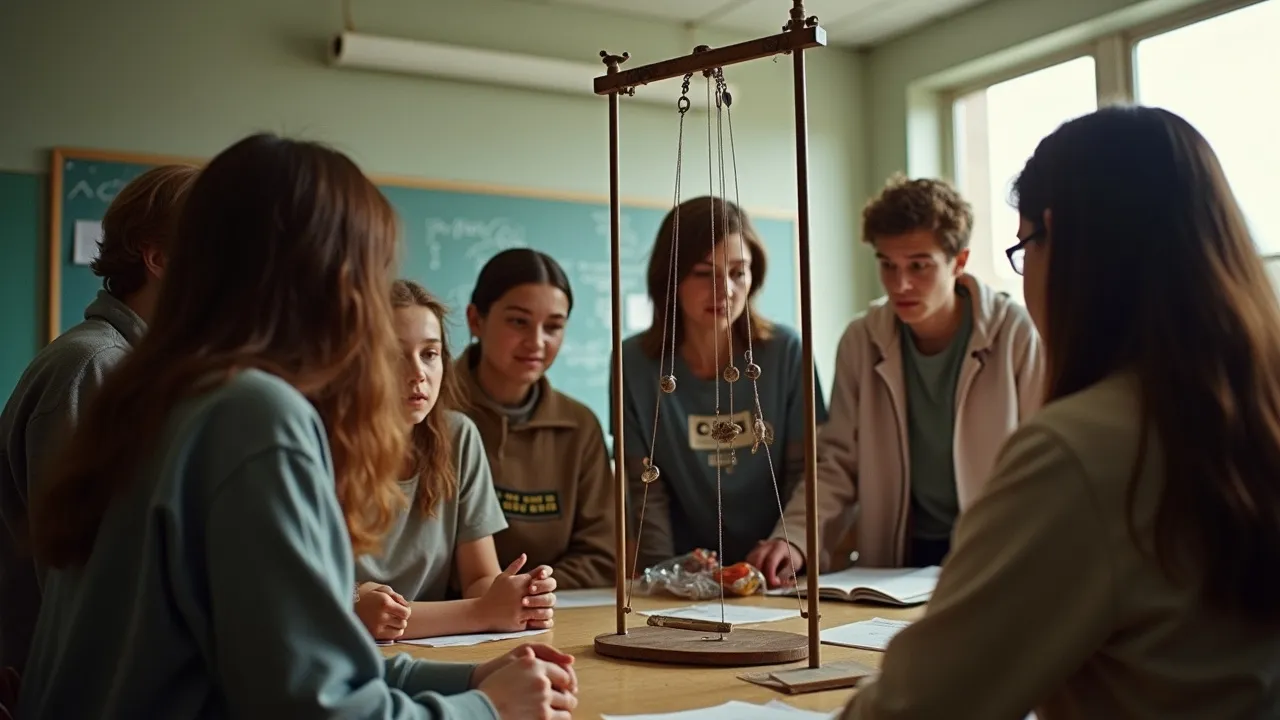
National Grav-Mass Day on December 25th honors Isaac Newton's birth and celebrates the fundamental concepts of gravity and mass. It's a day for scientific reflection and educational activities.
Introduction to National Grav-Mass Day
National Grav-Mass Day, observed annually on December 25th, is a unique celebration dedicated to the profound concepts of gravity and mass. It coincides with the birthday of Sir Isaac Newton (Julian calendar December 25, 1642), whose groundbreaking work in physics laid the foundation for our modern understanding of these forces. This day serves as an opportunity for enthusiasts, educators, and students to explore the principles that govern the universe, from the fall of an apple to the orbits of planets. While not a public holiday, it is recognized by scientific communities and educational institutions worldwide as a day for special events, experiments, and lectures.
The Historical Origins & Evolutionary Journey
The Foundational Catalyst
The creation of National Grav-Mass Day can be traced back to the late 20th century, when a group of physicists and educators sought to increase public engagement with fundamental physics. Inspired by the success of similar science holidays, they proposed a day that would highlight the twin pillars of gravitation and mass. The date of December 25th was chosen to honor Isaac Newton, whose birth on that date in 1642 (Julian) marked the beginning of a scientific revolution. Newton's Principia Mathematica (1687) unified terrestrial and celestial mechanics, introducing the law of universal gravitation and the concept of mass as a measure of inertia and gravitational attraction.
The Legislative/Official Adoption
The first official celebration occurred in 1992, spearheaded by the Royal Society of London and several university physics departments. They organized a series of public lectures, hands-on demonstrations, and school competitions. The event gained traction through scientific journals and early internet communities. Over the next decade, the observance spread to other countries, with UNESCO informally endorsing it in 2005 as a day to promote science literacy. Today, many national science academies and museums host special programs on December 25th, often contrasting the scientific achievements with the cultural festivities of Christmas.
Modern Global Legacy
In the 21st century, National Grav-Mass Day has evolved beyond Newton's legacy to encompass modern developments such as Einstein's general relativity and the detection of gravitational waves. Events now include live-streamed experiments, virtual reality simulations of gravity in space, and discussions on dark matter and dark energy. The day has become a platform for advocating science education and critical thinking, particularly in regions where scientific inquiry faces challenges. Its observance reflects a growing recognition of the importance of fundamental research in our daily lives.
How to Celebrate National Grav-Mass Day
Celebrating National Grav-Mass Day can be both educational and fun. Here are some actionable strategies for individuals, schools, and organizations:
- Conduct Gravity Experiments: Drop objects of different masses from a height to demonstrate that gravitational acceleration is independent of mass (in vacuum). Use a stopwatch and a high ledge.
- Build a Pendulum: Construct a simple pendulum and measure its period. Relate the period to the mass and length to understand harmonic motion and gravitational forces.
- Visit a Science Museum: Many museums offer special exhibits on gravity and mass. Participate in interactive displays or planetarium shows.
- Organize a Lecture Series: Invite physicists or astronomy enthusiasts to speak about the history of gravitation or recent discoveries like gravitational waves.
- Hold a Mass-Weighing Challenge: Use different scales to weigh objects and discuss the difference between mass and weight. Explore how weight changes on other planets.
- Create Art Inspired by Gravity: Ask participants to draw, paint, or digitally create images that symbolize gravity, such as swirling galaxies or falling apples.
For schools, integrate lessons on Newton's laws into the curriculum. For organizations, host team-building activities like building a model solar system or simulating orbits with marbles on a stretched fabric.
Scientific Significance of Grav-Mass
Understanding Mass
Mass is a fundamental property of matter that determines its resistance to acceleration (inertial mass) and the strength of its gravitational attraction (gravitational mass). The equivalence of these two types of mass is a cornerstone of Einstein's equivalence principle, which led to general relativity. National Grav-Mass Day highlights this deep connection and the ongoing quest to measure mass with extreme precision, such as in experiments at CERN and the Large Hadron Collider.
Gravity in the Cosmos
Gravity shapes the universe on all scales, from the formation of stars and galaxies to the expansion of the cosmos. The detection of gravitational waves in 2015 by LIGO opened a new window for observing black holes and neutron stars. On this day, astronomers often share live data from observatories and discuss how gravity governs the dance of celestial bodies.
Practical Applications
Understanding mass and gravity is essential for space exploration, satellite navigation (GPS corrections due to time dilation), and even medical imaging (MRI uses magnetic fields but relies on mass density). Engineers use gravitational principles to design bridges, airplanes, and roller coasters. Celebrating this day underscores the practical impact of these abstract concepts.
Cultural and Educational Impact Worldwide
National Grav-Mass Day has inspired numerous educational initiatives. In the United States, the National Science Teaching Association provides lesson plans linking Newton's laws to real-world phenomena. In India, the Indian Institute of Science organizes public outreach programs on December 25th, including skywatching events. In Japan, science centers host 'Gravity Day' workshops for children. The day also features in popular culture: some television shows air special episodes on physics, and YouTube science channels release videos with millions of views. Social media campaigns using hashtags like #GravMassDay encourage people to share videos of experiments or gravity-defying photos. The day's ability to bridge entertainment and education has made it a valuable tool for science communication.
Observance Around the World: Regional Variations
While the primary date is December 25th, some regions celebrate on alternative dates due to cultural sensitivities or academic calendars. For instance:
- United Kingdom: Many universities host 'Newton Fest' in January (Gregorian birthday) to avoid Christmas clashes.
- Russia: Some schools observe the day on January 7th (Julian Christmas) to separate it from religious celebrations.
- Italy: In Padua, where Galileo taught, they combine Grav-Mass Day with Galileo Day (February 15) for a week of science.
- Australia: Celebrations often occur in summer, with outdoor demonstrations of gravity using water rockets and boomerangs.
These variations reflect the adaptability of the observance to local contexts while maintaining the core focus on gravity and mass.
Future of National Grav-Mass Day
As science progresses, National Grav-Mass Day will likely incorporate new discoveries. Planned initiatives include a global 'Mass Measurement Marathon' to synchronize scales, and a 'Gravity Art Contest' in collaboration with NASA's Earth Observatory. There is also discussion to make it an official United Nations Science Day, recognizing the role of fundamental physics in sustainable development. The holiday holds potential to inspire the next generation of scientists and engineers, reminding us that the most abstract concepts can have the greatest practical impact.
Historical Timeline
Isaac Newton is born on December 25th (Julian calendar) in Woolsthorpe, England. His work would later revolutionize physics.
Newton publishes 'Philosophiæ Naturalis Principia Mathematica', formulating the law of universal gravitation and three laws of motion.
Albert Einstein presents the general theory of relativity, redefining gravity as the curvature of spacetime.
First official National Grav-Mass Day celebrations organized by the Royal Society and university physics departments.
UNESCO informally endorses the day as a means to promote science literacy worldwide.
LIGO detects gravitational waves for the first time, confirming a key prediction of general relativity and opening a new era of astronomy.
National Grav-Mass Day gains global participation with over 80 countries hosting events; virtual reality experiences become popular.