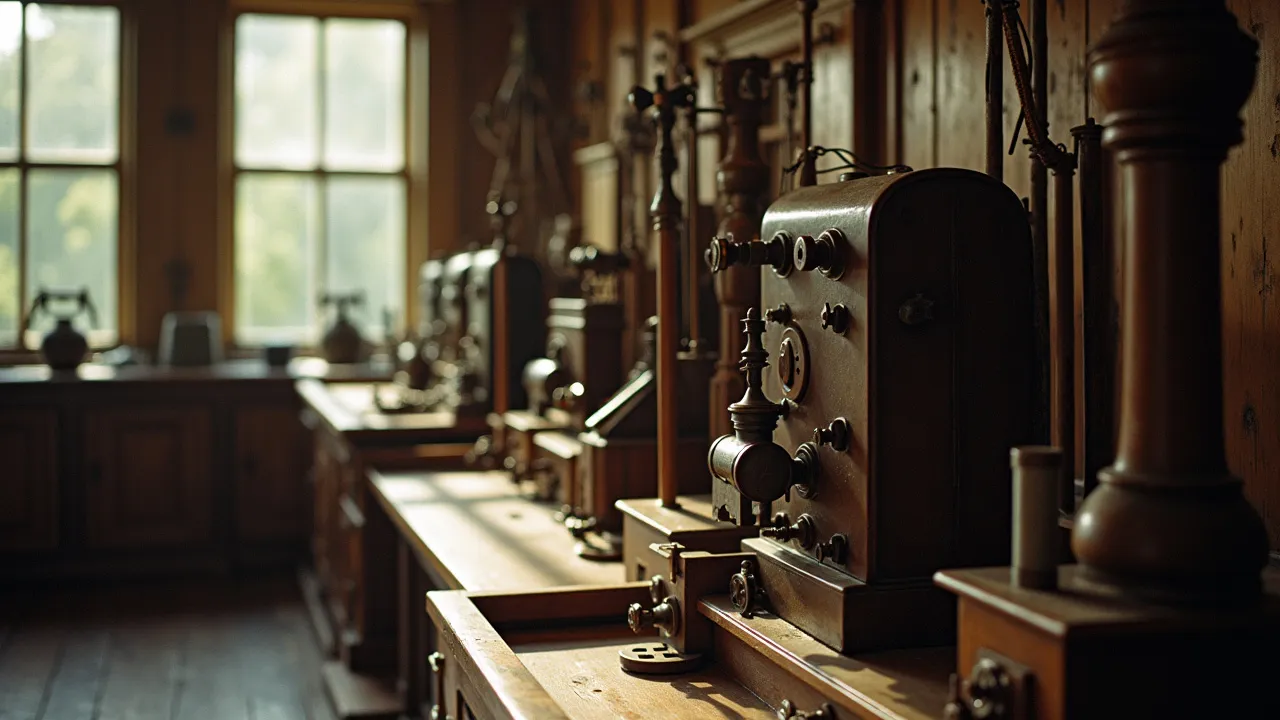
Loomis Day on May 30th honors Mahlon Loomis, the dentist who pioneered wireless telegraphy. This day celebrates innovation in communication and encourages exploration of radio technology.
The Historical Origins & Evolutionary Journey
Loomis Day commemorates the birth of wireless communication, rooted in the experiments of Dr. Mahlon Loomis (1826–1886), a dentist and inventor from New York. On May 30, 1866, Loomis successfully transmitted signals between two mountains in Virginia using kites and copper wires—a feat that predates Marconi by decades.
The Foundational Catalyst
Loomis's inspiration came from observing static electricity. He theorized that the atmosphere could conduct signals. In his 1872 patent, he described a method for "improvement in telegraphy" using atmospheric electricity. His demonstration involved sending a signal over 14 miles (22 km) without wires, using a grounded kite with a copper wire and a galvanometer.
Legislative & Official Adoption
Though Loomis received U.S. Patent No. 129,971 in 1872, his work was largely ignored until the 20th century. In 1966, the Wireless History Foundation designated May 30th as Loomis Day to honor his contributions. The date aligns with the anniversary of his 1866 demonstration.
Modern Global Legacy
Today, Loomis Day is observed by amateur radio operators, tech historians, and wireless enthusiasts. It serves as a reminder that innovation often comes from unexpected sources. The day is also a catalyst for STEM education, highlighting the evolution from telegraphy to 5G.
How to Celebrate Loomis Day
Loomis Day offers a unique opportunity to engage with the history and future of wireless communication. Here are actionable ways to celebrate:
For Individuals
- Visit a Wireless Museum: Explore exhibits on early telegraphy and radio. Many museums offer virtual tours.
- Build a Simple Crystal Radio: A hands-on project that demonstrates basic wireless principles.
- Listen to Morse Code: Tune into a ham radio frequency or use online tools to decode transmissions.
For Schools & Educational Institutions
- Host a STEM Workshop: Teach students about electromagnetic waves and Loomis's experiments.
- Organize a Kite-Flying Event: Replicate Loomis's experiment with a twist—use modern sensors to measure atmospheric conditions.
- Invite a Ham Radio Operator: Live demonstrations of wireless communication inspire future engineers.
For Organizations & Corporations
- Recognize Innovators: Award employees who push technological boundaries.
- Support STEM Grants: Contribute to organizations that fund wireless research.
- Host a Tech Talk: Discuss the evolution of wireless networks from 1G to 6G.
Globally, Loomis Day is celebrated differently: in the USA with ham radio field days, in Japan (where Loomis's work influenced early radio development) with exhibitions, and in Europe with academic symposiums on radio history.
The Science Behind Loomis's Experiment
Mahlon Loomis's 1866 demonstration relied on natural atmospheric electricity. He used two kites, each with a copper wire that touched the ground on one end and a galvanometer on the other. When one kite's wire was moved, the galvanometer on the other mountain deflected, indicating signal transmission.
Key Principles
- Conduction: Loomis believed the atmosphere was an electrical conductor. While incorrect about the exact mechanism, he inadvertently used ground currents and capacitive coupling.
- Grounding: The system required grounding at both ends, similar to modern monopole antennas.
- Frequency: Loomis's signals were in the VLF range (3–30 kHz), allowing propagation over distances.
Modern analysis suggests that Loomis's success was due to near-field inductive coupling rather than true wireless waves. Nonetheless, his work was a precursor to Marconi's and Tesla's innovations.
Loomis Day Global Impact & Cultural Relevance
While not a public holiday, Loomis Day resonates with communities passionate about radio history. It has fostered a niche but dedicated following among amateur radio operators (hams), who often hold special events on May 30th.
Cultural Themes
- Innovation from Unexpected Sources: Loomis was a dentist, not a physicist—a testament to cross-disciplinary creativity.
- Preserving History: The day encourages digitization of early wireless patents and correspondence.
- Inspiration for Youth: STEM programs use Loomis's story to show that anyone can contribute to technology.
In the digital age, social media campaigns like #LoomisDay amplify the message, with posts about Loomis's patents, radio trivia, and diy project tutorials.
How Loomis Day Influences Modern Wireless Standards
The principles Loomis tested are foundational to critical modern technologies:
- RFID: Near-field communication (NFC) is a direct descendant of Loomis's inductive coupling.
- Wireless Power Transfer: Short-range wireless charging uses similar magnetic fields.
- Distributed Antenna Systems: Modern cellular networks use concepts of ground-based conduction for signal distribution.
Loomis Day thus serves as a reminder that early experiments shape the backbone of today's connectivity. Engineers often cite Loomis's patent as one of the earliest for wireless systems, influencing later giants like Tesla and Marconi.
Educational Resources & STEM Connections
Loomis Day is a prime opportunity to introduce students to electromagnetism and communication history. Recommended resources:
Books & Articles
- The Wireless Telegraphy of Mahlon Loomis by John S. Belrose.
- Patent No. 129,971 (full text available online).
- Historical papers from the IEEE Microwave Theory and Techniques Society.
Hands-On Activities
- Build a Telegraph Key: Simple circuit with battery, buzzer, and switch.
- Simulate Loomis's Experiment: Use two cardboard kites, copper wire, and a multimeter on a sunny day.
- Analyze Radio Waves: Use an SDR (software-defined radio) to detect AM/FM signals.
Many libraries and science centers host Loomis Day workshops, and online tutorials from ARRL (American Radio Relay League) provide guides.
Historical Timeline
Mahlon Loomis is born in Oppenheim, New York.
On May 30, Loomis conducts first wireless telegraphy demonstration between two mountains in Virginia, sending a signal 14 miles.
Loomis receives U.S. Patent No. 129,971 for 'Improvement in Telegraphy' — one of the earliest wireless patents.
Mahlon Loomis dies in Terra Alta, West Virginia, largely unrecognized for his contributions.
Guglielmo Marconi builds on similar principles to achieve long-distance wireless communication.
Wireless History Foundation establishes May 30th as Loomis Day to honor his pioneering work.
The Loomis Day celebration gains traction among ham radio clubs in the United States.
IEEE Milestone plaque placed near Loomis's experiment site in West Virginia.
Loomis Day is recognized globally through online events, including a virtual symposium on wireless history.