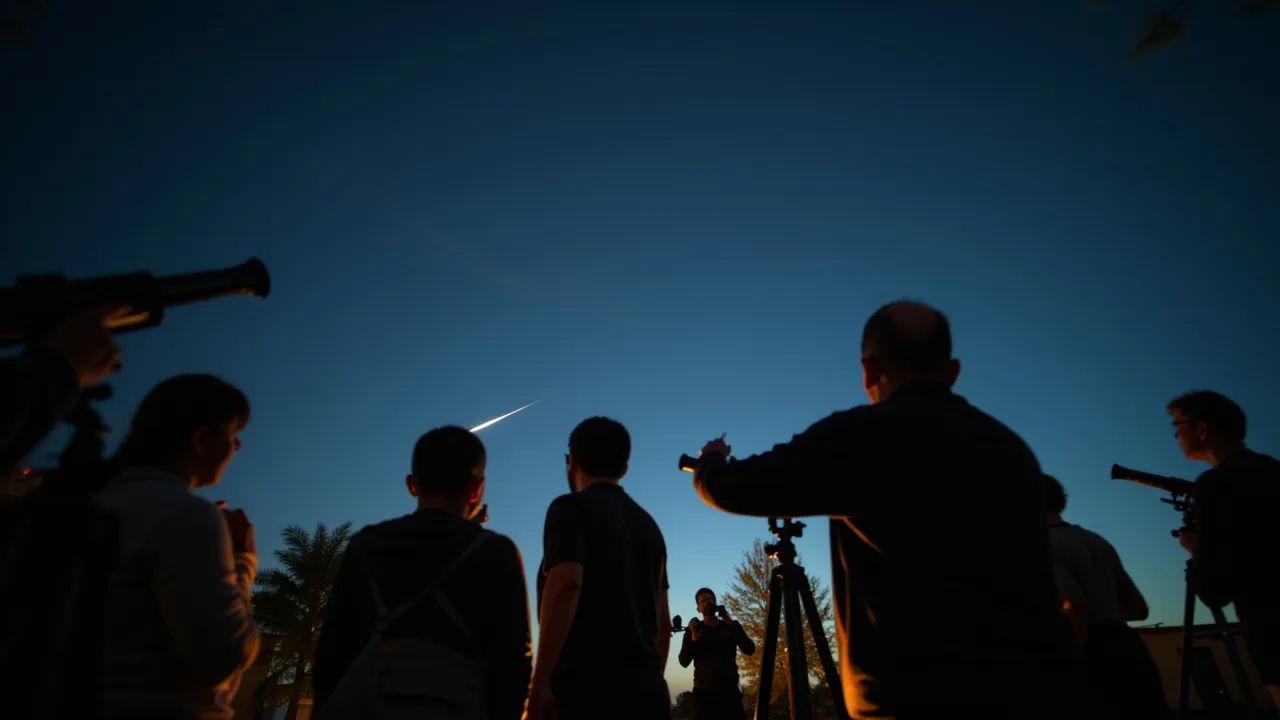
International Asteroid Day is observed annually on June 30th to raise awareness about asteroids and the need for planetary defense. Established by the United Nations, it commemorates the 1908 Tunguska event and promotes global cooperation in asteroid detection and mitigation.
History of International Asteroid Day
International Asteroid Day was established to educate the public about asteroid hazards and to encourage international cooperation in planetary defense. The date June 30th marks the anniversary of the 1908 Tunguska event, the largest asteroid impact in recorded history, which flattened 2,000 square kilometers of Siberian forest.
The Foundational Catalyst
The modern movement for an asteroid awareness day gained momentum in 2014 when prominent scientists, astronauts, and artists, including Dr. Brian May (Queen guitarist and astrophysicist), Apollo 9 astronaut Rusty Schweickart, and filmmaker Grigorij Richters, launched the Asteroid Day initiative. They drafted the 100x Declaration, calling for a 100-fold increase in asteroid detection rates.
Legislative and Official Adoption
After years of advocacy, the United Nations General Assembly officially recognized International Asteroid Day in December 2016 through Resolution A/RES/71/90. The resolution designated June 30th as the annual observance day, co-sponsored by the Association of Space Explorers and the Committee on the Peaceful Uses of Outer Space.
Modern Global Legacy
Since its UN adoption, International Asteroid Day has grown into a global phenomenon. Hundreds of events are organized each year by space agencies, museums, schools, and amateur astronomers. The day serves as a platform to announce new asteroid discoveries, planetary defense technologies, and public outreach campaigns.
How to Celebrate International Asteroid Day
Celebrating International Asteroid Day can be both educational and fun. Here is a definitive guide to activities for individuals, schools, and organizations worldwide.
For Individuals and Families
- Attend a local event: Many science centers and planetariums host special presentations, telescope viewings, and lectures.
- Watch asteroid documentaries: Stream films like 'Asteroid Hunters' or 'The Asteroid That Killed the Dinosaurs' with family.
- Participate in online webinars: Organizations like the Asteroid Foundation livestream expert panels and Q&A sessions.
- Host a stargazing night: Use binoculars or a telescope to locate asteroids like Vesta or Ceres. Apps like SkyView can help.
For Schools and Educators
- Classroom activities: Simulate asteroid impacts with flour and cocoa powder experiments to understand crater formation.
- Science projects: Encourage students to build model solar systems or research near-Earth objects (NEOs).
- Guest speakers: Invite local astronomers or planetary scientists to talk about asteroid mining or planetary defense.
For Organizations and Governments
- Launch awareness campaigns: Use social media with hashtags like #AsteroidDay and #PlanetaryDefense.
- Announce new missions: Space agencies (NASA, ESA, JAXA) often time press releases about asteroid missions on this day.
- Hold policy discussions: Organize roundtables on international cooperation for asteroid threat mitigation.
Different regions celebrate uniquely. In the United States, NASA's Jet Propulsion Laboratory hosts an open house. In Europe, the European Space Agency conducts special monitoring exercises. In Japan, public lectures highlight the Hayabusa2 mission. In Russia, memorial events honor the Tunguska event.
Global Impact on Planetary Defense
International Asteroid Day has significantly accelerated global investment in planetary defense. Since its inception, governments have allocated billions to asteroid detection and deflection technologies.
Detection Networks
- NASA's Planetary Defense Coordination Office (PDCO) was established in 2016 and now catalogs over 90% of near-Earth objects larger than 1 km.
- ESA's NEOCC (Near-Earth Object Coordination Centre) provides real-time risk assessments and coordination.
- Private initiatives like the B612 Foundation and the Asteroid Institute contribute to open-source asteroid tracking databases.
Deflection Missions
The day has inspired landmark missions. NASA's DART mission (2022) successfully crashed into the asteroid Dimorphos, altering its orbit—a proof-of-concept for kinetic impact deflection. China announced plans for a similar test by 2026. International Asteroid Day provides a platform to share these achievements and future goals.
Global Cooperation
The United Nations Office for Outer Space Affairs (UNOOSA) uses the day to promote the Space Mission Planning Advisory Group (SMPAG) and the International Asteroid Warning Network (IAWN), formalizing international response protocols for potential impact events.
Scientific Significance of Asteroids
Asteroids are remnants from the early solar system, offering crucial insights into planetary formation and the origins of life. International Asteroid Day highlights their scientific value.
Solar System History
- Asteroids like Bennu and Ryugu contain organic compounds and water-bearing minerals, suggesting they delivered the building blocks of life to Earth.
- Sample-return missions (e.g., OSIRIS-REx and Hayabusa2) have provided pristine samples that reveal the solar system's age and composition.
Resource Potential
Asteroid mining is a growing field. Metals like platinum and rare earth elements are abundant in certain asteroids. International Asteroid Day often features panels on the economic and ethical dimensions of space resource extraction.
Impact Hazards
Understanding asteroid composition is vital for deflection. Rubble pile asteroids (like Bennu) respond differently to impacts than solid ones. The day fosters research into these properties.
Asteroid Threats and Preparedness
International Asteroid Day emphasizes the real but manageable threat of asteroid impacts. While large impacts are rare, small events occur regularly.
Historical Impacts
- 1908 Tunguska Event: A 50-meter asteroid exploded over Siberia, releasing as much energy as a nuclear bomb. No casualties due to remote location, but it leveled 80 million trees.
- 2013 Chelyabinsk Event: A 20-meter asteroid broke up over Russia, injuring 1,500 people and damaging buildings. It highlighted the risk of unobserved asteroids.
Current Monitoring
The Sentinel System by NASA and the ATLAS project detect near-Earth objects daily. Over 28,000 NEOs are currently tracked, with new ones found weekly.
Emergency Plans
International Asteroid Day promotes awareness of response protocols. The IAWN provides a standard communication framework. In a real threat scenario, the United Nations would coordinate deflection or evacuation efforts.
Cultural Impact and Media
International Asteroid Day has permeated popular culture, inspiring art, film, and public discourse.
In Film and Literature
- Movies like Armageddon and Deep Impact raised public awareness, though often inaccurately. The day offers fact-checked alternatives.
- Books such as Carl Sagan's 'Pale Blue Dot' and Neil deGrasse Tyson's 'Death by Black Hole' include asteroid themes.
- Documentaries produced for the day are distributed through museums and streaming platforms.
Music and Art
Dr. Brian May (Queen guitarist/astrophysicist) co-founded the day and released a stereoscopic image of an asteroid. Museums host asteroid-themed art exhibitions. Some composers create music based on orbital data.
Social Media Campaigns
Annual hashtag campaigns reach millions. The #AsteroidDay trend on Twitter sees contributions from astronauts, scientists, and the general public sharing facts and events.
Historical Timeline
Tunguska event: A 50-meter asteroid explodes over Siberia, flattening 2,000 sq km of forest. This event later inspires the date for International Asteroid Day.
Chelyabinsk event: A 20-meter asteroid explodes over Russia, injuring 1,500 people. It underscores the need for asteroid detection and public awareness.
The Asteroid Day initiative is launched by scientists and artists including Dr. Brian May and Rusty Schweickart, with the 100x Declaration calling for faster asteroid detection.
United Nations General Assembly officially declares June 30th as International Asteroid Day via Resolution A/RES/71/90.
First official UN-sanctioned International Asteroid Day events held globally, with over 200 participating institutions.
NASA's DART mission successfully impacts the asteroid Dimorphos, demonstrating kinetic deflection technology. Results announced on Asteroid Day.
OSIRIS-REx returns samples from asteroid Bennu. Analysis reveals carbon and water compounds, fueling discussions on asteroid mining and origins of life.
International Asteroid Day expands to include virtual reality simulations of asteroid impacts; over 50 countries host official events.