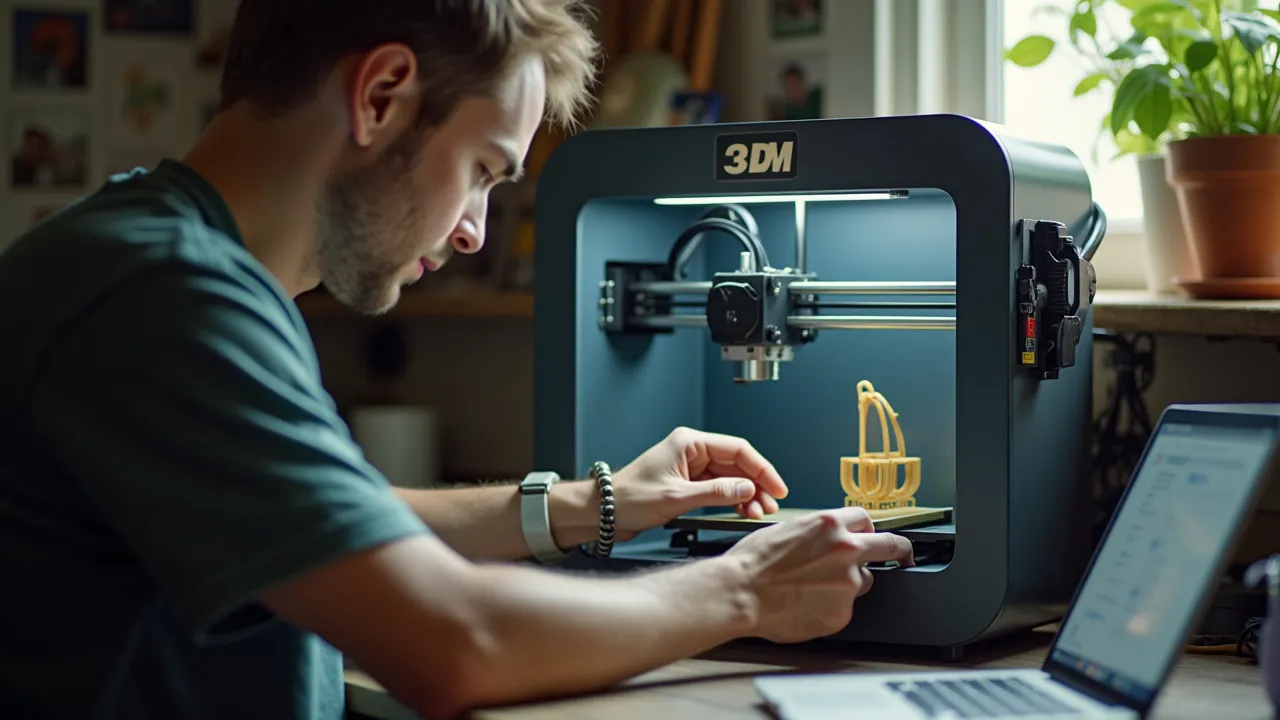
International 3D Printing Day, observed annually on December 3rd, celebrates the transformative technology of additive manufacturing. It honors the innovations that have revolutionized prototyping, production, and customization across industries.
The Historical Origins & Evolutionary Journey
The Foundational Catalyst
The origins of 3D printing date back to 1983 when Charles Hull invented stereolithography (SLA). He later founded 3D Systems Corporation and commercialized the first 3D printer in 1987. This invention laid the groundwork for additive manufacturing, a process that builds objects layer by layer from digital models. Initially used for rapid prototyping, the technology slowly expanded into various industries.
The Official Adoption of International 3D Printing Day
International 3D Printing Day was established in 2016 by a coalition of industry leaders, including 3D Systems, Stratasys, and the Additive Manufacturing Users Group (AMUG). The date December 3rd was chosen to symbolize the three dimensions (12/3) and to honor the three-decade anniversary of the first patent. The day was officially recognized by the United Nations as a day to promote innovation and sustainable manufacturing.
Modern Global Legacy
Today, International 3D Printing Day is celebrated through events like the 3D Printing Conference, online webinars, and community workshops. Educational institutions use it to introduce students to design thinking, while companies showcase new materials like biopolymers and metals. The observance underscores how 3D printing has evolved from a niche prototyping tool into a mainstream manufacturing technology that empowers customization, reduces waste, and accelerates innovation worldwide.
How to Celebrate International 3D Printing Day
For Individuals
- Try designing a simple object using free CAD software like Tinkercad or Fusion 360.
- Visit a local makerspace or library with 3D printers to see the technology in action.
- Participate in an online 3D printing challenge, such as the #3DPrintDay Challenge on social media.
For Schools and Educators
- Organize a workshop where students design and print keychains or custom parts.
- Invite a guest speaker from the additive manufacturing industry.
- Host a design competition with prizes for the most innovative functional print.
For Organizations and Companies
- Offer special discounts on 3D printing services or materials.
- Host an open house to demonstrate industrial 3D printers and their applications.
- Collaborate with local schools to sponsor 3D printing equipment or curriculum.
Global Celebrations
In the United States, many museums host 3D printing exhibits. In Japan, companies often release limited-edition 3D-printed figurines. In Germany, engineering schools hold symposia on additive manufacturing research. The day is also marked by the Additive Manufacturing Day initiative, which coordinates global events.
Impact on Manufacturing: From Prototyping to Production
Revolutionizing Rapid Prototyping
3D printing drastically reduced the time and cost of prototyping, allowing engineers to iterate designs in hours instead of weeks. This capability has accelerated product development cycles across automotive, aerospace, and consumer goods sectors.
Direct Digital Manufacturing
Today, companies use 3D printing for end-use parts, from dental implants to aircraft engine components. Customization is now viable without tooling changes, enabling mass personalization. Additive manufacturing also reduces inventory waste through on-demand production.
Supply Chain Disruption
Localized 3D printing cuts shipping emissions and lead times. During the COVID-19 pandemic, distributed manufacturing of PPE demonstrated resilience. International 3D Printing Day highlights these transformations, encouraging adoption of additive workflows.
Medical Breakthroughs: Saving Lives Layer by Layer
Patient-Specific Implants and Prosthetics
3D printing enables custom implants matched to a patient's anatomy, improving surgical outcomes. Limb prosthetics are produced affordably, especially for children who require frequent replacements.
Bioprinting: The Next Frontier
Scientists have printed living tissues, including skin grafts and corneal tissue. Researchers are working on printing functional organs, such as kidneys and hearts, using patient cells to eliminate rejection risks.
Regenerative Medicine
Scaffolds printed from biocompatible materials guide cell growth for repairing bones and cartilage. International 3D Printing Day showcases these life-saving applications and supports funding for further research.
Educational and STEM Promotion
Hands-On Learning
3D printing engages students in design, engineering, and problem-solving. From elementary school to university, projects like printing geometric shapes or working models teach spatial reasoning and iteration.
Curriculum Integration
Teachers integrate 3D printing into science, technology, engineering, art, and math (STEAM) lessons. Students learn to use CAD software and understand material properties. Competitions like the VEX IQ 3D Printing Challenge inspire innovation.
Accessible Technology
Affordable desktop printers allow schools with limited budgets to adopt the technology. International 3D Printing Day promotes free resources and tutorials to democratize access to advanced manufacturing skills.
Environmental Benefits and Sustainability
Waste Reduction
Additive manufacturing generates far less scrap than subtractive methods. Material is deposited only where needed, reducing waste by up to 90 percent in some cases.
Circular Economy
Recycled filaments from plastic bottles and other waste are now common. Companies like Filabot produce affordable recycled filament. Additionally, 3D printing enables repair of broken parts, extending product life.
Lightweight Structures
Generative design algorithms create parts that use minimum material while maintaining strength. Lighter components in vehicles reduce fuel consumption. International 3D Printing Day encourages these sustainable practices.
Future Trends: Bioprinting, 4D Printing, and Beyond
4D Printing: Smart Materials
Objects that change shape over time in response to stimuli like heat or water are emerging. This has applications in self-assembling furniture and medical stents.
Large-Scale Construction
Companies print concrete houses and bridges, reducing construction time and waste. The first 3D-printed neighborhood in Mexico is a milestone.
Space Exploration
NASA and ESA are testing 3D printing on the International Space Station to manufacture tools on-demand. Printing habitats on the Moon or Mars using local regolith is under research.
Ethical and Regulatory Considerations
As bioprinting advances, ethical debates around printing organs and the potential for weapon printing continue. International 3D Printing Day serves as a platform for discussing responsible innovation.
Historical Timeline
Charles Hull invents stereolithography (SLA), the first 3D printing process. He later patents the technology in 1986 and releases the first commercial SLA machine in 1988.
Stratasys patents Fused Deposition Modeling (FDM), which becomes the most widely used 3D printing technology.
Scientists at the Wake Forest Institute for Regenerative Medicine create the first 3D-printed human organ—a bladder—and successfully implant it into a patient.
The RepRap project launches, aiming to create self-replicating 3D printers. This open-source initiative lowers the cost and access barriers to 3D printing.
The FDM patent expires, leading to a boom in consumer-grade 3D printers like the MakerBot Cupcake CNC.
The first 3D-printed gun, the Liberator, is fired, sparking global debates on regulating digital firearms.
International 3D Printing Day is first celebrated on December 3rd, chosen to symbolize the three dimensions (12/3).
Scientists at Tel Aviv University 3D print a small, functioning heart using human cells, marking a major milestone in bioprinting.
NASA installs a 3D printer on the International Space Station to produce tools on-demand, reducing dependency on Earth resupply.
Advancements in multi-material printing and speed enable the first FDA-approved 3D-printed drug tablets to be mass-produced.