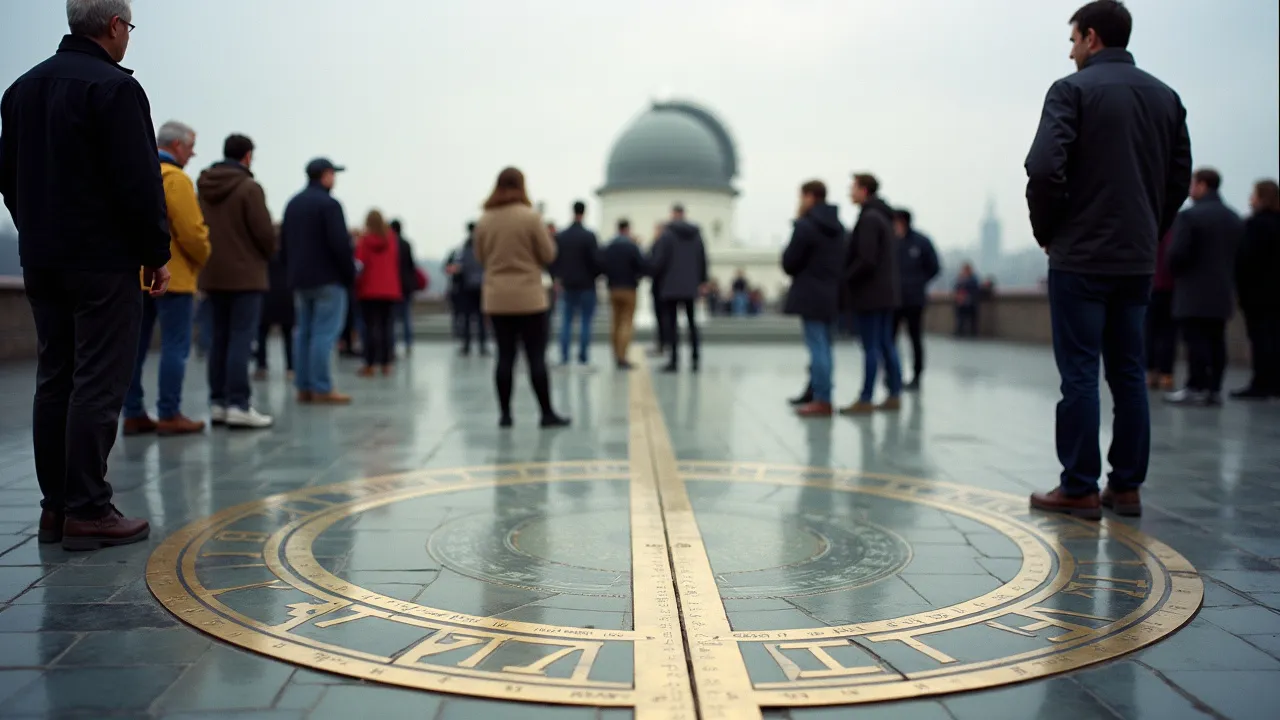
Celebrated on November 1st, Prime Meridian Day honors the historic establishment of the world's prime meridian at Greenwich, London. It highlights the importance of global timekeeping and navigation standards.
The Historical Origins & Evolutionary Journey
Prime Meridian Day, observed annually on November 1st, commemorates the establishment of the prime meridian at Greenwich, England, and the global adoption of Greenwich Mean Time (GMT) as the world's time standard. This day serves as a reminder of humanity's quest for precision in navigation, communication, and timekeeping.
The Foundational Catalyst
Before the 19th century, every town and city kept its own local time based on the sun's position. With the expansion of railways and telegraph networks, the need for a standardized time became critical. The Great Western Railway in Britain adopted London time in 1840, and by 1847, most railway companies followed suit, using Greenwich Mean Time as their reference. However, internationally, there was no universal prime meridian. Sailors relied on various meridians, including those of Paris, Cadiz, and Copenhagen, causing confusion and navigational errors.
The Legislative/Official Adoption
The turning point came in 1884 when U.S. President Chester A. Arthur convened the International Meridian Conference in Washington, D.C. Delegates from 25 nations met from October 1 to November 1, 1884. After intense debate, on November 1st, they voted 22-1 in favor of adopting the meridian passing through the Royal Observatory at Greenwich as the prime meridian. This choice was influenced by the fact that two-thirds of the world's shipping already used Greenwich charts. The resolution also established the universal day beginning at midnight GMT. The final vote on November 1st is why Prime Meridian Day is celebrated on that date.
Modern Global Legacy
Today, the prime meridian at Greenwich is marked by a laser line at night and a brass strip in the ground, attracting millions of visitors. The adoption of Coordinated Universal Time (UTC) in 1972 further refined global timekeeping, but GMT remains the basis. Prime Meridian Day promotes awareness of the history of timekeeping, navigation, and international cooperation. It is observed by educational institutions, astronomy clubs, and history enthusiasts worldwide through virtual tours, lectures, and exhibitions.
How to Celebrate Prime Meridian Day
Prime Meridian Day offers a unique opportunity to explore the intersection of history, geography, and science. Here are actionable ways to celebrate, whether you are an individual, a school, or an organization.
For Individuals
- Visit the Royal Observatory: If in London, walk the meridian line at Greenwich Park. Take a photo with one foot in each hemisphere.
- Set Your Watch to GMT: Manually adjust your timepieces to Greenwich Mean Time for the day as a reminder of the global standard.
- Read Historical Accounts: Delve into books like The Longitude Prize or articles about the 1884 conference.
For Schools and Educators
- Teach Time Zones: Use interactive maps to explain how the prime meridian divides the Earth and how time zones (up to UTC+14) work.
- Organize a Meridian Walk: In the schoolyard, draw a north-south line and have students stand on it to understand longitude.
- Host a Virtual Tour: Connect with the Royal Observatory's live webcam showing the meridian.
For Organizations and Communities
Public Lectures: Invite historians or astronomers to speak on the impact of standard time on railways, telecommunications, and global trade. Meridian-themed Exhibits: Libraries and museums can display antique chronometers, maps, and telegraph equipment. Online Challenges: Create a social media campaign using #PrimeMeridianDay where participants share their meridian photos or time conversion puzzles.
Globally, different regions add local flavors. In the UK, special ceremonies at the Royal Observatory include the unveiling of historical plaques. In former British colonies, the day may be tied to discussions on colonial legacy and modern standardization. Astronomers without Borders often host global stargazing events tied to the meridian.
Global Impact on Navigation and Trade
The adoption of a single prime meridian revolutionized global navigation and international trade. Before 1884, ships often carried multiple chronometers set to different meridians, leading to frequent miscalculations. The standardization reduced shipping accidents and insurance costs. Exports and imports could be synchronized across time zones, enabling just-in-time logistics. Today, the Global Positioning System (GPS) relies on a prime meridian (the IERS Reference Meridian), which is about 102 meters east of the historic Greenwich line due to tectonic shifts and technology. However, the symbolic importance remains, reminding us that cooperation across borders is possible.
Scientific Significance in Astronomy and Geodesy
The prime meridian is more than a line on a map; it is a fundamental reference for astronomy and geodesy.
Astronomical Observations
For centuries, the Royal Observatory's telescopes mapped the stars relative to the meridian, producing the first accurate star catalogs. The meridian circle instrument allowed precise measurements of right ascension and declination.
Geodetic Reference Systems
Modern satellite geodesy uses the International Terrestrial Reference Frame (ITRF), which defines the center of the Earth’s mass and the orientation of axes. The prime meridian is a key component. Without this reference, mapping sea level rise, tectonic plate movement, and global navigation would be impossible. Prime Meridian Day highlights these scientific achievements.
Cultural Symbolism and Global Unity
The prime meridian has become a cultural icon representing global unity and shared progress.
In Literature and Art
Writers like Jules Verne in Around the World in Eighty Days used meridian-based travel as a plot device. Artists create installations that interact with the meridian line.
Diplomatic Symbol
The 1884 conference was a rare moment of international consensus during an era of imperial rivalries. Today, the meridian line at Greenwich is a site where tourists from all nations gather, symbolizing that despite different time zones, we share a common standard. Prime Meridian Day encourages reflection on how a simple line on the globe can foster collaboration and understanding.
Modern Relevance in a Digital World
In the age of the internet and global communications, time synchronization is more critical than ever. Network Time Protocol (NTP) servers use UTC (based on atomic clocks) to synchronize computers worldwide. The concept of the meridian underpins timestamping in financial transactions, internet logs, and satellite communications.
Time Zones and Software
Software developers must handle time zone conversions, daylight saving time, and historical calendar changes—all rooted in the prime meridian. Prime Meridian Day serves as a reminder to appreciate the invisible infrastructure that keeps our digital lives in sync. Without standardized time, global stock markets, air traffic control, and even video calls would descend into chaos.
Historical Timeline
King Charles II founds the Royal Observatory in Greenwich, tasked with solving the longitude problem.
The Great Western Railway adopts London Time (GMT) for its timetables, leading to widespread railway time in Britain.
The International Meridian Conference in Washington, D.C., votes on November 1 to adopt the Greenwich meridian as the prime meridian.
The Greenwich meridian officially becomes the international standard for time and longitude.
Universal Time (UT) is introduced, closely related to GMT but based on astronomical observations.
Coordinated Universal Time (UTC) replaces GMT as the global time standard, using atomic clocks.
The IERS Reference Meridian is adopted, shifting slightly east of the traditional Greenwich meridian due to technology improvements.
First official Prime Meridian Day observed by Royal Museums Greenwich, promoting heritage and science education.