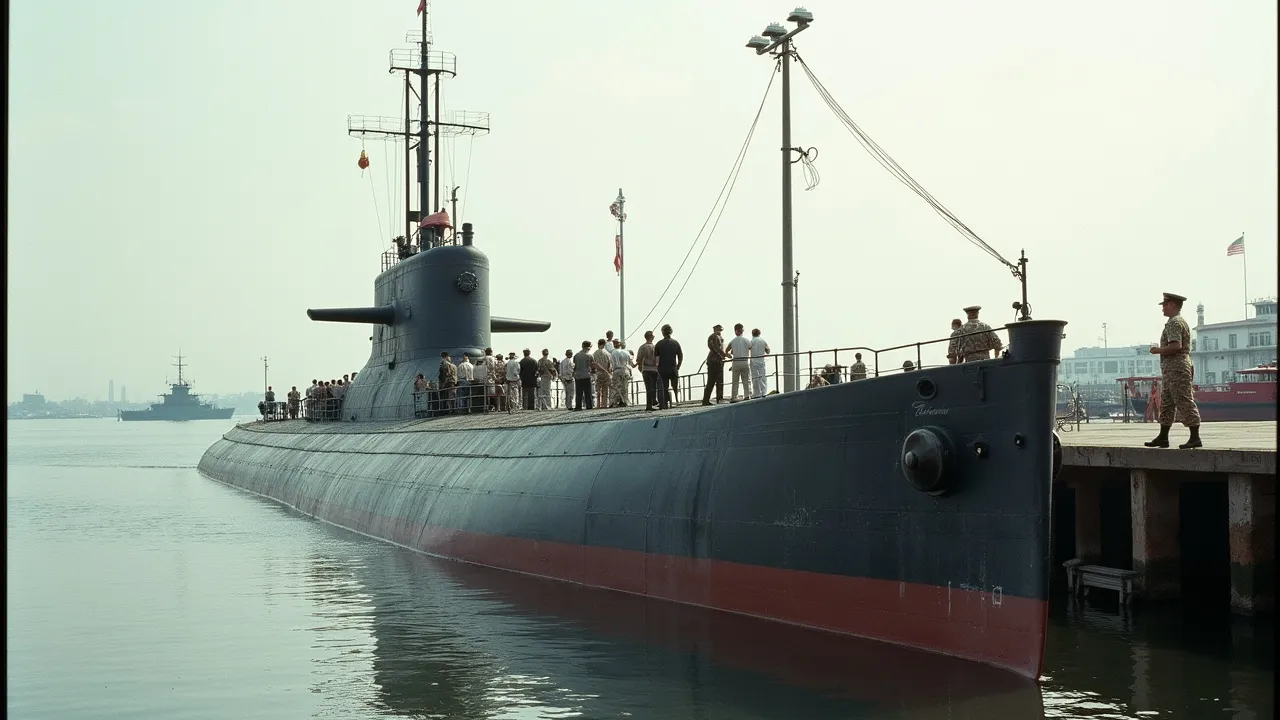
National Submarine Day, observed annually on April 11th, honors the history and contributions of submarine forces worldwide. It commemorates the day the U.S. Navy purchased its first submarine, the USS Holland, in 1900.
The Historical Origins & Evolutionary Journey
National Submarine Day traces its roots to April 11, 1900, when the U.S. Navy officially purchased its first modern submarine, the USS Holland (SS-1), designed by John Philip Holland. This day marks the birth of the U.S. Submarine Force, which has since evolved into a critical component of naval warfare and global security.
The Foundational Catalyst
Submarines have fascinated inventors for centuries. Early concepts like the Turtle (1776) and the Nautilus (1800) paved the way for Holland's breakthrough. His design, the Holland VI, was the first submarine to successfully incorporate electric motors for underwater propulsion and a gasoline engine for surface cruising. The Navy recognized its potential and bought it for $150,000, renaming it the USS Holland.
The Legislative/Official Adoption
While National Submarine Day is not a federal holiday, it was officially recognized by the U.S. Congress in the 1990s, thanks to lobbying by submarine veterans and naval historians. The day is now celebrated annually with ceremonies at submarine bases, museums, and naval installations. Key landmarks include the Submarine Force Library and Museum in Groton, Connecticut, which hosts special events.
Modern Global Legacy
Submarines have played pivotal roles in both World Wars, the Cold War, and modern anti-piracy missions. Today, over 40 nations operate submarines, ranging from small coastal patrol boats to nuclear-powered ballistic missile submarines. National Submarine Day honors not only U.S. forces but also the international submarine community, highlighting shared advancements in stealth, technology, and maritime strategy.
How to Celebrate National Submarine Day
National Submarine Day offers a unique opportunity to learn, appreciate, and engage with submarine history and culture. Below are actionable ways to celebrate, from individual activities to large-scale events.
For Individuals and Families
- Visit a Submarine Museum or Memorial: Many naval museums offer tours of decommissioned submarines, such as the USS Nautilus in Groton or the USS Pampanito in San Francisco.
- Watch Documentaries: Films like The Silent Service or Das Boot provide gripping insights into submarine life. Educational documentaries on Discovery or PBS are also excellent.
- Read Submarine Literature: Books like Run Silent, Run Deep by Edward L. Beach or The Hunt for Red October by Tom Clancy offer thrilling narratives.
For Schools and Educators
- Organize a submarine STEM challenge: Students design and build simple submarine models using plastic bottles and balloons to learn about buoyancy and propulsion.
- Host a guest speaker session with a Navy veteran or submarine historian to discuss the role of subs in naval history.
- Create a timeline wall highlighting key submarine milestones from the Turtle to modern nuclear-powered vessels.
For Organizations and Naval Commands
- Ceremonies: Hold a wreath-laying at submarine memorials, such as the USS Thresher memorial in Portsmouth, NH.
- Public Open House: If feasible, host a tour of an active or museum submarine for the community.
- Social Media Campaign: Use hashtags like #NationalSubmarineDay to share historical facts, crew interviews, and behind-the-scenes content.
Global Perspectives
Different nations mark their own submarine days. For instance, Russia celebrates Submariner's Day on March 19, while the United Kingdom observes Submarine Day on November 29 (the founding of the Submarine Service). National Submarine Day on April 11 is primarily a U.S. observance, but it is increasingly recognized by allied navies through joint events and online collaborations.
The Global Impact of Submarine Technology
Submarines have profoundly shaped geopolitics, warfare, and ocean exploration. Their ability to operate stealthily underwater makes them strategic assets for deterrence, surveillance, and strike capabilities.
Military Strategy
The development of nuclear-powered submarines, like the USS Nautilus (1955), revolutionized naval strategy. Ballistic missile submarines (SSBNs) form the core of nuclear deterrents for the U.S., Russia, China, and other powers. Submarines also play crucial roles in anti-submarine warfare (ASW) and special operations, such as inserting Navy SEALs.
Scientific Research
Submersibles like the DSV Alvin have explored the deepest ocean trenches, discovering new species and geological features. Research submarines aid in marine biology, oceanography, and climate studies, providing data that is impossible to gather otherwise.
Economic and Commercial Use
Military submarine technology often trickles down to civilian applications, such as underwater tourism (e.g., tourist subs in Hawaii) and deep-sea oil and gas exploration. Autonomous underwater vehicles (AUVs) are now used for pipeline inspection, cable maintenance, and search-and-rescue missions.
Famous Submarines and Their Stories
From the earliest experiments to modern marvels, submarines have storied histories. Here are a few that stand out.
- USS Holland (SS-1): The Navy's first submarine, commissioned 1900. It served as a training vessel until 1905.
- U-9 (Germany): In 1914, this submarine sank three British cruisers in a single hour, changing naval warfare forever.
- USS Nautilus (SSN-571): First nuclear-powered vessel, traveled under the North Pole in 1958.
- K-19 (Soviet): First Soviet nuclear submarine, experienced a reactor accident in 1961, later depicted in film.
- USS Blueback (SS-581): Last non-nuclear submarine in the U.S. Navy, now a museum in Portland, Oregon.
- INS Arihant (India): First indigenously built nuclear submarine, commissioned in 2016, marking a major step for India's strategic deterrence.
These vessels embody the innovation and sacrifice inherent in submarine service.
Submarine Service Life: Challenges and Culture
Life aboard a submarine is uniquely demanding, requiring psychological resilience, technical expertise, and strong camaraderie. Crews often spend months underwater, isolated from sunlight and fresh air.
Daily Routine
A typical day on a submarine involves 18-hour shifts (6 hours on watch, 6 hours off, subdivided). Crew members must master multiple roles due to limited personnel. Tasks include navigation, sonar operation, engine maintenance, and cooking.
Cultural Traditions
Submariners have distinct traditions, such as the "Dolphin" pin (earned after qualifying in submarine operations), the Shellback ceremony for crossing the equator, and the "Silent Service" mottos. They also celebrate achievements like the first patrol, with special meals and ceremonies.
Mental Health
Isolation and confined spaces can lead to stress. Modern submarines provide recreation areas, email access, and psych support. The bond among crew members often becomes a family-like support system.
National Submarine Day in Popular Culture and Media
Submarines have captured the imagination of storytellers for decades. National Submarine Day often sees a spike in submarine-themed content across books, films, and games.
- Films: The Hunt for Red October (1990) starring Sean Connery, Das Boot (1981) a German classic, and Greyhound (2020) though focused on destroyers, emphasizes submarine threats. Documentaries like Submarine: The Silent Service (2022) are popular on streaming platforms.
- Books: Tom Clancy's The Hunt for Red October, Edward Beach's Run Silent, Run Deep, and nonfiction like Blind Man's Bluff by Sherry Sontag.
- Video Games: Silent Hunter series, Wolfpack, and World of Warships offer submarine simulations that educate players about tactics and history.
Media portrayals often romanticize submarine warfare, but they also highlight the bravery and skill of submariners, contributing to the day's popularity.
Historical Timeline
Cornelis Drebbel builds the first navigable submarine, a rowboat covered in greased leather, tested in the Thames River.
David Bushnell designs the Turtle, the first military submarine, used in an attempt to attach a mine to a British ship in New York Harbor.
The Fenian Ram, designed by John Philip Holland, launches, a precursor to modern submarines.
On April 11, the U.S. Navy purchases the USS Holland (SS-1), officially establishing the Submarine Force.
German U-boat U-9 sinks three British cruisers in one hour, demonstrating the submarine's lethality in war.
USS Nautilus (SSN-571), the world's first nuclear-powered submarine, gets underway, revolutionizing naval endurance.
USS Nautilus completes the first submerged transit of the North Pole.
USS Triton completes the first submerged circumnavigation of the globe.
During the Falklands War, the British submarine HMS Conqueror sinks the Argentine cruiser ARA General Belgrano, the only nuclear submarine sinking of a warship.
India commissions INS Arihant, its first indigenously built nuclear submarine, joining an elite group of nations.