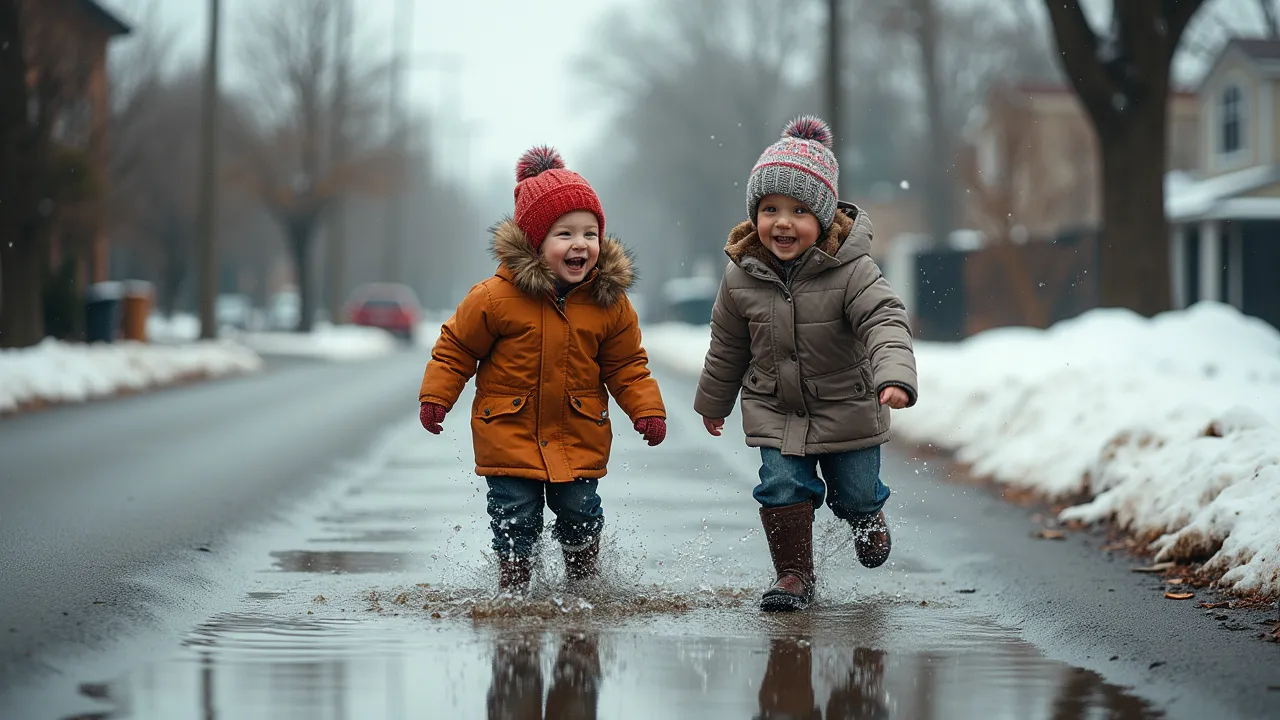
Celebrated on January 11th, this playful day encourages people to embrace childhood joy by stepping in puddles and splashing friends. Originating in the 1970s, it promotes outdoor fun and spontaneous laughter.
The Historical Origins & Evolutionary Journey
National Step in a Puddle and Splash Your Friends Day, observed annually on January 11th, has a surprisingly rich history that intertwines childhood nostalgia with a movement to reclaim outdoor play. The day was conceived by Thomas 'Splash' Thompson, a fourth-grade teacher in Portland, Oregon, who noticed his students becoming increasingly glued to screens and hesitant to get dirty.
The Foundational Catalyst
In the winter of 1971, during a particularly rainy Oregon season, Thompson observed a lone student gleefully jumping into a puddle, sending water cascading across the playground. The other children laughed and soon joined in, forgetting their usual inhibitions. Inspired by this moment, Thompson proposed a dedicated day to celebrate the simple joy of splashing. He wrote to local newspapers and community boards, suggesting January 11th—mid-winter, when puddles are abundant and spirits need lifting. The first official celebration occurred in 1972 in a small park in Portland, with about 50 children and parents participating. The event included puddle-jumping contests, splashing relays, and warm hot chocolate for all.
The Legislative/Official Adoption
The day remained a local affair for years. However, in 1985, the National Recreation and Park Association (NRPA) featured it in their annual calendar of quirky holidays, giving it national exposure. By the early 1990s, schools across the United States began incorporating Puddle Splashing Day into their outdoor curricula, emphasizing unstructured play. In 2001, the city of Portland officially proclaimed January 11th as 'Step in a Puddle Day,' making Thompson an honorary citizen for life. Today, the day is observed in over 20 countries, from Japan to Brazil, each adding their own cultural spin.
Modern Global Legacy
In the 2010s, social media turned the day into a viral phenomenon. Hashtags like #PuddleSplashDay and #StepInAPuddle trend annually, with families sharing photos and videos. The day now serves as a counterpoint to the hyper-scheduled, screen-dominated lives of children, reminding adults that spontaneous fun is vital for mental health. Environmental groups have also adopted the day to highlight the importance of water conservation and the role of puddles in urban ecosystems.
How to Celebrate National Step in a Puddle and Splash Your Friends Day
Celebrating this day is all about embracing childlike joy and letting go of grown-up reservations. Whether you are an individual, a school, or a company, here are actionable ways to participate.
For Individuals & Families
- Find the Perfect Puddle: After rain or melting snow, scout your neighborhood for large, clean puddles. Avoid muddy or slippery patches near traffic.
- Dress for Splash Success: Wear waterproof boots, old clothes, or even raincoats. Bring a change of socks and shoes.
- Start a Splash Battle: Take turns stepping hard to create big splashes. Challenge friends to see who can make the biggest wave.
- Capture the Moment: Take photos or a short video. Share using #StepInAPuddleDay (but keep phones in waterproof bags).
- Warm Up Afterwards: Have hot cocoa or tea ready to prevent chills.
- Puddle Playtime: Recess can be extended or dedicated to puddle jumping. Set up a 'splash zone' with supervised puddles.
- Educational Tie-Ins: Teach about the water cycle or absorption rates using puddles.
- Charity Splash: Collect donations per splash to fund clean water projects in developing nations.
- Safety First: Ensure puddles are not over drains or electrical equipment.
For Schools & Organizations
Corporate & Community Events
Companies can host team-building puddle walks or sponsor a community puddle party at a local park. Some tech firms even organize 'mud runs' with artificial puddles. The key is to foster connection and laughter.
Global Traditions and Regional Variations
While January 11th is the primary date, some regions celebrate on different days due to climate or culture. Here are notable variations:
United States
Most cities follow January 11th. In rainy Seattle, the day is celebrated with a citywide 'puddle hop' event at Green Lake Park. In the Midwest, where winters are snowy, participants often stomp slush puddles.
United Kingdom
The UK has a strong puddle-splashing tradition due to constant rain. Many schools have a 'Puddle Day' on the first Friday of February, when puddles are deepest. The National Trust promotes it as part of their '50 Things to Do Before You’re 11¾' campaign.
Japan
In Japan, the day is known as 'Mizutamari no Hi' (Puddle Day). It’s observed in early April during cherry blossom season, when spring rains create photogenic puddles. Families wear colorful rubber boots and visit parks for hanami (flower viewing) combined with puddle jumping.
Australia
Due to the Southern Hemisphere summer, Australia celebrates on July 11th, the middle of their winter. Events often coincide with school holidays, and puddles are created artificially during droughts using sprinklers.
Brazil
In Brazil, 'Dia de Pular na Poça' is celebrated on January 11th during summer rains but also on Carnival Saturday, when street parties include splashing in temporary puddles.
The Psychology of Puddle Splashing
Why do we love splashing in puddles? Psychologists and neuroscientists have explored this seemingly simple act and found profound benefits.
Stress Relief and Mindfulness
Stepping into a puddle forces one to be present. The sound of water, the sensation of cold, and the immediate splash create a meditative break from rumination. Studies show that mindful moments in nature reduce cortisol levels.
Social Bonding
Splashing is often a shared activity. Laughter is contagious, and the act of getting messy together builds trust and camaraderie. It’s a non-verbal way of saying 'let’s have fun.'
Reclaiming Play
Adults often lose the capacity for unstructured play. Puddle splashing is a low-stakes way to break free from perfectionism. It reminds us that joy doesn’t require skill or competition.
Scientific Perspective
Research from the University of Loughborough indicates that playful activities like splashing improve creativity and problem-solving. The unpredictability of water patterns stimulates the brain’s novelty centers.
Environmental Awareness and Puddles
Puddles are more than just fun: they are vital micro-ecosystems. This day has been co-opted by environmental educators to teach about water sustainability.
Urban Puddles and Runoff
Puddles often form due to impervious surfaces like asphalt. They can carry pollutants. Learning about puddle chemistry encourages discussion on stormwater management and green infrastructure.
Wildlife Havens
Temporary puddles provide breeding grounds for mosquitoes (a negative) but also for frogs, toads, and insects. They hydrate birds and small mammals. Observing puddle life can spark interest in ecology.
Citizen Science
Groups like the GLOBE Program encourage people to measure puddle depth and water quality on this day, contributing to global databases. It’s a fun way to engage in science.
Health and Safety Considerations
While the day is about fun, safety is paramount. Do not splash in puddles near:
- Road traffic or driveways
- Electrical substations or downed power lines
- Stagnant water that may harbor bacteria (e.g., near farms)
- Deep puddles that cover hidden hazards (e.g., broken glass)
Historical Timeline
Portland teacher Thomas Thompson witnesses the spontaneous joy of puddle splashing on his school playground, inspiring the idea for a dedicated day.
The first official National Step in a Puddle and Splash Your Friends Day is celebrated in a small Portland park with 50 participants.
The National Recreation and Park Association includes the day in its annual calendar, giving it national exposure in the United States.
The city of Portland officially proclaims January 11th as 'Step in a Puddle Day,' honoring Thomas Thompson as an honorary citizen.
Social media adoption begins; hashtags like #PuddleSplashDay trend annually, spreading the celebration globally.
Due to the COVID-19 pandemic, the day gains popularity as a safe outdoor activity; virtual splash challenges emerge on TikTok.