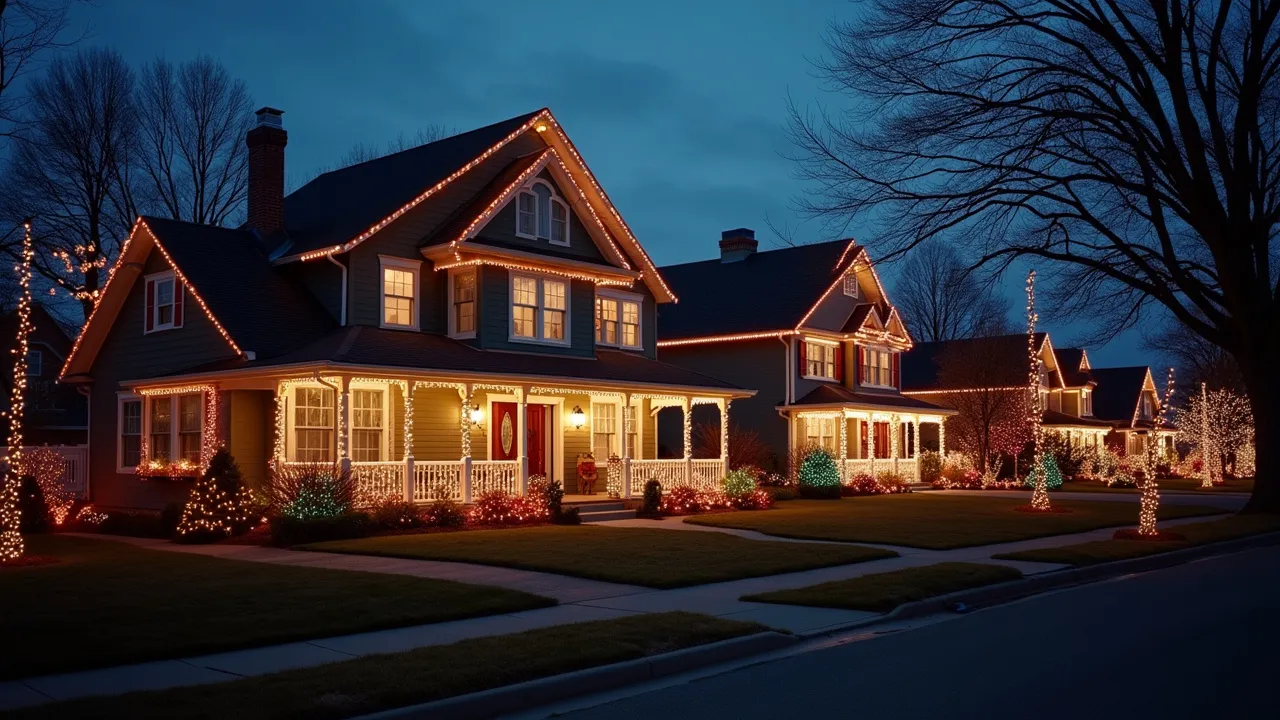
National Christmas Lights Day on December 1st encourages everyone to embrace the festive spirit by decorating homes and communities with dazzling lights. It kicks off the holiday season with brightness and joy.
The Historical Origins & Evolutionary Journey
National Christmas Lights Day, observed on December 1st, traces its origins to the modern movement to formalize the start of the holiday lighting season. While the practice of decorating with lights during Christmas dates back centuries, the establishment of a dedicated day is a recent phenomenon that reflects the growing cultural importance of light displays.
The Foundational Catalyst
The tradition of using lights during Christmas began with small candles on Christmas trees in 17th-century Germany. However, it was Thomas Edison's invention of the incandescent light bulb in 1879 that revolutionized holiday decorations. In 1880, Edison hung strings of lights outside his Menlo Park laboratory, creating the first documented outdoor Christmas light display. By 1882, Edward Johnson, Edison's friend, hand-wired the first electrically illuminated Christmas tree in New York City. This generated public fascination, and by the early 20th century, electric Christmas lights became commercially available, largely replacing hazardous candles.
The Legislative/Official Adoption
Despite the historical use of lights, a specific day to celebrate the act of lighting up homes did not exist until the 21st century. The National Day Calendar, a repository for unofficial holidays, partnered with Christmas Lights Etc., a retailer of holiday lighting, to establish National Christmas Lights Day. The first official observance was on December 1, 2019. The date was chosen because it falls early in the holiday season, encouraging people to start decorating and spreading cheer from the very beginning of December.
Modern Global Legacy
Since its inception, National Christmas Lights Day has grown in popularity, amplified by social media campaigns such as #ChristmasLightsDay. Communities now organize lighting ceremonies, competitions, and tours on this date. The day serves as a symbolic kickoff for holiday celebrations worldwide, aligning with similar events like the lighting of the Rockefeller Center Christmas Tree in New York City (which typically occurs in late November). The legacy continues to evolve with advancements in LED technology, smart lighting, and synchronized music-and-light shows, making the celebration more spectacular each year.
How to Celebrate National Christmas Lights Day
National Christmas Lights Day offers numerous ways to participate, from simple home decorations to elaborate community events. Below are actionable strategies for different groups.
For Individuals and Families
- Decorate Your Home: String lights on your roof, windows, trees, and bushes. Use a mix of warm white and multicolored LEDs for variety.
- Host a Lighting Party: Invite friends and neighbors to watch as you switch on your lights for the first time. Serve hot cocoa and cookies.
- Go on a Lights Tour: Drive or walk through your neighborhood to admire displays. Use apps like Google Maps to find highly-rated displays.
- Participate in Social Media: Share photos of your display using hashtags like #NationalChristmasLightsDay and #ChristmasLightsDay.
For Communities and Neighborhoods
- Organize a Block Party: Coordinate with neighbors to turn on all lights simultaneously.
- Hold a Contest: Award prizes for best display, most creative, or most energy-efficient.
- Create a Walking Tour: Map out a route of decorated homes and share it with the public.
For Businesses and Organizations
- Decorate Storefronts: Attract customers with festive lighting.
- Sponsor a Public Display: Fund a large tree lighting or park illumination.
- Host a Charity Event: Partner with a local charity and donate a portion of sales on December 1st.
The Economics of Christmas Lights: Industry and Market
The Christmas lights industry is a significant economic driver during the holiday season. According to the National Retail Federation, Americans spend over $1 billion on holiday lighting each year. The market includes string lights, net lights, icicle lights, projectors, and smart lighting systems. Major retailers like Home Depot, Lowe's, and Amazon see peak sales in late November and early December. The industry also supports seasonal employment in manufacturing, distribution, and installation services. Furthermore, municipalities and tourism boards invest heavily in public light displays to attract visitors, leading to increased revenue for local businesses such as hotels, restaurants, and shops. The economic impact extends beyond direct sales, as spectacular light shows become tourist destinations, such as the annual display at Dyker Heights in Brooklyn, New York, which draws thousands of visitors each year.
Environmental Considerations and the Shift to LED Lights
The environmental footprint of Christmas lights has been a growing concern. Traditional incandescent bulbs consume significantly more energy and have shorter lifespans compared to modern LEDs. The shift to LED lights has been dramatic: LEDs use up to 80% less energy and last 25 times longer. Many municipalities now encourage or mandate the use of LEDs for public displays. Additionally, recycling programs for old lights have emerged; companies like HolidayLEDs.com offer trade-in discounts for old strands. Solar-powered lights are also gaining popularity, eliminating electricity usage entirely. On National Christmas Lights Day, consider using a timer to limit the hours of operation, typically 5 p.m. to 11 p.m., to reduce energy waste. This balance between celebration and environmental stewardship ensures that the tradition can continue sustainably.
Global Traditions: How Different Cultures Illuminate the Holidays
While National Christmas Lights Day originated in the United States, light celebrations occur worldwide with unique variations. In the Philippines, the Giant Lantern Festival (Ligligan Parul) in December features enormous, intricately lit parols (star-shaped lanterns). In Mexico, Las Posadas includes processions with faroles (paper lanterns). In Sweden, the feast of Saint Lucia on December 13 involves candlelit processions. In Japan, Christmas lights (illuminations) are a major attraction, with cities like Tokyo and Osaka featuring spectacular displays that are non-religious and purely aesthetic. In the United Kingdom, many towns host a Christmas lights switch-on event with festivities. Australia celebrates with beachside light displays due to the summer season. These global traditions enrich the spirit of National Christmas Lights Day, proving that the joy of lights transcends borders and religions.
Safety and Best Practices for Installing Holiday Lights
Safety should be a top priority when decorating for National Christmas Lights Day. Follow these guidelines to prevent accidents:
- Inspect Lights: Check for frayed wires, broken sockets, or loose connections. Discard damaged sets.
- Use Proper Outdoor Lights: Ensure lights are rated for outdoor use by looking for the UL mark and a green tag.
- Don't Overload Circuits: Connect no more than three standard strands of incandescent lights together; LEDs can handle more but check manufacturer limits.
- Use Sturdy Ladders: When hanging lights at height, use a stable ladder and have a spotter.
- Avoid Nails and Staples: Use plastic clips or hooks designed for lights to avoid damaging wires.
- Timers and Auto-Off: Use timers to turn lights off during the day and late at night to save energy and reduce fire risk.
- Keep Christmas Trees Watered: If using a real tree, ensure it stays hydrated to avoid it drying out and becoming a fire hazard.
Community Impact and Social Bonding Through Shared Light Displays
National Christmas Lights Day fosters community spirit and social bonding. Neighbors often come together to compare displays, share decorating tips, and collaborate on block-wide themes. Many communities host an annual "Lights On" event where residents gather at a central location to flip a switch together, symbolizing unity and shared joy. For families, driving through neighborhoods to see lights creates lasting memories and traditions. Studies have shown that festive decorating increases a sense of belonging and neighborhood pride. In times of crisis, such as the COVID-19 pandemic, light displays provided a safe, outdoor activity that lifted morale. The day also encourages charitable giving, as some displays collect donations for food banks or hospitals. Ultimately, the shared experience of transforming darkness into a canvas of light strengthens social ties and reinforces the holiday message of hope and togetherness.
Historical Timeline
Thomas Edison creates the first outdoor Christmas light display outside his Menlo Park laboratory, using incandescent bulbs.
Edward Johnson, vice president of Edison Electric Light Company, hand-wires the first electrically illuminated Christmas tree in his New York City home.
General Electric begins selling pre-assembled strings of Christmas lights, making them accessible to the public.
Outdoor Christmas lights become popular as electricity spreads to more homes; cities begin public light displays.
The advent ofplastic and miniaturized bulbs leads to mass production and lower costs, fueling a boom in home decorating.
Energy crises lead to conservation efforts; some communities impose restrictions on holiday lighting.
LED Christmas lights emerge, initially expensive but offering greater durability and energy efficiency.
LED lights become dominant; smart lighting and music-synchronized displays gain popularity via YouTube and social media.
The first official National Christmas Lights Day is observed on December 1st, established by the National Day Calendar and Christmas Lights Etc.
Amid the COVID-19 pandemic, more families decorate heavily, turning neighborhoods into festive destinations for safe outdoor entertainment.