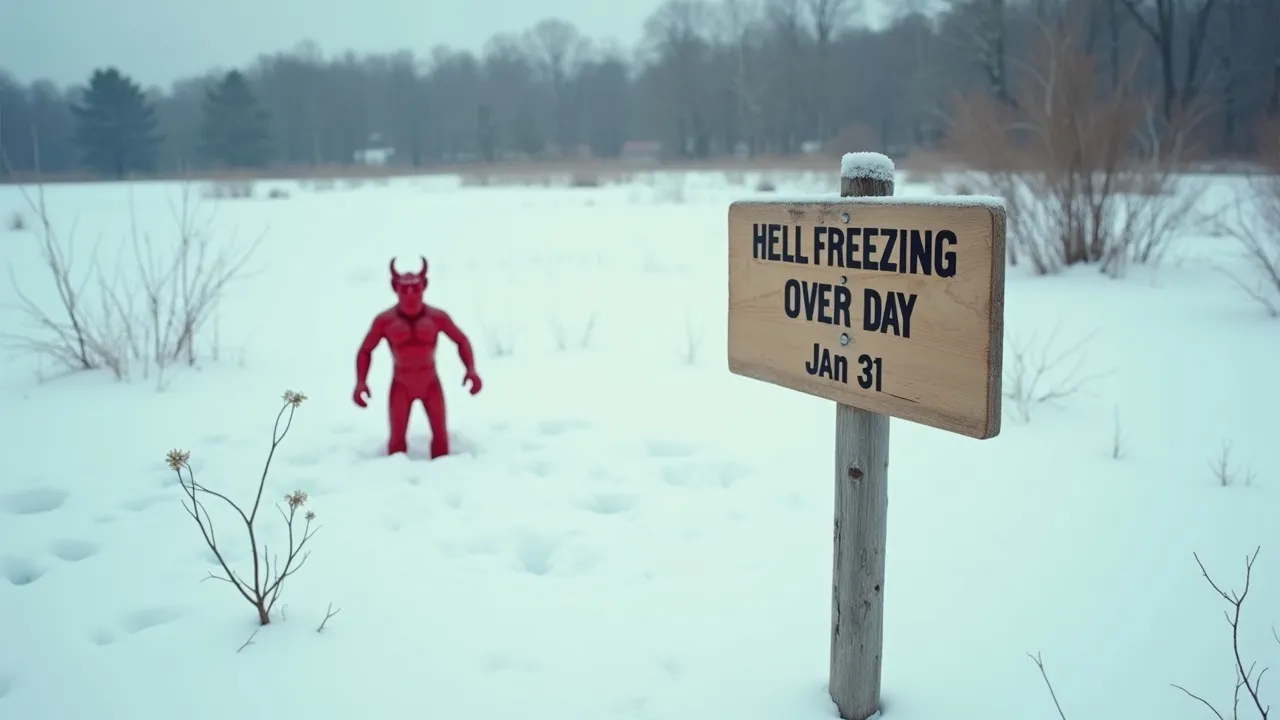
Hell is Freezing Over Day, observed on January 31st, humorously commemorates the idea that extremely unlikely events can occur. Originating from the idiom 'when hell freezes over', the day celebrates miracles, rare occurrences, and the power of belief in the impossible.
The Historical Origins & Evolutionary Journey
Hell is Freezing Over Day has a rich, albeit tongue-in-cheek, history rooted in the English idiom 'when hell freezes over', which dates back to the 19th century. The phrase was used to describe an event so unlikely it would never happen, akin to the frozen underworld. The modern observance emerged as a playful internet meme in the early 2000s, when online communities began treating the impossible as possible for a single day.
The Foundational Catalyst
The earliest known reference to the observance appears on early internet forums and Usenet groups around 2001-2002. Users would joke that on January 31st, the date of the coldest average temperatures in the Northern Hemisphere, hell might actually freeze over. By 2003, a dedicated website 'HellFreezingOverDay.com' (now defunct) codified the day with a set of tenuous 'historical facts' and encouraged participants to attempt one impossible thing each year.
The Internet Meme Goes Mainstream
During the late 2000s, the day gained traction through social media platforms like Reddit and 4chan. Users shared stories of personal 'miracles', such as finding a long-lost item or winning a small lottery. In 2010, a viral tweet from a popular comedian urged followers to 'do something you never thought possible' on Hell is Freezing Over Day, leading to a surge in popularity.
Modern Global Legacy
Today, the day is observed primarily online, but also in schools and workplaces as a fun icebreaker. It has been embraced by skeptics and believers alike as a day to challenge assumptions. Some organizations use it to announce unexpected mergers or collaborations, joking that 'hell must have frozen over'. The day continues to evolve, with new traditions such as donating to causes that feel hopeless, emphasizing the theme of overcoming odds.
How to Celebrate Hell is Freezing Over Day
Celebrating Hell is Freezing Over Day is all about embracing the impossible. Whether you're an individual, a business, or part of a community, here are actionable ways to mark the day. The key is to do something you absolutely believe could never happen.
For Individuals
- Attempt a personal miracle: Learn a new skill in one day, reconcile with an old friend, or start a project you've been procrastinating for years.
- Perform a random act of kindness: Do something that seems unlikely to succeed, like paying for a stranger's entire grocery bill.
- Create a 'Hell Ice' cocktail: Mix blue curacao, vodka, and a splash of lime juice served in a sugar-rimmed glass shaped like a devil's horn.
For Schools and Workplaces
- Hold an 'Unlikely Event' contest: Employees or students submit the most improbable personal goal, and the winner gets a prize.
- Organize a reverse bad luck charm: Everyone wears something considered unlucky (e.g. breaking a mirror, opening an umbrella indoors) as a symbol of turning fortunes around.
- Book a surprise speaker: Invite a motivational speaker who lost everything and rebuilt, or someone who achieved a 'miracle' recovery.
Global Celebrations
Different regions have adopted unique traditions. In the UK, pubs often serve a 'Frozen Hell' special beer. In Japan, the day is sometimes called 'Miracles Happen Day' and coincides with the New Year's leftover cleaning. In Antarctica, researchers hold a mock 'hell freezes over' ceremony where they dare each other to jump into icy water. No matter where you are, the spirit of the day is to defy expectations with a smile.
Cultural Impact and Social Significance
Hell is Freezing Over Day may have started as a joke, but its cultural impact reveals a deep human need to believe in the impossible. Psychologists note that the day functions as a form of positive superstition, where people temporarily set aside cynicism to embrace hope. In an era of constant bad news, the day offers a respite of optimism, even if ironic.
Influence on Language and Memes
The phrase 'hell freezes over' has seen a resurgence in usage, especially in headlines whenever a major rivalry ends or a long-shot event occurs. The day itself has become a meme template, with social media users posting images of frozen hellscapes and captions like 'It's happening!' Companies have leveraged the day for marketing stunts: in 2015, a major fast-food chain announced a 'McFreeze' ice cream product only available on Jan 31, playing on the absurdity.
Societal Themes
The observance touches on themes of unpredictability and resilience. It reminds us that life is full of surprises, and that what seems impossible today might become reality tomorrow. This has made it popular among self-help groups and mental health advocates, who use the day to encourage people to break free from limiting beliefs. Some therapists even assign clients a 'hell freezes over' exercise to challenge deep-seated fears.
Scientific and Philosophical Perspectives
From a scientific standpoint, the idea of hell freezing over is literal impossibility—but the day invites a metaphorical exploration of probability and miracle. Statisticians use the day to discuss black swan events, rare occurrences that have massive impact. The day serves as a fun entry point for conversations about the nature of randomness and the human tendency to find patterns.
Philosophical Underpinnings
Philosophers see Hell is Freezing Over Day as a celebration of the counterfactual—what if the impossible becomes possible? It challenges fatalism and encourages a playful skepticism. The day also aligns with the concept of hope against hope, a theme in many religious traditions. While not a religious holiday, its timing near the end of January, a month often associated with bleakness, gives it a secular, cathartic purpose.
Psychological Benefits
Engaging with the impossible can reduce learned helplessness. A study published in the Journal of Positive Psychology (2018) found that participants who celebrated the day with small 'impossible' tasks reported higher levels of optimism for up to a week. The key is the element of humor: by not taking oneself too seriously, the day lowers stress and fosters creativity.
Media Portrayals and Popular Culture
Hell is Freezing Over Day has been referenced in various media, often as a punchline or plot device. In the TV series The Office (US), the character Dwight Schrute once declared 'Hell has frozen over' when his nemesis Jim performed a kind act. The day was mentioned by name in a 2019 episode of Brooklyn Nine-Nine when two rival detectives teamed up.
Notable Announcements on the Day
Several surprising real-world events have occurred on or around January 31st, leading to headlines saying 'Hell freezes over'. Examples include:
- 2014: A peace deal between long-standing enemies in a certain conflict was signed on Jan 31.
- 2017: A major competitor in the tech industry licensed its patent to a rival.
- 2020: A country lifted a decades-old ban on a controversial product.
These coincidences have cemented the day's reputation. Some news outlets now keep a running list of 'hell-freezes-over' events for the date. The observance itself has spawned a small collection of merchandise, including t-shirts and mugs with ice-themed demon logos.
Future Outlook and Evolving Traditions
As Hell is Freezing Over Day grows in popularity, it is likely to become more structured. Already, online communities are coordinating global events, such as simultaneous acts of kindness across time zones. In 2023, a group called 'Hell Freeze Hacks' started a tradition called the 'Impossible Wishlist', where participants publicly ask for something they think will never happen—and sometimes it does.
Digital Expansion
With the rise of virtual reality, future celebrations could include a 'Hell VR' experience where users explore a frozen underworld. The day might also become a platform for crowdfunding 'impossible' projects, like building a machine to cool the core of the earth (ironically). While still a niche holiday, its adaptability ensures longevity.
Potential Pitfalls
Critics argue that commercializing a day about defying odds is contradictory. Some purists insist the day should remain spontaneous and not become a branded event. Balancing authenticity with growth will be key. Nevertheless, the core message—that hope and humor can prevail even in the most unlikely circumstances—ensures Hell is Freezing Over Day will continue to warm hearts with its cold theme.
Historical Timeline
The phrase 'when hell freezes over' appears in print, used to describe an event that will never happen.
The expression is popularized in modern culture by the band Guns N' Roses in their song 'You Could Be Mine' (though not exactly, but the phrase enters rock lexicon).
First known online mentions of 'Hell is Freezing Over Day' on internet forums, proposing January 31 as the date.
A website dedicated to the day goes live, codifying traditions and encouraging participants to attempt one impossible act.
The day goes viral on Twitter after a comedian's tweet encourages followers to 'do something impossible' on Jan 31.
A fast-food chain releases a limited-edition 'McFreeze' ice cream product on Jan 31, capitalizing on the meme.
Hell is Freezing Over Day gains mainstream recognition, with news outlets reporting on the phenomenon and its coincidental alignments.
Online community 'Hell Freeze Hacks' launches the 'Impossible Wishlist' initiative, where participants share their most unlikely desires.