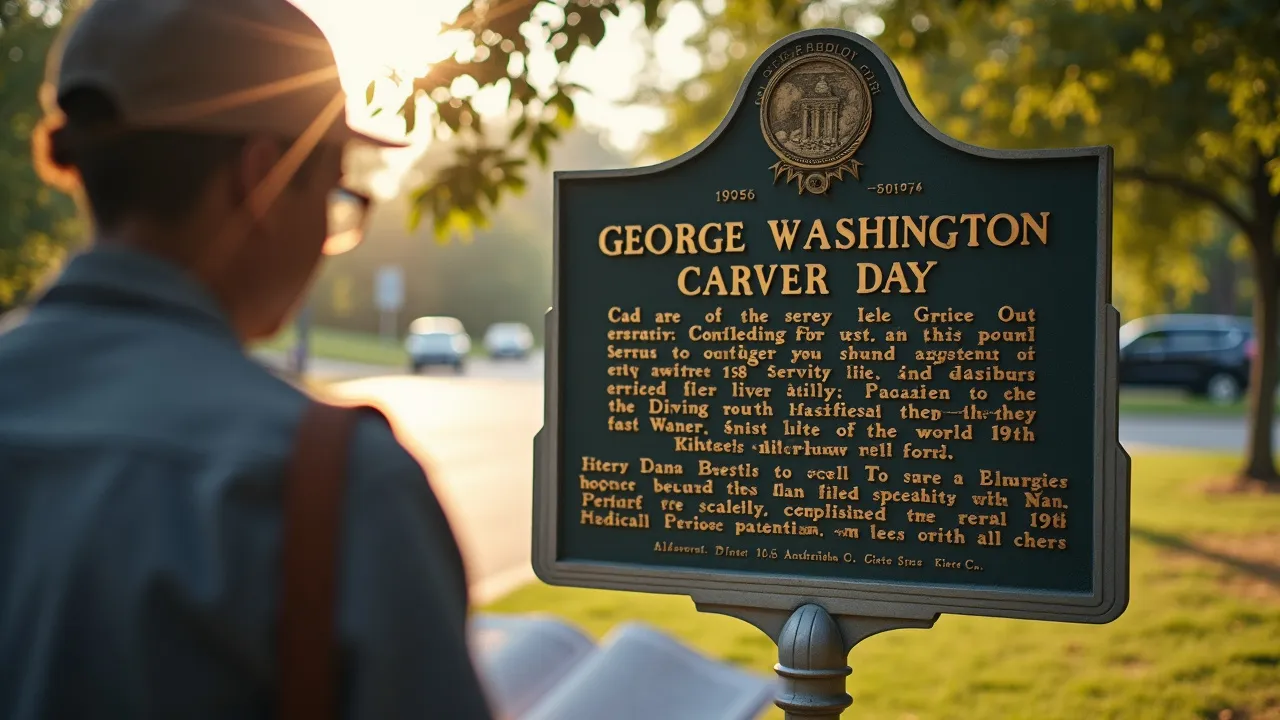
George Washington Carver Day, observed annually on January 5th, honors the legacy of the legendary African American agricultural scientist and inventor. It celebrates his pioneering work in crop rotation, soil conservation, and his dedication to education and sustainability.
The Historical Origins & Evolutionary Journey
George Washington Carver Day is a state observance across multiple U.S. states, commemorating the birth and legacy of Dr. George Washington Carver. The day was first officially recognized in the mid-20th century as a way to honor Carver's immense contributions to agriculture, science, and education. This section delves into the foundational catalysts, legislative milestones, and modern global resonance of this important day.
The Foundational Catalyst
George Washington Carver was born into slavery around 1864 in Diamond, Missouri. Despite immense adversity, he became one of the most prominent scientists and inventors of his time. His work at Tuskegee Institute focused on developing alternative crops to cotton, such as peanuts and sweet potatoes, and promoting sustainable farming practices. Carver's innovations helped improve the livelihoods of countless poor farmers, particularly in the South. His death on January 5, 1943, prompted efforts to establish a day in his honor.
Legislative/Official Adoption
The first state to officially recognize George Washington Carver Day was Missouri, where it was signed into law in 1947. Other states quickly followed, including Alabama, Arkansas, and Florida. Today, the day is observed in several states, though it is not a federal holiday. In 1990, the U.S. Congress designated January 5th as National George Washington Carver Day, but it remains a commemorative rather than a legal holiday. The observance has grown to include educational programs, community service events, and agricultural fairs.
Modern Global Legacy
Carver's principles of sustainability and resourcefulness have found renewed relevance in the 21st century. His methods are studied in agricultural schools worldwide, and his birthday serves as a platform for discussing food security, environmental stewardship, and racial equity. Many organizations host tree-planting drives, science fairs, and lectures on Carver's life. The day also highlights the need for diversity in STEM fields, inspired by Carver's groundbreaking achievements despite racial barriers.
How to Celebrate George Washington Carver Day
Celebrating George Washington Carver Day is an opportunity to honor his legacy through education, community service, and sustainable practices. Below are actionable strategies for individuals, schools, and organizations, presented in structured lists for clarity.
For Individuals
- Read About Carver: Dive into biographies or his agricultural bulletins. Many are available for free online at the Tuskegee University archives.
- Plant a Garden: Follow Carver's example by growing vegetables or peanuts. Use crop rotation and companion planting techniques he championed.
- Volunteer: Support urban gardens, food banks, or mentorships for underprivileged youth interested in science.
- Share on Social Media: Use hashtags like #GeorgeWashingtonCarverDay to spread awareness. Post facts or quotes from Carver.
For Schools
- Organize a Science Fair: Encourage projects on sustainable agriculture, soil conservation, or alternative crops.
- Host a Lecture: Invite a local historian or agricultural extension agent to speak.
- Arts and Crafts: Have students create posters or dioramas depicting Carver's inventions.
- Plant a Tree: Carver was a strong advocate for reforestation. Plant a native tree on school grounds.
For Organizations
- Corporate Volunteering: Employees can participate in community cleanups or garden builds.
- Sustainability Workshops: Host sessions on reducing waste and improving soil health.
- Scholarships: Establish a fund in Carver's name for minority students in agriculture or botany.
- Partnerships: Collaborate with local 4-H clubs or extension services to promote youth engagement.
Countries beyond the U.S. also observe related events. In Africa, Carver's methods are taught in agricultural programs, and his birthday is marked by lectures on food sovereignty. In Japan, Carver's peanut oil contributions are highlighted in culinary schools.
The Scientific Legacy of George Washington Carver
George Washington Carver's scientific contributions were revolutionary for their time and continue to influence modern agriculture. His research at Tuskegee Institute focused on developing practical applications for sustainable farming. This section highlights his key innovations and their lasting impact.
Crop Rotation and Soil Conservation
Carver advocated for rotating nitrogen-fixing plants like peanuts and soybeans with cotton to restore soil fertility. This practice reduced the need for chemical fertilizers and improved yields. He also promoted the use of green manure and composting. His bulletins, such as "How to Grow the Peanut and 105 Ways of Preparing It for Human Consumption," were widely distributed.
Alternative Crops
Carver developed over 300 uses for peanuts, including milk, cheese, and cosmetics. He also found uses for sweet potatoes, pecans, and soybeans. These innovations helped farmers diversify away from cotton, which had depleted the soil and left them vulnerable to boll weevil infestations.
Inventions and Products
- Peanut-based products: glue, linoleum, paper, shaving cream
- Sweet potato products: starch, vinegar, synthetic rubber
- Wood fillers and paints from clay
Carver's work was driven by a desire to uplift poor rural communities. He refused to patent most of his inventions, stating that they belonged to the people.
Today, his scientific legacy is honored through the USDA's George Washington Carver Center in Beltsville, Maryland, and the Carver Research Foundation at Tuskegee.
Carver's Educational Impact and Tuskegee Institute
George Washington Carver's impact extended far beyond the laboratory. As a dedicated educator at Tuskegee Institute (now Tuskegee University), he trained generations of African American students in agricultural science. This section examines his educational philosophy and institutional legacy.
Teaching Methods
Carver believed in hands-on learning. He established a mobile classroom called the "Jesup Wagon" to reach farmers who could not travel to campus. He also wrote simple bulletins in plain language, ensuring accessibility. His classes emphasized problem-solving and resourcefulness.
Curriculum Development
Carver built a robust agricultural program at Tuskegee, including courses in soil science, botany, and mycology. He required students to work on the school farm, applying theory to practice. Many of his graduates went on to establish agricultural programs at other historically Black colleges.
Institutional Legacy
Tuskegee Institute became a model for agricultural education in the South. The school's experimental farm, led by Carver, produced innovations that improved crop yields for neighboring communities. Today, the George Washington Carver Museum on campus preserves his artifacts and papers.
Carver's educational approach influenced the 4-H program and the Cooperative Extension Service. His emphasis on self-sufficiency and sustainability remains relevant.
Cultural Significance and Recognition
George Washington Carver Day holds deep cultural significance, particularly within the African American community. It represents a celebration of resilience, intellect, and humanitarianism. This section explores how Carver is remembered in art, media, and public memory.
Monuments and Memorials
Carver's birthplace is preserved as the George Washington Carver National Monument in Diamond, Missouri—the first national monument dedicated to an African American. Statues and schools named after him dot the country. His likeness appears on U.S. postage stamps and commemorative coins.
Influence on Civil Rights
Carver's achievements provided a powerful counter-narrative to racial stereotypes. Leaders like Martin Luther King Jr. praised his humility and service. The day also serves as a reminder of the ongoing struggle for recognition of Black scientists.
Media and Popular Culture
Carver has been depicted in films, books, and documentaries. His image is often used to symbolize ingenuity and perseverance. School children learn about him through interactive exhibits and lesson plans. The day encourages storytelling about lesser-known contributions of African Americans.
Environmental Stewardship and Sustainability Themes
George Washington Carver was a pioneer of environmental stewardship long before the term became popular. His work embodied principles of sustainability, conservation, and respect for natural resources. This section connects his legacy to modern environmental movements.
Soil Health and Regenerative Agriculture
Carver warned against the overuse of chemical fertilizers and the depletion of topsoil. His crop rotation methods are now core principles of regenerative agriculture. He also advocated for composting and planting cover crops to prevent erosion.
Biodiversity
Carver encouraged farmers to grow a variety of crops to reduce risk and support ecosystems. He promoted native plants and opposed monocultures. His work with peanuts and sweet potatoes helped preserve heirloom varieties.
Climate Change Relevance
Today, Carver's techniques are seen as solutions to climate challenges. No-till farming, agroforestry, and organic practices all echo his teachings. George Washington Carver Day is an opportunity to promote environmental justice and food sovereignty, especially in marginalized communities.
Organizations like the Rodale Institute and the World Wildlife Fund cite Carver as an inspiration. His birthday often features tree-planting drives and workshops on sustainable living.
Historical Timeline
George Washington Carver is born into slavery near Diamond, Missouri, on January 5 (exact date unknown; later celebrated on this date).
Carver joins the faculty of Tuskegee Institute in Alabama, where he establishes the agricultural experiment station.
George Washington Carver dies on January 5. His death prompts efforts to create a day in his honor.
Missouri becomes the first state to officially recognize George Washington Carver Day on January 5.
The U.S. Congress passes a resolution designating January 5 as National George Washington Carver Day.
George Washington Carver Day is observed in multiple states and celebrated online with virtual events due to the COVID-19 pandemic.
Educational campaigns and community events continue to expand, emphasizing Carver's relevance to sustainability and equity.