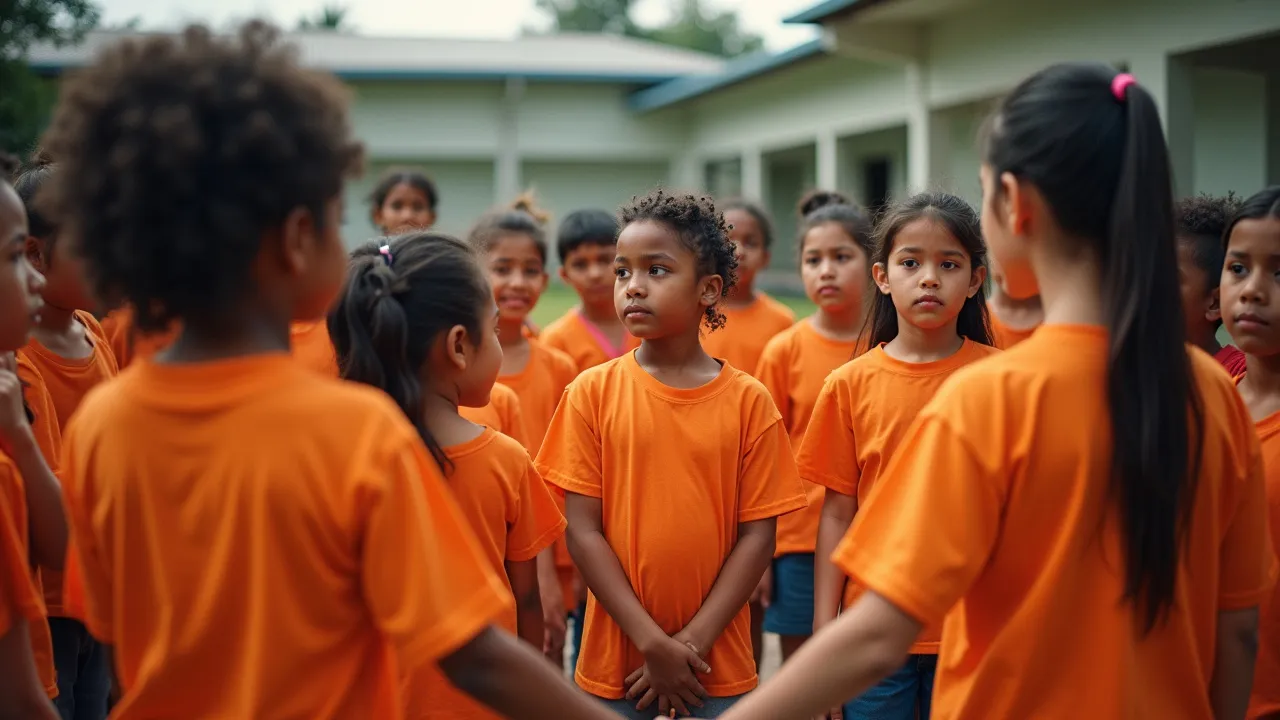
Orange Shirt Day, observed on September 30th, is a Canadian day of remembrance for the victims and survivors of the Indian Residential School system. It promotes the principle that Every Child Matters and encourages reconciliation through education and awareness.
The Historical Origins & Evolutionary Journey
Orange Shirt Day began as a grassroots commemoration of the legacy of the Indian Residential School system in Canada. The day was inspired by the story of Phyllis Webstad, a former residential school student who, on her first day at St. Joseph Mission Residential School in 1973, had her shiny new orange shirt taken away by the school staff. The color orange has since become a symbol of the stripping away of Indigenous culture, language, and identity.
The Foundational Catalyst
In May 2013, the idea was born during a community event in Williams Lake, British Columbia, when Webstad shared her story at a gathering of the Alkali Lake Indian Band and the Cariboo Regional District. The event was part of the "St. Joseph Mission Reconciliation Commemoration" committee's efforts to raise awareness. The first official Orange Shirt Day was held on September 30, 2013, chosen because September is the time when children were historically taken from their families to attend residential schools.
The Legislative/Official Adoption
In 2021, the Government of Canada officially designated September 30th as the National Day for Truth and Reconciliation, a federal statutory holiday, following the discovery of unmarked graves at former residential school sites. Orange Shirt Day continues as the grassroots counterpart, with many schools, workplaces, and communities participating in both events. The day is not just Canadian; it has inspired similar movements in the United States and other countries grappling with colonial legacies.
Modern Global Legacy
Orange Shirt Day has evolved into a global movement called Every Child Matters, with events held in the United States, Australia, and New Zealand. It serves as a reminder that the trauma inflicted on Indigenous children through forced assimilation is a universal human rights issue. The day emphasizes reconciliation, education, and the importance of honoring survivors and remembering those who did not return home.
How to Celebrate Orange Shirt Day
Orange Shirt Day is a day for reflection, education, and action. Here is a definitive guide to celebrating respectfully and meaningfully.
For Individuals
- Wear an orange shirt: The most visible act. Explain its meaning when asked.
- Educate yourself: Read books like Orange Shirt Day by Phyllis Webstad or watch films about residential schools.
- Attend local events: Many communities hold walks, vigils, or ceremonies.
- Donate: Support Indigenous-led organizations like the Indian Residential School Survivors Society.
For Schools
- Hold a school-wide assembly with Indigenous speakers or elders.
- Integrate curriculum: Teach age-appropriate lessons about residential schools in the days leading up.
- Art projects: Create orange shirt-themed art or banners to display.
- Moment of silence: Observe a minute of silence at 10 a.m. local time.
For Workplaces
- Encourage staff to wear orange and provide information about the day.
- Host a lunch-and-learn with Indigenous perspectives.
- Review company policies on reconciliation and diversity.
Across Canada, different regions have unique traditions. In British Columbia, ceremonies often include drumming and smudging. In Ontario, schools frequently partner with local First Nations. Internationally, the movement has adapted; in the U.S., it is often tied to Native American Heritage Month activities.
The Story of Phyllis Webstad and the Orange Shirt
Phyllis Webstad is a Northern Secwepemc (Shuswap) woman from the Stswecem'c Xgat'tem First Nation. Her story is the heart of Orange Shirt Day. In 1973, at age six, she was taken to St. Joseph Mission Residential School in Williams Lake. Her grandmother had bought her a new orange shirt for the occasion, but it was immediately confiscated and never returned. The loss of that shirt symbolized the loss of her childhood, culture, and family connections. For decades, Webstad carried the trauma of residential school abuse. In 2013, she shared her story at a reconciliation event, and the orange shirt became a rallying symbol. Her book, The Orange Shirt Story, is used in schools across Canada to teach children about this chapter of history. Webstad continues to advocate for survivors and to spread the message that Every Child Matters.
Impact on Indigenous Communities and Reconciliation
Orange Shirt Day has had profound tangible and intangible impacts on Indigenous communities. It has elevated the conversation about residential schools from a footnote in history to a national reckoning. The day provides a platform for survivors to speak, for communities to heal, and for non-Indigenous Canadians to listen and learn. Schools have integrated Indigenous perspectives into curricula, and many institutions now have reconciliation action plans. The discovery of unmarked graves in 2021 at Kamloops Indian Residential School and other sites intensified the day's significance, leading to the federal holiday. Economically, the day has spurred a market for orange shirts designed by Indigenous artists, with proceeds supporting community projects. However, critics note that the day can become performative; true reconciliation requires ongoing commitment beyond September 30th.
Global Reach and Similar Movements
While Orange Shirt Day is Canadian in origin, its message of truth and reconciliation has resonated globally. In the United States, similar movements address the legacy of Indian boarding schools, where Indigenous children were forcibly assimilated. Organizations like the National Native American Boarding School Healing Coalition have partnered with Canadian groups to share resources. In Australia, the National Sorry Day (May 26) and National Reconciliation Week (May 27–June 3) serve analogous purposes. New Zealand has its own commemorations for the Waitangi Treaty breaches. The orange shirt has become an international symbol for the rights of Indigenous children. Social media amplifies the movement; the hashtag #OrangeShirtDay trends annually, and virtual events connect global audiences. The day also intersects with the United Nations Declaration on the Rights of Indigenous Peoples (UNDRIP), reinforcing that every child’s culture and dignity must be respected.
Educational Resources and Teaching the Next Generation
Orange Shirt Day is primarily an educational initiative. Teachers are encouraged to use age-appropriate resources to explain residential schools to students. The Orange Shirt Society provides free lesson plans, videos, and activity sheets. For younger children, the focus is on kindness and inclusion, using the story of the orange shirt to talk about fairness. For older students, discussions include the intergenerational trauma, the Truth and Reconciliation Commission's Calls to Action, and the importance of Indigenous rights. Many schools hold orange shirt days on September 30th, and some districts mandate that the day be treated as a learning day, not a day off. The availability of resources has expanded dramatically since 2013, with many Indigenous authors and educators contributing. In addition, museums and cultural centers offer virtual tours and exhibits. The goal is to ensure that the next generation understands this history so that it is never repeated.
Historical Timeline
Phyllis Webstad, age six, has her new orange shirt taken away on her first day at St. Joseph Mission Residential School in British Columbia.
Phyllis Webstad shares her story at a reconciliation event in Williams Lake, sparking the idea for Orange Shirt Day.
First official Orange Shirt Day is held, with community events in British Columbia.
The Truth and Reconciliation Commission of Canada releases its final report, including 94 Calls to Action, one of which calls for a national day of remembrance.
Discovery of unmarked graves at Kamloops Indian Residential School in British Columbia, intensifying calls for a federal holiday.
Canadian Parliament passes Bill C-5, designating September 30th as the National Day for Truth and Reconciliation, a federal statutory holiday.
First official National Day for Truth and Reconciliation is observed across Canada, coinciding with Orange Shirt Day.
Orange Shirt Day marks its 10th anniversary, with events spanning Canada and internationally, including the United States, Australia, and New Zealand.